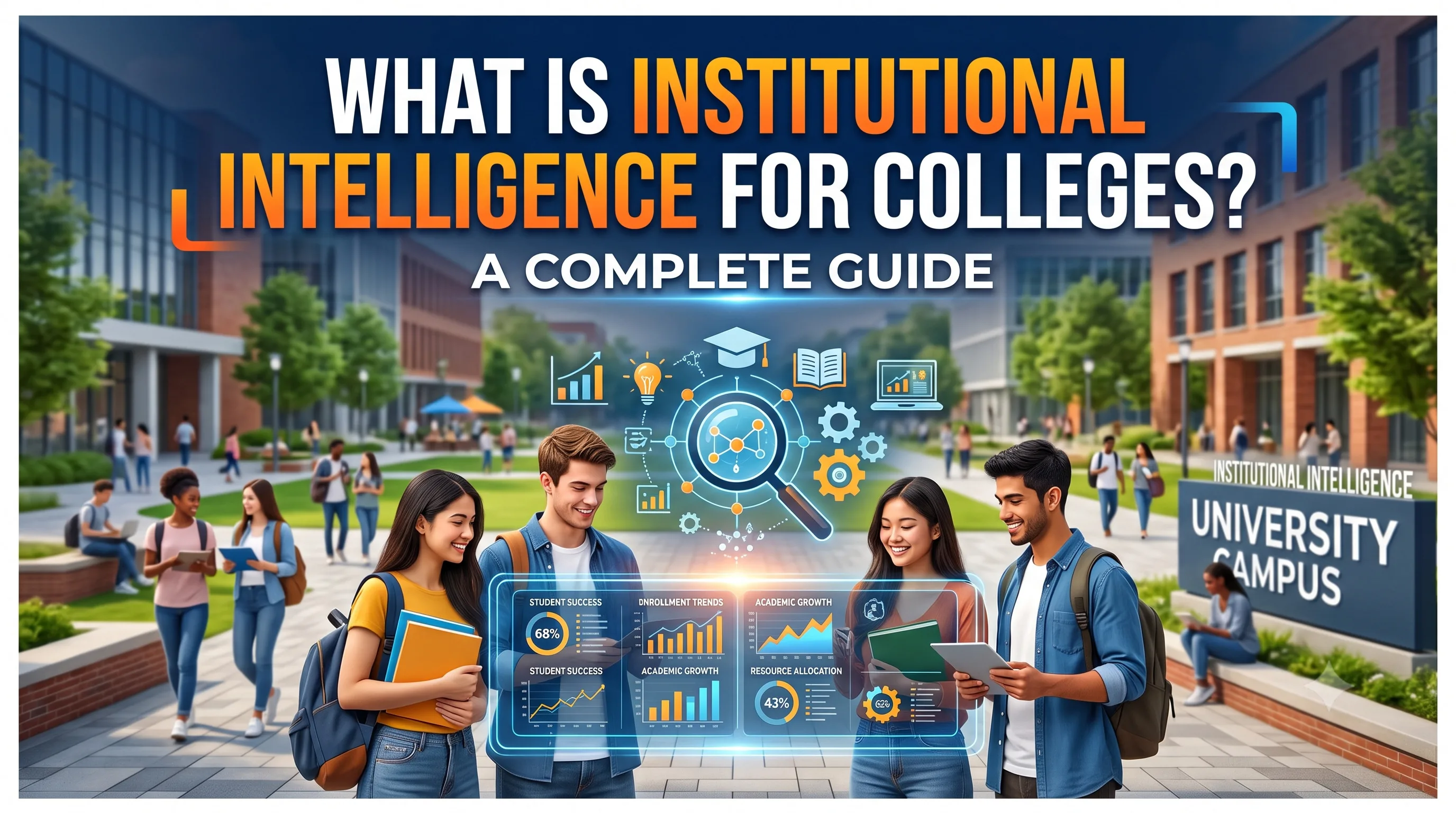
Higher education institutions generate enormous amounts of data every day—from student applications and enrollment to academic performance, engagement, fees, communication, and alumni interactions. Institutional Intelligence (II) brings this information together to help colleges turn data into actionable insights and make smarter decisions.
Rather than relying on disconnected reports or intuition, institutional intelligence gives colleges a more complete view of what is happening across the institution.
What Is Institutional Intelligence?
Institutional Intelligence is the ability of a college or university to collect, integrate, analyze, and use institutional data to support strategic and operational decision-making.
It combines data from multiple departments and systems, such as admissions, student information systems, learning platforms, finance, CRM platforms, and student engagement tools. The goal is not simply to collect data but to understand it and use those insights to improve institutional outcomes.
For example, a college can use institutional intelligence to identify which admission channels generate the most qualified applicants, understand why students may disengage, forecast enrollment, or determine which student support initiatives are producing better results.
Why Is Institutional Intelligence Important for Colleges?
Colleges today operate in a highly competitive environment. They need to attract students, improve retention, optimize resources, and deliver better experiences while managing increasing amounts of information.
Institutional intelligence can help colleges:
- Make data-driven strategic decisions
- Improve student recruitment and enrollment
- Identify students who may need additional support
- Improve student engagement and retention
- Measure institutional performance
- Understand trends across departments
- Improve operational efficiency
- Personalize communication and student services
When information is available in one connected environment, leadership teams can move from simply reporting what happened to understanding why it happened and what action should come next.
Key Components of Institutional Intelligence
Institutional intelligence typically involves several important capabilities.
1. Data Integration
Colleges often use multiple systems to manage different areas of their operations. Integrating these sources creates a more unified view of institutional performance.
2. Analytics and Reporting
Dashboards and reports help administrators monitor important metrics such as applications, admissions, enrollment, retention, student engagement, and financial performance.
3. Predictive Insights
Advanced analytics can help institutions identify trends and anticipate potential outcomes. For example, colleges may identify patterns associated with student disengagement and intervene earlier.
4. Actionable Intelligence
The real value of institutional intelligence comes from turning insights into action. Data should help teams determine what they need to do next—not simply provide another report.
How AI Is Changing Institutional Intelligence
Artificial intelligence is making institutional intelligence more proactive. AI can analyze large volumes of institutional data, identify patterns, automate repetitive processes, and support faster decision-making.
For example, AI-powered systems can help admissions teams prioritize prospective students, assist staff in responding to routine questions, and identify engagement patterns that may require intervention.
Platforms such as Talisma can complement this approach by bringing CRM, engagement, automation, and AI capabilities together for education-focused institutions. Instead of treating every student interaction separately, institutions can use connected information to create more contextual and personalized engagement.
Institutional Intelligence Across the Student Lifecycle
Institutional intelligence can support students from their first interaction with a college through graduation and beyond.
During admissions, colleges can analyze inquiry, application, and conversion trends to understand recruitment performance.
During enrollment, institutions can identify bottlenecks and improve communication with admitted students.
During the student journey, engagement data can help institutions understand participation and identify students who may benefit from timely support.
For retention, analytics can reveal patterns that may indicate disengagement or potential drop-off.
After graduation, institutions can use intelligence to strengthen alumni engagement, fundraising, and long-term relationships.
Benefits for Higher Education Leaders
Institutional intelligence provides leadership teams with a clearer picture of institutional performance. Instead of reviewing isolated departmental reports, decision-makers can examine connected information across the student lifecycle.
This can support better resource allocation, stronger enrollment planning, improved student services, and more effective institutional strategies.
The key is to establish reliable data, connect relevant systems, protect student information, and ensure that staff can easily understand and act on insights.
Conclusion
Institutional Intelligence for colleges is about more than dashboards and data collection. It is a strategic approach to using institutional information to make better decisions, improve student experiences, and achieve measurable outcomes.
Solutions such as Talisma can play a role in this transformation by helping institutions connect student information, engagement, and AI-powered capabilities within a higher-education-focused environment. The result is a more connected approach to institutional decision-making—where data does not just explain the past but helps colleges plan and act for the future.