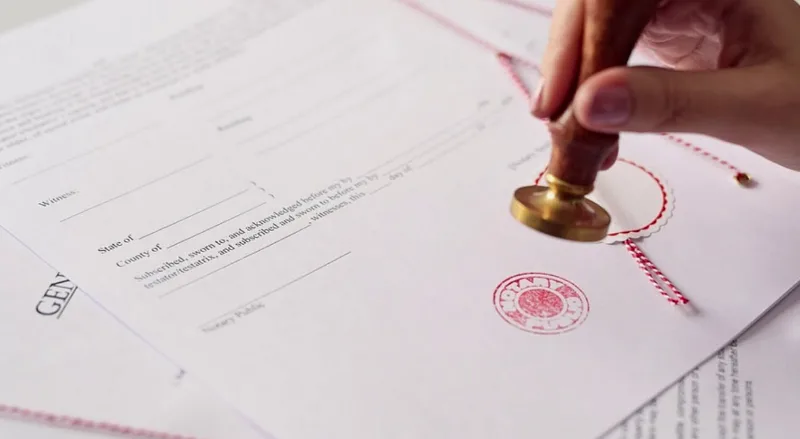
A borrower sits at a kitchen table in Goodyear with a stack of loan papers, a blue pen, and a deadline that suddenly feels too close. Across town, someone preparing a power of attorney pauses before signing because the instructions say a witness and notary may be needed. Another person has a tax authorization form ready, but is not sure whether it needs a stamp or simply a correct signature.
That small moment of uncertainty is common. Most people do not think about which documents need to be notarized in Arizona until a bank, title company, court form, agency, or family matter makes it urgent. The good news is that the answer is usually not mysterious. The document itself, the receiving party, and the type of notarial wording often reveal what is needed.
Key Takeaways
- Not every important paper needs a notary.
- Arizona notaries verify identity and signing details, not legal quality.
- Power of attorney, real estate, affidavits, and some vehicle forms commonly involve notarization.
- Signers should read instructions before signing anything.
Why A Notary Stamp Matters
A notarization is a formal identity and signing safeguard. It helps show that the signer appeared before a notary, was identified, and completed the required act connected to the document. Arizona’s Secretary of State notes that Arizona notaries perform acknowledgments, jurats, copy certifications, and oaths or affirmations.
The Arizona Legislature’s definitions explain that an acknowledgment confirms a signer appeared and acknowledged signing, while a jurat involves signing in the notary’s presence and taking an oath or affirmation about the truthfulness of the document. That distinction matters. A notary is not there to approve a contract, judge whether a tax choice is wise, or decide whether a legal form is suitable. The notary’s role is narrower and more specific.
Which Documents Need To Be Notarized In Arizona?
A paper usually needs notarization when the document instructions, a government agency, a court form, a title company, a lender, or another receiving party requires a verified signature, sworn statement, acknowledgment, or certified copy.
Common examples include:
- Real estate deeds and title-related papers
- Loan and mortgage signing packages
- Powers of attorney
- Some affidavits and sworn statements
- Certain vehicle ownership or authorization forms
- Business or banking authority forms
- Some estate, family, or health care planning papers
- Copy certification requests when allowed
The safest rule is simple: the paper does not need a notary just because it feels important. It needs one when the form, law, recipient, or transaction requires a notarial act.
What Does A Notary Verify?
A notary verifies the signing event, not the full legal effect of the paper. Arizona law describes notarization as an act a notary is authorized to perform that verifies only the identity of a signer, not the truthfulness, accuracy, or validity of the document itself.
That is where many people get confused. A notarized document can still contain mistakes. A notarized document can still be rejected if it uses the wrong form, misses required fields, or does not meet the receiving party’s rules.
Acknowledgment Confirms A Willing Signature
An acknowledgment is often used when a person needs to confirm that a signature is theirs and that they signed willingly. This can appear in real estate documents, recorded papers, business forms, and many financial documents.
Jurat Confirms Truth Under Oath
A jurat is different. The signer usually signs in the notary’s presence and swears or affirms that the contents are true. This is common with affidavits, sworn statements, and certain declarations.
Copy Certification Has Narrow Use
A copy certification is used when a notary certifies that a copy matches an original, but Arizona’s definition limits this to an original document that is neither a public record nor publicly recordable. That means not every copy can be certified by a notary.
Common Papers That Need Attention
Several Arizona paperwork situations deserve extra care because they often involve notarization, witnesses, or both.
Power Of Attorney Forms
Arizona power of attorney forms often require careful signing. The Maricopa County Superior Court’s power of attorney resource states that Arizona law requires the principal to sign a power of attorney in the presence of a notary public and that a witness must also sign a statement before a notary.
That means a signer should not casually sign at home first unless the form instructions clearly allow it.
Health Care Planning Papers
Health care power of attorney forms may have different witnessing choices. The Arizona Attorney General’s health care power of attorney form says the signer should not sign until a witness or notary is present, and it notes that at least one adult witness or a notary may witness the signing.
This is a good example of why reading the exact form matters. Similar-looking documents can have different signing rules.
Vehicle Authorization Forms
Vehicle paperwork can also involve notarization. Arizona Department of Transportation’s power of attorney form for vehicle matters includes space for a notary or MVD agent signature.
For sales, title transfers, dealership matters, or vehicle authority forms, the signer should follow the exact form instructions.
Tax Authorization Forms
Tax paperwork is not automatically a notary matter. The Arizona Department of Revenue says Form 285 may be used to authorize the department to release confidential information to an appointee.
A tax form may need accurate preparation, proper signatures, and correct submission more than it needs notarization. The best move is to read the form instructions instead of assuming every tax-related paper needs a stamp.
Use The SIFT Method
The SIFT method helps people decide what to check before a signing appointment.
- Signer: Confirm who must appear and sign.
- Instructions: Read the form directions before the appointment.
- Form wording: Look for acknowledgment, jurat, oath, affirmation, or notarial certificate language.
- Timing: Do not sign early if the notary must witness the signature.
- Recipient: Ask the lender, title company, agency, bank, or court what it will accept.
This method saves time because most signing problems are not dramatic. They are small details missed too late.
What Do People Often Misread?
Many delays happen because people focus on the document title instead of the signing instructions.
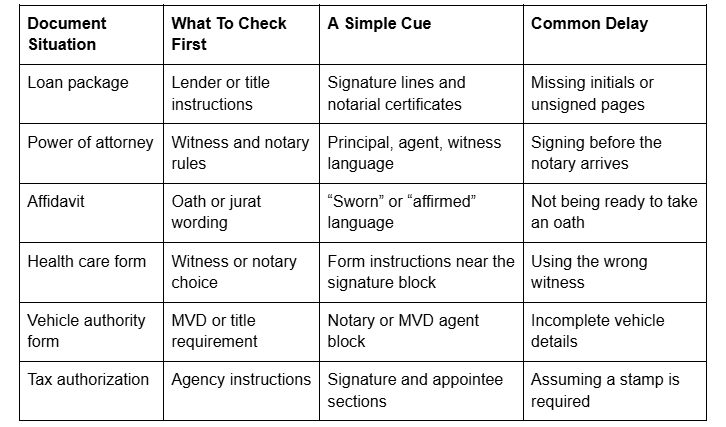
A notary appointment goes more smoothly when the signer treats the form like a map. The signature block, certificate wording, and recipient instructions usually point the way.
What Should Signers Bring Along?
A signer should bring the complete document, valid identification, any required witnesses, and the receiving party’s instructions.
A clean preparation checklist looks like this:
- Complete forms, but leave signature lines unsigned when required.
- Bring current identification that matches the signer’s name.
- Confirm whether witnesses are needed.
- Bring every page of the document, not just the signature page.
- Know the receiving party’s deadline.
- Ask about fees before the appointment.
- Avoid blank spaces unless the form instructions allow them.
This is especially important for title companies, banks, and lending companies because one missing signature can slow a larger transaction.
Where Mobile Service Helps Most
Mobile notary services can be useful when timing, transportation, or transaction pressure make a traditional office visit difficult.
For example, a signer may need loan documents completed after business hours, a family member may need help with a power of attorney at home, or a title-related signing may need to happen at a convenient neutral location. Convenience still depends on preparation. A mobile appointment is not a shortcut around rules. It simply brings the signing process to a location that works better for the signer.
A Familiar Arizona Signing Scenario
Consider a familiar situation: a family in the West Valley is helping an older parent organize financial authority, health care paperwork, and a vehicle matter. The family gathers the forms in one folder. One document needs a notary and a witness. Another allows a witness or notary. The vehicle form includes a notary or MVD agent section. A tax authorization form needs careful completion, but the instructions do not call for the same notarization steps.
Nothing about that situation is unusual. The challenge is not the amount of paperwork. The challenge is that every paper has its own rules. The calmest path is to separate the documents by signing requirement before the appointment. That way, the notary is not being asked to solve legal questions at the table, and the signer is not rushing through decisions.
Cost Clarity And Timing Basics
Arizona’s Secretary of State states that notary fees can range from no charge up to a maximum of $10 per notarial act, including electronic and remote online notary fees. That figure helps people understand the notarial act itself, but mobile appointments may involve scheduling, travel, or convenience-related costs depending on the provider.
A signer should ask for pricing before the meeting starts. Timing also matters. Some documents expire, some lender packages have same-day requirements, and some agencies reject forms if dates do not match. A signer should avoid waiting until the last hour unless the situation truly cannot wait.
How To Choose Reliable Help?
The right help should make the process feel clearer, not more confusing.
A reliable provider should:
- Explain what a notary can and cannot do.
- Review visible signing instructions without giving legal advice.
- Ask signers to bring proper identification.
- Clarify fees before service.
- Respect privacy during sensitive paperwork.
- Avoid rushing important forms.
- Recommend legal or tax professionals when the question goes beyond notarial duties.
For legal document preparation, tax preparation, and notary support, the real value is not just a stamp. It is organized guidance, careful handling, and fewer preventable delays.
Final Verdict
The easiest way to know which documents need to be notarized in Arizona is to look at the document instructions, the notarial wording, and the receiving party’s requirements before anyone signs.
For residents and businesses near Litchfield Park, organizations like Blue Feather Signing Services LLC are one local option for certified legal document preparation, tax preparation, and mobile notary support, with services organized around accessible, ethical, accurate, and convenient help. A notary appointment should not feel like a last-minute mystery. With the right preparation, the signing can feel orderly, informed, and far less stressful.
FAQs
- Can A Paper Be Notarized After It Is Already Signed?
Sometimes, but not always. If the form requires the notary to witness the signature, the signer should not sign before the appointment.
- Does Every Legal Paper Need A Notary?
No. A paper only needs a notary when the form instructions, receiving party, court, lender, bank, or agency requires it.
- What Should Someone Bring To A Notary Appointment?
The signer should bring the full document, a valid photo ID, any required witnesses, and any instructions from the receiving party.
- Can A Mobile Notary Meet At A Home Or Office?
Yes. A mobile notary can often meet at a home, office, or trusted public location, depending on scheduling and service availability.
- Who Decides If A Form Needs Notarization?
The requirement usually comes from the form itself, the receiving organization, state rules, lender instructions, or the agency requesting the document.