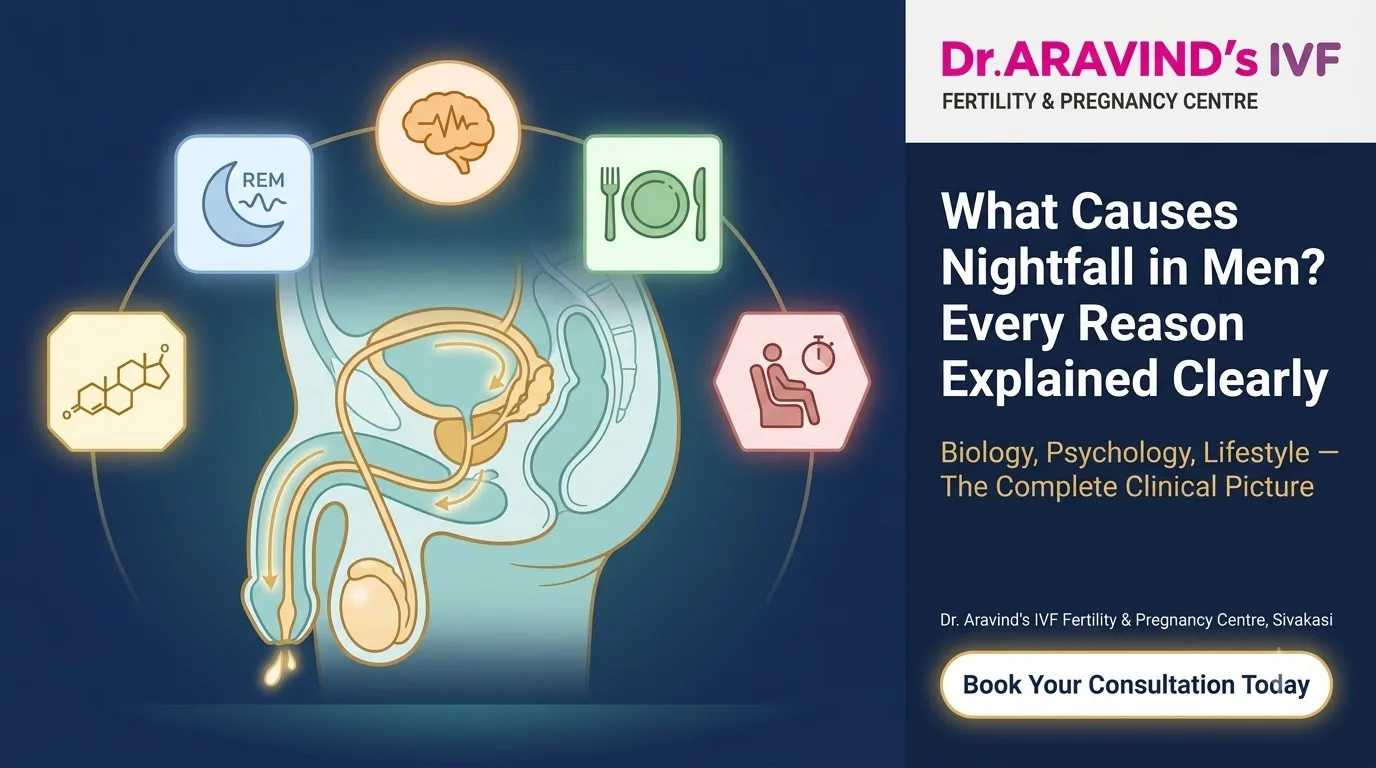
Most men experience nightfall at some point in their lives and never fully understand why it happens. The biology behind it is straightforward, but the cultural silence around the topic means most men piece together explanations from unreliable sources rather than accurate clinical information.
At Dr. Aravind's IVF Fertility & Pregnancy Centre, the best IVF centre in Sivakasi, questions about nightfall in men are treated with the same clinical seriousness as any other reproductive health concern. Here is a complete, honest explanation of every reason nightfall occurs.
The Basic Biology Behind Nightfall
The male body produces sperm and semen continuously. The testicles never fully stop their production cycle. When semen accumulates beyond the body's natural storage capacity and is not released through regular sexual activity, the body discharges it involuntarily during sleep.
This process — known medically as nocturnal emission — is driven entirely by normal reproductive physiology. It is the body's built-in pressure release mechanism, not a malfunction. Testosterone plays a central role here. Higher testosterone levels, which are most pronounced during adolescence and early adulthood, directly increase semen production and make nightfall more frequent during these years.
Physical Reasons for Nightfall in Men
Extended Sexual Inactivity
The most straightforward physical reason for nightfall is a prolonged period without ejaculation. When semen accumulates over several days or weeks, involuntary release during sleep becomes increasingly likely. This is simply the body's way of maintaining equilibrium in the reproductive system.
Testosterone Levels
High testosterone increases semen production and heightens sensitivity in the reproductive system. This is why nightfall is most common between the ages of fourteen and thirty, when testosterone is at its peak. It is also why men who engage in activities that temporarily elevate testosterone — intense exercise, adequate sleep, a nutrient-rich diet — may notice increased frequency.
Full Bladder Pressure
A full bladder during sleep can place gentle pressure on the prostate and seminal vesicles, sometimes triggering involuntary ejaculation. This is a recognised physical trigger for nightfall that has nothing to do with hormonal imbalance or psychological factors.
Prostate Sensitivity
An overly sensitive or mildly inflamed prostate can increase the likelihood of nocturnal emission. Men with prostatitis — inflammation of the prostate — sometimes report higher nightfall frequency as one of several symptoms. This is a reason to seek evaluation if nightfall frequency increases suddenly alongside other urinary or pelvic symptoms.
Psychological Reasons for Nightfall
Erotic Dreams and REM Sleep
Nightfall most commonly occurs during REM sleep — the stage of sleep associated with vivid dreaming. Erotic content during REM sleep activates the same physiological arousal response as waking sexual stimulation, which can trigger ejaculation without any conscious awareness. This is not something a man can control, and it reflects normal neurological function during sleep.
Stress and Anxiety
Paradoxically, psychological stress and anxiety — including anxiety specifically about nightfall itself — can increase its frequency. Stress activates the sympathetic nervous system, which affects reproductive function in ways that can make involuntary ejaculation more likely during sleep. Men who develop significant worry about nightfall sometimes find themselves caught in a cycle where the anxiety worsens the very thing they are anxious about.
Suppressed Sexual Tension
Extended periods of sexual arousal without release — from consuming sexual content, prolonged attraction without physical expression, or simply heightened sensitivity — can build tension in the reproductive system that discharges during sleep. This is a recognised psychological trigger for nocturnal emission that is entirely normal in young men.
Lifestyle Factors That Increase Nightfall Frequency
Poor Sleep Hygiene
Irregular sleep patterns, sleeping in unusually long sessions, or sleeping in positions that create prolonged pressure on the pelvic region can all increase the likelihood of nightfall. Establishing consistent sleep and wake times reduces frequency in many men without any other intervention.
Diet and Sperm Production
A diet rich in zinc, protein, and healthy fats supports robust sperm and semen production — which can make nightfall more frequent when sexual activity is low. This is not a reason to change diet for fertility purposes. It simply explains why some men notice more frequent nightfall after dietary improvements.
Sedentary Lifestyle
Prolonged sitting and reduced physical movement can create pelvic congestion — a buildup of blood flow in the pelvic region that increases sensitivity and can trigger nightfall more frequently. Regular moderate exercise, particularly walking and yoga, helps regulate pelvic circulation and often reduces nightfall frequency naturally.
Watching Explicit Content
Regular exposure to sexually explicit material without physical release increases arousal tension in the nervous system. This accumulated tension discharges during sleep more readily than in men who do not consume such content regularly. This is one of the most commonly reported lifestyle triggers for high-frequency nightfall in young men in India.
When the Reason for Nightfall Needs Clinical Attention
Most causes of nightfall in men are entirely normal and require no intervention. However, certain patterns indicate that something beyond normal physiology may be driving the frequency.
Sudden increase in nightfall frequency after years of stability, particularly if accompanied by pelvic discomfort or urinary symptoms, can indicate prostate changes or infection. Nightfall accompanied by blood in semen requires prompt evaluation regardless of frequency. Severe psychological distress caused by nightfall — including significant sleep disruption, anxiety, or avoidance of social situations — warrants professional support.
For men who are also concerned about male fertility, high-frequency nightfall is sometimes one of several symptoms that prompt a proper evaluation. The evaluation itself — semen analysis, sperm DNA fragmentation testing, hormonal panel — gives a far more useful clinical picture than the nightfall frequency alone.
Conclusion
The reasons behind nightfall in men range from straightforward biology to lifestyle patterns and psychological triggers — and in the vast majority of cases, the cause is entirely normal and self-resolving. Understanding why it happens removes the anxiety that often amplifies the frequency, and for men with genuine reproductive health concerns, that understanding is the foundation of a productive clinical conversation.
As the best IVF centre in Sivakasi, Dr. Aravind's IVF Fertility & Pregnancy Centre provides honest, judgment-free guidance on every aspect of male reproductive health — including the questions most men have never felt comfortable asking out loud.
FAQ
Q1. What is the main cause of nightfall in men?
The primary cause of nightfall in men is the natural accumulation of semen when ejaculation has not occurred for several days. The body releases it involuntarily during sleep as a normal physiological process. Testosterone levels, REM sleep activity, and sexual arousal patterns all contribute to how often this occurs.
Q2. Why does nightfall happen more frequently in young men?
Testosterone is highest during adolescence and early adulthood, driving increased semen production and heightened sensitivity in the reproductive system. Combined with less regular sexual activity in many young men, this makes nightfall significantly more common between the ages of fourteen and thirty.
Q3. Can stress cause nightfall to happen more often?
Yes. Psychological stress and anxiety activate the sympathetic nervous system, which can increase nightfall frequency. Anxiety specifically about nightfall itself often creates a self-reinforcing cycle. Managing stress through regular exercise, consistent sleep, and where needed psychological support reduces frequency in many men.
Q4. Does nightfall in men indicate a problem with sperm health?
No. Occasional nightfall does not indicate poor sperm health or reduced fertility. Sperm is produced continuously and is not meaningfully depleted by nocturnal emission. Men concerned about fertility should seek a proper male fertility evaluation rather than using nightfall frequency as a proxy for sperm quality.
Q5. When should a man in Sivakasi see a doctor about nightfall?
Seek evaluation at the best IVF centre in Sivakasi if nightfall occurs every night or multiple times per week consistently, if it is accompanied by pelvic pain, urinary symptoms, or blood in semen, or if it is causing significant anxiety or sleep disruption. Dr. Aravind's IVF Fertility & Pregnancy Centre provides complete, confidential male reproductive health evaluations for men at every stage of their fertility journey.