A missed budget overrun. A contractor dispute that drags for weeks because nobody can find the original approval email. A buyer who enquired three days ago and still hasn't heard back. Every property developer knows these situations. They're not bad luck — they're what happens when a complex, multi-stage business is being managed through a patchwork of spreadsheets, group chats, and memory.
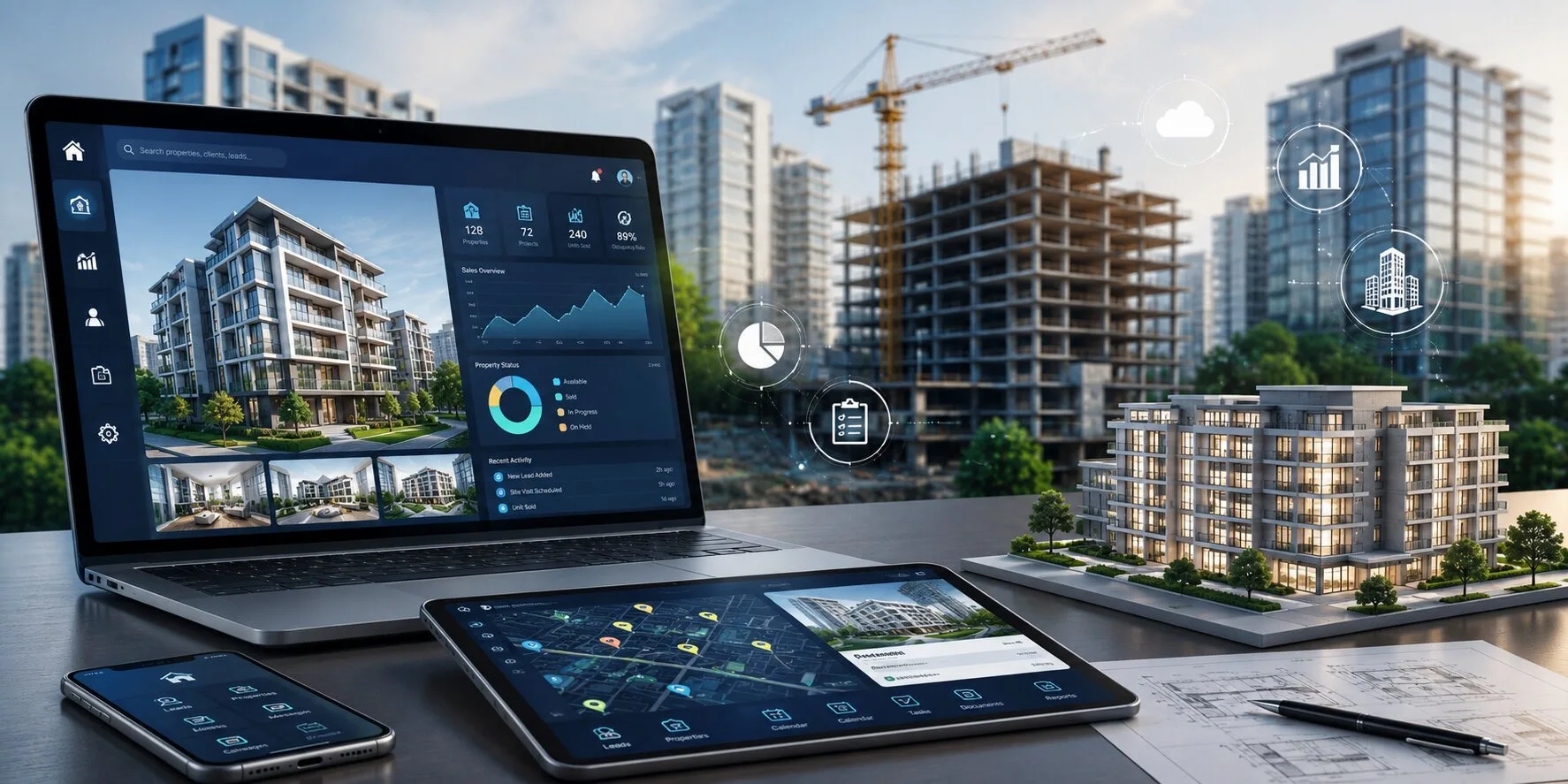
The right real estate software for property development changes this. Not by adding complexity — by removing it. The best platforms centralise what currently lives across five different tools: budgets, documents, client communication, project timelines, and sales pipelines. Get the stack right and a project that used to require weekly status calls practically runs its own reporting.
This article covers the main software categories developers actually use, what to look for in each, and a practical framework for deciding when off-the-shelf tools are enough — and when they're not.
The Software Categories That Actually Matter for Property Developers
Not all real estate software is built for the same job. A letting agent needs different tools from a residential developer, who needs different tools from a commercial developer running ground-up builds. Before evaluating platforms, it helps to be clear about which part of the development lifecycle you're trying to fix.
Development Management and Cost Control
These platforms own the active construction phase. Budget tracking, contractor coordination, RFI management, construction draws, and schedule monitoring. Northspyre is the most widely cited tool in this category — purpose-built for commercial developers, with AI-assisted data entry and native integrations with accounting platforms. Procore is the dominant name on the contractor and field coordination side, better suited where subcontractor management is the main pressure point.
For mid-sized developers who find enterprise pricing unjustifiable, Buildertrend and Mastt offer solid project tracking at a lower cost of entry. Rabbet focuses specifically on construction draw management — a narrower problem, but one that causes disproportionate delays when handled badly.
Financial Modelling and Investor Reporting
ARGUS Enterprise is the institutional standard for commercial real estate financial modelling. It handles proforma analysis, IRR projections, and scenario planning at a level most other tools don't approach. For developers who raise equity from investors, AppFolio Investment Manager adds a capital management layer — distribution tracking, LP reporting, and capital call management.
Smaller developers often find ARGUS overkill and price-prohibitive. At that scale, a combination of Excel-based proforma templates and a lighter analytics tool tends to do the job — at least until the portfolio gets complex enough to justify the upgrade.
CRM and Sales Pipeline Management
This is the category where generic tools create the most friction for property developers. A CRM built for a SaaS company doesn't know what a unit number is, doesn't understand how to link a booking to a specific property inventory item, and doesn't handle the document trail that comes with a property sale — NOCs, agreements, receipts.
What a property developer CRM should handle: multi-channel lead capture (portals, website, WhatsApp), unit-level inventory tracking, automated follow-up sequences, document storage linked to client profiles, and reporting that shows where deals are stalling. Zoho CRM is the most commonly adapted general-purpose tool for this — it's flexible enough with the right customisation. Purpose-built options like Sales CRM from real estate platforms handle it out of the box, at the cost of lower configurability.
Site Selection and Land Acquisition Tools
This category has seen the most change in the last two years. AI-native platforms are now capable of combining parcel data with zoning analysis, cutting site feasibility research from weeks to hours. Prophetic and ZoneAI are examples on the North American market. For developers in India, these tools are largely unavailable — which is one of the reasons regional firms end up building custom alternatives.
PropStream remains the standard for finding motivated sellers and running market comparables, particularly for residential and mixed-use deals.
What Features Should Property Development Software Actually Have?
Feature lists on vendor websites are consistently misleading. Most platforms claim to do everything. Here's what actually matters when you're running a development project, not a demo:
Real-time budget visibility. The most common reason projects overrun isn't poor planning — it's a lag between spending and visibility. If cost data is only updated in a month-end report, the decision-making that happens in between is guesswork.
Document management with search. A medium-sized residential development can generate hundreds of documents across its lifecycle. Contracts, planning approvals, contractor agreements, payment certificates, NOCs. Without a structured, searchable system, finding a specific document can take longer than the meeting it was needed for.
Accounting integration. A platform that doesn't connect to your accounting software creates a manual reconciliation problem at every reporting cycle. Look for native integrations with whatever you're using — Tally, Zoho Books, QuickBooks, or a custom ERP.
Mobile access that actually works. Site engineers don't sit at desks. If the software isn't usable from a phone on a construction site, it won't be used on a construction site. This sounds obvious but a surprising number of platforms fail it.
Scalability without degradation. A tool that works well for one project should handle five without slowing down or repricing into unworkability. Check what happens to performance and cost as you add projects, users, and data volume.
When Does Off-the-Shelf Software Stop Working for Property Developers?
Generic platforms usually work well enough at the start. They cover 70–80% of the workflow, and the workarounds feel manageable. Then the portfolio grows. The team expands. The projects get more complex. Suddenly there are five SaaS subscriptions that still don't talk to each other, and someone on the team is exporting everything into a spreadsheet just to get a clear picture.
The clearest signals that off-the-shelf has run its course: you're rebuilding reports outside the platform; the CRM doesn't understand your unit inventory structure; there's no way to customise the workflow to match how your projects actually run; or you're operating in a market — like India or Southeast Asia — where the compliance and process norms baked into most platforms simply don't apply.
At that point, custom-built software starts making financial sense. You get full ownership of the data and the workflows, no forced feature changes from vendor roadmaps, and a system that fits your actual operations rather than a generalised version of them. The upfront cost is higher. But accumulated SaaS subscriptions add up fast — and so does the productivity drag of tools that require workarounds to do basic things.
India-based property developers in particular often find this tipping point earlier than expected, because most available platforms were built for North American or European regulatory environments. Local compliance requirements, regional language needs, and the way property transactions actually work here don't always fit. That's a gap some specialised real estate software development companies — including a few Kolkata-based studios like Originate Soft — have built their practice around addressing.
Should You Buy Software or Build Something Custom? A Practical Framework
The decision isn't as binary as it often gets framed. Most developers end up with a hybrid — off-the-shelf for the parts of the business where standard tools are genuinely good enough, and custom-built for the pieces that are specific to how they operate.
Buy off-the-shelf if: the portfolio is small (one to three projects), the workflows are relatively standard, and a platform like Buildertrend or Zoho CRM covers the core needs at a price that makes sense per project. No sense building something custom when the problem is simple enough that an existing tool solves it.
Build custom if: there are unique unit inventory structures, investor reporting requirements that don't fit standard templates, compliance or workflow norms that generic platforms weren't built for, or the business includes a client-facing property portal or marketplace. A branded portal — where buyers can browse units, check availability, and submit enquiries — is almost always better built custom than adapted from a generic template. The conversion difference is significant.
The honest version of the decision: what does it actually cost when the tool doesn't quite fit? Count the hours spent on workarounds, the manual reconciliation, the delayed reporting. For a developer at five projects and growing, that misfit cost often exceeds the investment in a purpose-built solution within two to three years.
Frequently Asked Questions
Which software is best for small property developers?
For developers running one to three projects, a combination of Buildertrend for project and construction management, and a lightweight CRM like Zoho CRM or a real-estate-specific tool, covers most workflows without unnecessary complexity. The priority at this stage is not to over-engineer the stack. Pick tools with month-to-month contracts where possible — the needs will change as the portfolio grows.
What is the difference between property management software and property development software?
Property management software — tools like Buildium or AppFolio — is designed for the post-handover phase: tenant management, rent collection, lease administration, maintenance requests. Property development software handles the build phase: budget control, contractor coordination, construction draws, planning documentation, and sales pipeline before the property is complete. Some platforms try to cover both; most are meaningfully stronger at one than the other.
How much does custom real estate software development cost in India?
Scope varies significantly. A basic CRM with lead management, unit inventory, and automated follow-ups can be built in the $10,000–$25,000 range. A full development management platform — with financial modelling, investor portals, and third-party integrations — sits higher. Development costs in India are generally lower than equivalent quality in North America or Western Europe, which is why a growing number of international property firms are partnering with Indian studios for this work.
The Bottom Line
There's no single best platform for property development software — there's the right combination for the stage and complexity of the business. Northspyre and Procore lead the enterprise development management space. Rabbet solves a specific draw management problem well. Zoho CRM, adapted with the right configuration, handles most sales pipelines until they get complex enough to warrant something purpose-built.
Where the market is heading: more AI in site selection and feasibility analysis, tighter integration between financial modelling and project management tools, and — particularly in high-growth markets across South Asia — a shift toward custom-built platforms that reflect how property businesses in those markets actually operate.
The practical takeaway: audit what your current tools can't do before shopping for new ones. The gap between what's needed and what off-the-shelf provides is usually where the real decision lives.
About the Author
Sumita Jain writes about software, web, and digital product development for founders and growing businesses. She has followed the work of teams such as Originate Soft Pvt Ltd, a Kolkata-based custom software, web, and mobile app development studio working with startups and SMBs across real estate, automotive, and marketplace verticals.