An air diffuser in aeration tank is one of the most important components in modern wastewater treatment systems. It is the heart of the biological treatment process where microorganisms break down organic pollutants, remove harmful contaminants, and improve overall water quality before discharge or reuse.
In industrial plants, municipal sewage treatment facilities, commercial complexes, and residential wastewater systems, aeration tanks play a vital role in maintaining environmental safety and regulatory compliance. Without effective aeration, wastewater retains high levels of organic matter, suspended solids, ammonia, and pathogens that can severely impact aquatic ecosystems and public health.
The aeration process introduces oxygen into wastewater, creating an ideal environment for aerobic bacteria to digest biodegradable pollutants. This process significantly reduces Biological Oxygen Demand (BOD) and Chemical Oxygen Demand (COD), making treated water safer for disposal or recycling.
What Is an Aeration Tank?
An aeration tank is a specially designed chamber used in wastewater treatment plants where air or oxygen is mixed with wastewater to support biological degradation of pollutants.
Inside the tank, microorganisms consume organic waste materials as food. Continuous oxygen supply allows these microbes to remain active and efficient throughout the treatment process.
The aeration tank typically operates as part of the activated sludge process, which is one of the most widely used biological wastewater treatment methods worldwide.
Main Objectives of an Aeration Tank
- Remove dissolved and suspended organic matter
- Reduce BOD and COD levels
- Oxidize ammonia into nitrates
- Maintain healthy microbial activity
- Improve overall treatment efficiency
- Prepare wastewater for secondary clarification
How an Aeration Tank Works?
The working principle of an aeration tank is based on biological oxidation.
Step 1: Wastewater Entry
Primary treated wastewater enters the aeration tank after large solids and debris are removed during preliminary treatment.
Step 2: Oxygen Supply
Air diffusers or mechanical aerators continuously inject oxygen into the tank. This oxygen is essential for aerobic bacteria growth.
Step 3: Biological Decomposition
Microorganisms consume organic pollutants and convert them into simpler substances such as:
- Carbon dioxide
- Water
- Energy
- New microbial cells
Step 4: Formation of Activated Sludge
The microbial mass forms flocs called activated sludge. These flocs absorb and break down contaminants effectively.
Step 5: Secondary Clarification
The mixed liquor from the aeration tank moves to a secondary clarifier where sludge settles. Part of the sludge is recycled back into the aeration tank to maintain microbial concentration.
Types of Aeration Tanks
Different wastewater treatment applications require different aeration tank configurations.
1. Conventional Aeration Tank
This is the most commonly used design in municipal wastewater treatment plants.
Features
- Long hydraulic retention time
- Stable operation
- High treatment efficiency
Applications
- Municipal sewage treatment
- Large industrial facilities
2. Extended Aeration Tank
Extended aeration systems provide longer aeration periods, resulting in more complete stabilization of sludge.
Advantages
- Lower sludge production
- Reduced odor generation
- Simpler operation
Best For
- Small communities
- Residential complexes
- Commercial buildings
3. Complete Mix Aeration Tank
In this system, wastewater and microorganisms are uniformly mixed throughout the tank.
Benefits
- Uniform oxygen distribution
- Better shock load handling
- Stable microbial activity
4. Plug Flow Aeration Tank
Wastewater flows through the tank in one direction with minimal mixing.
Advantages
- Higher efficiency
- Better organic removal
- Suitable for large-scale treatment plants
5. Sequencing Batch Reactor (SBR)
SBR systems combine aeration and sedimentation in a single tank.
Key Features
- Compact design
- Automated operation
- High nutrient removal efficiency
Components of an Aeration Tank
An aeration tank consists of several important components that ensure efficient wastewater treatment.
Air Diffusers
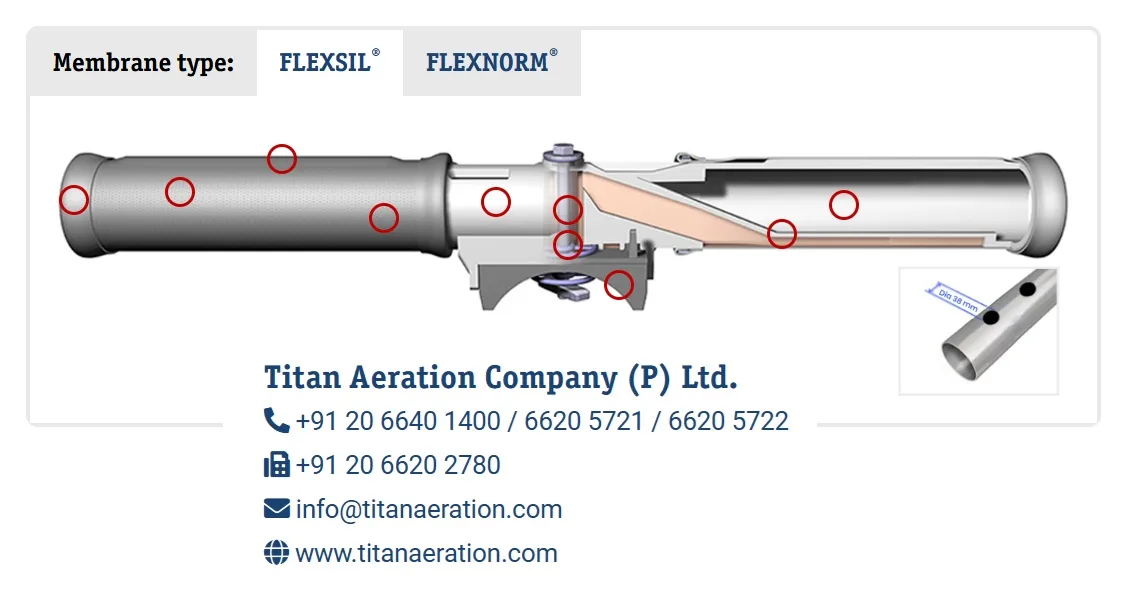
Air diffusers release fine bubbles into wastewater to improve oxygen transfer efficiency.
Types of Diffusers
- Fine bubble diffusers
- Coarse bubble diffusers
- Disc diffusers
- Tube diffusers
Mechanical Aerators
Mechanical aerators agitate wastewater while introducing oxygen.
Common Types
- Surface aerators
- Turbine aerators
- Paddle wheel aerators
Blowers
Blowers provide compressed air to diffusers inside the tank.
Functions
- Maintain dissolved oxygen levels
- Support microbial respiration
- Improve mixing
Return Activated Sludge System
This system recycles settled sludge back into the aeration tank to maintain microbial population.
Importance of Dissolved Oxygen in Aeration Tanks
Dissolved oxygen (DO) is a critical parameter in aeration tank performance.
Optimal DO Levels
Most treatment plants maintain DO levels between:
- 1.5 to 3.0 mg/L
Low oxygen levels reduce microbial efficiency, while excessive oxygen increases energy costs.
Effects of Poor Oxygen Control
Low DO Causes
- Odor problems
- Poor sludge settling
- Reduced BOD removal
- Anaerobic conditions
High DO Causes
- Excessive power consumption
- Increased operational costs
Activated Sludge Process in Aeration Tanks
The activated sludge process is the biological engine of wastewater treatment.
Stages of the Process
1. Mixing
Wastewater combines with activated sludge.
2. Aeration
Oxygen supports microbial metabolism.
3. Oxidation
Organic pollutants are biologically degraded.
4. Sedimentation
Sludge settles in clarifiers.
5. Sludge Recycling
Settled biomass returns to the aeration tank.
Advantages of Aeration Tanks
Aeration tanks provide several operational and environmental benefits.
High Treatment Efficiency
They effectively remove:
- Organic pollutants
- Nitrogen compounds
- Suspended solids
Environmentally Friendly
Biological treatment minimizes chemical usage and reduces environmental impact.
Flexible Operation
Aeration systems can be adjusted according to:
- Flow variations
- Pollution load
- Seasonal changes
Odor Reduction
Proper aeration prevents anaerobic decomposition and foul smells.
Disadvantages of Aeration Tanks
Despite their benefits, aeration tanks also have limitations.
High Energy Consumption
Aeration equipment consumes significant electrical power.
Maintenance Requirements
Diffusers, blowers, and aerators require regular maintenance.
Sludge Handling Challenges
Excess sludge must be treated and disposed of properly.
Design Parameters of Aeration Tanks
Efficient aeration tank design depends on multiple engineering parameters.
Hydraulic Retention Time (HRT)
HRT determines how long wastewater remains inside the tank.
Typical Range
- 4 to 8 hours
Food to Microorganism Ratio (F/M Ratio)
This ratio balances organic loading with microbial population.
Mixed Liquor Suspended Solids (MLSS)
MLSS indicates the concentration of microorganisms in the aeration tank.
Common Range
- 2,000 to 5,000 mg/L
Sludge Retention Time (SRT)
SRT measures how long biomass remains in the system.
Applications of Aeration Tanks
Aeration tanks are widely used across multiple industries.
Municipal Wastewater Treatment
Cities and towns rely on aeration tanks for sewage treatment.
Food Processing Industries
Food plants use aeration systems to remove organic waste and grease.
Textile Industries
Textile wastewater requires biological treatment for dye and chemical removal.
Pharmaceutical Industries
Aeration tanks help reduce pharmaceutical contaminants and organic pollutants.
Chemical Manufacturing Plants
Industrial effluents undergo biological oxidation before discharge.
Aeration Tank Maintenance
Regular maintenance ensures optimal performance and long equipment life.
Routine Inspection
Operators inspect:
- Diffusers
- Blowers
- Air pipelines
- Mechanical aerators
Sludge Monitoring
Maintaining proper sludge concentration is essential for stable treatment.
Cleaning and Descaling
Diffusers and piping require periodic cleaning to prevent clogging.
Monitoring Oxygen Levels
Continuous DO monitoring improves process efficiency.
Energy Efficiency in Aeration Systems
Aeration accounts for a major portion of wastewater treatment energy consumption.
Ways to Improve Efficiency
Use Fine Bubble Diffusers
Fine bubbles provide better oxygen transfer.
Install Variable Frequency Drives (VFDs)
VFDs optimize blower operation.
Automated Oxygen Control
Smart sensors reduce unnecessary aeration.
Regular Equipment Maintenance
Clean systems consume less energy.
Common Problems in Aeration Tanks
Foaming
Caused by:
- Filamentous bacteria
- High grease content
- Detergents
Bulking Sludge
Occurs when sludge fails to settle properly.
Low Oxygen Transfer
Common reasons include:
- Clogged diffusers
- Damaged blowers
- Excess sludge concentration
Odor Generation
Usually caused by insufficient aeration and anaerobic conditions.
Future Trends in Aeration Tank Technology
Modern wastewater treatment plants are rapidly adopting advanced technologies.
Smart Monitoring Systems
IoT-based sensors provide real-time monitoring of:
- DO levels
- Airflow
- Sludge quality
- Energy consumption
Energy-Efficient Blowers
Advanced turbo blowers reduce operational costs significantly.
Membrane Bioreactor Integration
Combining aeration with membrane filtration improves effluent quality.
AI-Based Process Automation
Artificial intelligence optimizes aeration control and sludge management.
Conclusion
Air diffuser in aeration tank is the foundation of efficient biological wastewater treatment systems. By supplying oxygen to microorganisms, these tanks enable the breakdown of organic pollutants, improve water quality, and protect the environment from harmful contamination.
Modern aeration systems offer high efficiency, operational flexibility, and sustainable wastewater management for municipalities and industries alike. Proper design, oxygen control, equipment maintenance, and process optimization are essential for maximizing aeration tank performance and reducing operating costs.
As wastewater treatment technology continues to evolve, advanced aeration solutions will remain critical for achieving cleaner water, environmental compliance, and long-term sustainability.