
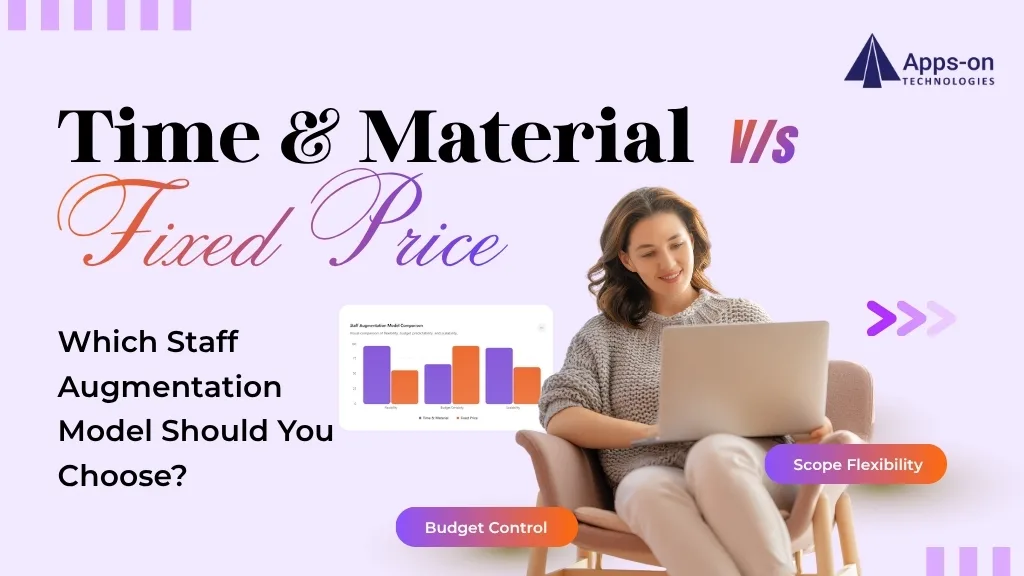
Choosing the right Staff Augmentation Model can directly impact your project’s success, budget, scalability, and delivery timeline. As businesses increasingly rely on remote development teams and outsourced talent, selecting between Time & Material and Fixed Price models has become one of the most important decisions in software development and IT outsourcing.

Both pricing models offer unique advantages depending on project complexity, flexibility, business goals, and budget predictability. While some businesses prefer the structure of fixed pricing, others need the adaptability and scalability that flexible engagement models provide.
In this blog, we will explore the differences between Time & Material and Fixed Price models, their benefits, limitations, and how to choose the right approach for your business needs.
Understanding Staff Augmentation Models
Staff augmentation is a hiring strategy where businesses extend their in-house teams with external professionals to meet project demands. This approach allows companies to:
- Scale development teams quickly
- Access specialized talent
- Reduce recruitment costs
- Speed up project delivery
- Improve operational flexibility
The two most common engagement models in staff augmentation are:
- Time & Material (T&M)
- Fixed Price
Each model works differently and suits different project types.
What Is a Time & Material Model?
The Time & Material model is a flexible engagement approach where clients pay based on:
- Actual working hours
- Resources used
- Project duration
- Team involvement
This model works best when project requirements are likely to evolve during development.
Benefits of Time & Material Model
Flexibility
Businesses can modify features, priorities, or project scope without restarting contracts.
Faster Project Start
Projects can begin quickly without extensive documentation or finalized requirements.
Better Scalability
Companies can easily scale development teams up or down based on project demands.
Continuous Improvements
The development process remains adaptable to market feedback and business changes.
When Should You Choose a Time and Material Contract?
A Time and Material Contract is ideal for:
- Long-term projects
- Agile development
- Startups with evolving requirements
- AI and SaaS product development
- Complex software systems
This model is highly popular among technology companies because it supports innovation and iterative development.
However, businesses should maintain clear communication and project tracking to avoid budget overruns.
What Is a Fixed Price Model?
The Fixed Price model involves agreeing on:
- Project scope
- Timeline
- Budget
- Deliverables
before development begins.
In this approach, the development company commits to delivering the project within the agreed budget and timeframe.
Benefits of Fixed Price Software Development
Many businesses prefer Fixed Price Software Development because it provides predictable costs and lower financial uncertainty.
Budget ControlBusinesses know the exact project cost in advance.
Defined ScopeClear requirements help avoid confusion during development.
Easier PlanningProject timelines and milestones are usually well-structured.
Lower Management InvolvementThe development team handles most execution responsibilities.
This model works well for projects with clearly defined requirements and limited changes.
When Should You Choose a Fixed Price Model?The Fixed Price model is best for:
- Small to medium projects
- MVP development
- Short-term development tasks
- Projects with clear requirements
- Businesses with strict budgets
However, flexibility can become limited if project requirements change later.
Key Differences Between Time & Material and Fixed Price
Flexibility vs PredictabilityThe Time & Material model offers flexibility, while Fixed Price provides budget predictability.
Scope ManagementFixed Price works best when scope is fixed. T&M supports evolving project requirements.
Risk DistributionIn Fixed Price projects, more delivery risk falls on the development company. In T&M projects, businesses maintain greater control and responsibility.
Team CollaborationT&M encourages continuous collaboration between clients and development teams, making it ideal for agile environments.
Which Model Is Better for Startups?Startups often prefer the Time & Material model because:
- Product ideas evolve rapidly
- Market feedback changes priorities
- Flexibility is essential
- Faster experimentation is needed
This approach supports innovation without rigid development limitations.
Which Model Is Better for Enterprises?Enterprises may choose Fixed Price for:
- Structured internal approval processes
- Defined project objectives
- Budget planning requirements
However, many enterprises now combine both models depending on project complexity.
How IT Staff Augmentation Services Help Businesses
Modern IT Staff Augmentation Services help businesses choose the right engagement model based on:
- Project scope
- Team size
- Technical requirements
- Budget
- Scalability needs
Experienced technology partners can help companies avoid hiring challenges while accelerating software delivery.
Staff augmentation also allows businesses to access:
- Dedicated developers
- AI engineers
- UI/UX designers
- DevOps specialists
- QA experts
without long-term hiring commitments.
Tips for Choosing the Right Staff Augmentation Model
Before selecting a pricing model, businesses should evaluate:
Project ComplexityComplex and evolving projects usually benefit from Time & Material.
Budget FlexibilityIf cost predictability is critical, Fixed Price may work better.
Development SpeedAgile and fast-moving projects often require more flexible engagement models.
Internal Team AvailabilityBusinesses with strong project management teams can effectively manage Time & Material contracts.
FAQs
What is the difference between Time & Material and Fixed Price?
Time & Material is flexible and based on actual work hours, while Fixed Price involves a predefined budget and scope.
Which model is better for startups?
Startups usually prefer Time & Material because it supports evolving project requirements and agile development.
Is Fixed Price cheaper than Time & Material?
Not always. Fixed Price may appear predictable, but changes in requirements can increase costs later.
Which projects are ideal for Fixed Price development?
Projects with clear requirements, fixed deadlines, and limited scope changes work best with Fixed Price.
Conclusion
Both Time & Material and Fixed Price models offer valuable advantages depending on your business goals, project complexity, and budget flexibility. Choosing the right engagement strategy can improve development efficiency, reduce operational risks, and accelerate business growth.
Businesses looking for flexibility and innovation often choose Time & Material, while companies requiring predictable costs may prefer Fixed Price models. The key is understanding your project needs before making a decision.
If you are planning to scale your development team or outsource software projects, professional IT Staff Augmentation Services can help you select the ideal model for long-term success.
Book Your Free 30-Minute Consultation Call
Need help choosing the right staff augmentation strategy for your business? Connect with our experts today at https://appsontechnologies.com/ and discover the best development model for your next project.
Original Source: https://bit.ly/49flfaH