There is a question worth asking before you register for any emergency training course: what is this training preparing me for?
Not the marketing answer. Not the list of skills covered or the credentials earned. The honest operational answer — the one that describes the specific scenario, the specific environment, the specific conditions under which these skills will be needed, and whether the training you are receiving will function under those conditions when the moment arrives.
Valkyries Austere Medical Solutions has built its entire training philosophy around that question. Every course they offer, every standard they hold their students to, every scenario they construct and every instructor they deploy is oriented toward a single honest answer: we are preparing you to function effectively in an actual emergency — not a sanitized training-room version of one, but the real thing, with real stakes, in conditions that are demanding, unpredictable, and nothing like a classroom.
Three of the most powerful expressions of that philosophy are the Tactical Combat Casualty Care Course (TCCC), the Technical Rope Rescue Course, and the Survival Medicine Course — three programs that address three distinct categories of life-threatening emergency, each built to the same uncompromising standard of operational realism and genuine skill development that defines everything Valkyries delivers.
Valkyries Austere Medical Solutions: The Organization Behind the Training
Before examining what, each course delivers, it is worth understanding what makes Valkyries the organization to learn these skills from.
The emergency training market has expanded significantly as awareness of tactical medicine, wilderness rescue, and austere environment preparedness has grown. With that expansion has come an increase in providers offering courses that look serious from the outside — military-adjacent terminology, certification cards, online registration — but that deliver instruction that has not been meaningfully tested against the operational reality it claims to prepare students for.
Valkyries occupies a different position in this landscape. The organization was built by and continues to be staffed by instructors who bring genuine operational credentials: military medicine experience from deployed environments, law enforcement tactical medicine backgrounds, wilderness search and rescue experience, and emergency clinical practice. These are people who have applied the skills they teach in actual high-stakes situations — who know from personal experience what works under pressure and what fails, what training transfers to real performance and what does not survive contact with reality.
This operational foundation does not just shape the credentials section of a course description. It shapes every training decision — the scenarios that are constructed, the standards that are set, the errors that are identified and corrected, and the judgment that determines when a student has genuinely achieved the capability the course is designed to produce versus when they have simply completed the required hours.
That is the Valkyries difference. And it is the difference that matters most when the training is eventually tested.
Tactical Combat Casualty Care Course: The Gold Standard for High-Threat Medical Response
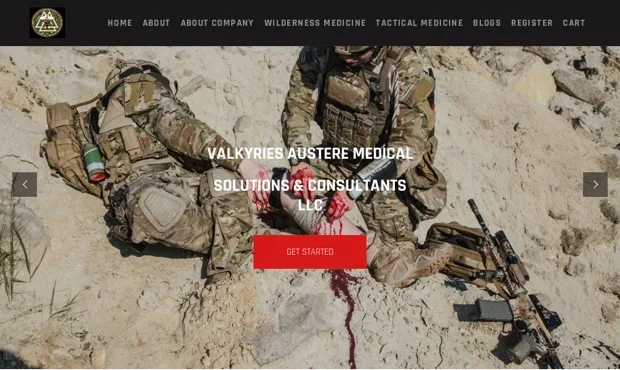
The Tactical Combat Casualty Care Course (TCCC) at Valkyries Austere Medical Solutions delivers the evidence-based framework for prehospital trauma management in high-threat environments that has become the recognized standard for military, law enforcement, and high-risk civilian applications across the United States.
TCCC emerged from a rigorous analysis of preventable combat deaths — a systematic examination of who died, from what injuries, and whether trained intervention at the point of injury could have changed the outcome. The findings were stark and actionable: most preventable deaths resulted from three treatable conditions — uncontrolled extremity hemorrhage, tension pneumothorax, and airway obstruction. All three are manageable by a trained non-physician provider with basic equipment. All three become preventable deaths when the right training has been delivered to the right people.
The TCCC framework built around these findings organizes tactical casualty management into three sequential phases, each with its own priorities and its own specific interventions:
Care Under Fire — the seconds immediately following injury while the threat remains active — demands the absolute minimum intervention needed to prevent immediate death from hemorrhage, executed with the speed and the certainty that only genuine automaticity provides. Valkyries trains tourniquet application under this phase to a standard that goes beyond competence: the device applied correctly, in the right location, with the right tension, in the minimum possible time, regardless of ambient conditions, physical stress level, or whether the dominant hand is available. Students practice this skill not once or twice but repeatedly, under increasing stress and constraint, until the performance is encoded at the level of reliable physical reflex.
Tactical Field Care — conducted once relative safety allows a more complete assessment — deploys the full toolkit of TCCC clinical skills in systematic sequence: airway management, chest assessment and decompression, wound packing and pressure dressing application, vascular access, fluid administration, hypothermia prevention, and the documentation that enables seamless handoff to the next level of care. Each skill is practiced individually and then integrated into the complete field care sequence through scenario exercises that replicate the clinical complexity and time pressure of real casualty management.
Tactical Evacuation Care — the active management of the casualty during movement to definitive care — addresses the reassessment, anticipation, and proactive intervention that prevent in-transit deterioration, and the standardized patient reporting that transfers clinical responsibility completely and accurately to receiving medical personnel.
The scenarios through which Valkyries delivers TCCC training are constructed from real incident types, calibrated to the stress levels that actual casualty events generate, and evaluated by instructors whose operational experience allows them to distinguish genuine capability from training-environment performance. Graduates leave not just certified but genuinely ready.
Technical Rope Rescue Course: Reaching Casualties That Cannot Be Reached Any Other Way
Not every casualty is accessible by foot. Not every emergency unfolds on flat, navigable ground. Some of the most critical rescue situations in the operational and wilderness environments that Valkyries students work in involve casualties who are below vertical faces, above inaccessible terrain, or in positions that require rope systems to safely reach, package, and extract.
The Technical Rope Rescue Course at Valkyries Austere Medical Solutions addresses this reality with a program that teaches the complete skill set for rope-based rescue operations in demanding environments — from the physics and rigging principles that govern safe rope systems to the patient packaging and movement techniques that complete a successful extraction.
Rope systems and rigging fundamentals ground the course in the physics that determine whether a rope rescue system is safe — load-sharing anchor construction, mechanical advantage systems for hauling and lowering, the force calculations that govern equipment selection, and the failure modes that rigorous system design prevents. Students develop genuine understanding of these principles rather than simply following prescribed configurations, because genuine understanding is what allows effective improvisation when ideal equipment is unavailable or conditions do not match what the standard configuration assumes.
Anchor building is taught with the depth and the practical variation that real rescue environments demand. Natural anchors, structural anchors, bombproof redundant systems constructed from available materials — students practice building anchors that are appropriate for the load, the terrain, and the specific rescue scenario, and learn to evaluate anchor integrity under conditions that do not allow for second opinions.
Patient packaging for vertical and horizontal movement addresses the specific challenge of moving an injured person through rope systems without creating secondary injuries. Spinal precautions, fracture management during extraction, packaging for unconscious versus conscious casualties, and the specific challenges of packaging a patient in a confined space or on a steep face are all addressed with the hands-on practice that builds genuine competence in this technically demanding skill set.
Lowering and hauling systems — both simple and mechanically complex — are rigged and operated by students across a range of scenarios, building the mechanical intuition that allows rope rescue providers to construct and troubleshoot systems under field conditions.
High-angle and low-angle rescue operations are both addressed, along with the transition points between them and the specific technique variations each demands. Real rescue environments rarely present pure high-angle or pure low-angle scenarios; effective rope rescue providers can work across the spectrum and adapt their systems to whatever the terrain requires.
Rescue incident command addresses the organizational dimension of technical rope rescue — role assignment, communication, scene management, and the coordination of multiple team members working simultaneously in different positions on the rescue system. Individual rope skills without team coordination produce chaos; the Valkyries course develops both.
Survival Medicine Course: Medical Knowledge for When the System Has Failed
The Survival Medicine Course at Valkyries Austere Medical Solutions occupies a uniquely important position in the emergency preparedness landscape — addressing the category of emergency that standard first aid training, TCCC training, and even wilderness medicine training is not fully designed for: the scenario in which all conventional medical support is unavailable, indefinitely.
Not unavailable for the next thirty minutes while an ambulance routes to your location. Not unavailable for the next few hours while a helicopter is dispatched. Unavailable because the infrastructure that normally makes medical care accessible — hospitals, pharmacies, emergency services, supply chains — has been disrupted, degraded, or destroyed. Post-disaster environments. Grid-down scenarios. Remote expeditions beyond the range of any evacuation resource. International operations in locations where medical infrastructure does not exist.
In these environments, the trained survival medicine provider is the entire medical system available to the people around them. The decisions they make, the care they provide, and the knowledge they carry will determine outcomes that no other resource can influence.
The Survival Medicine Course at Valkyries builds the comprehensive capability this responsibility demands:
Austere patient assessment teaches systematic clinical evaluation without diagnostic equipment — developing the physical examination skills, the clinical reasoning framework, and the diagnostic judgment that allow a trained provider to assess and manage patients across a range of conditions without the laboratory tests, imaging, or monitoring technology that clinical medicine normally depends on.
Wound management in austere conditions addresses the full lifecycle of wound care in environments without reliable access to antibiotics, sterile supplies, or professional support — initial management, ongoing dressing changes, infection recognition before it progresses to systemic illness, and the improvised wound care techniques that maintain acceptable outcomes when commercial supplies are exhausted.
Improvised pharmacology covers the medications that provide genuine benefit in survival contexts — their indications, contraindications, dosing, storage requirements, and the clinical monitoring that allows effective use in the absence of physician oversight.
Environmental emergency management addresses hypothermia, hyperthermia, altitude illness, and the range of environmental threats that survival contexts amplify — with the prevention, recognition, and treatment protocols calibrated to the resource limitations of genuine austere environments.
Prolonged patient care — the management of injured or ill patients across days in the field — covers the nutrition, hydration, repositioning, monitoring, and decision-making that sustain patients through extended care without the resupply and clinical support of conventional medical settings.
Improvised equipment and techniques develop the adaptive capability that resource-limited environments demand — constructing functional medical equipment from available materials, adapting standard techniques to non-standard supplies, and maintaining the clinical effectiveness of interventions when the ideal tools are simply not present.
Three Courses. The Capabilities That Change Outcomes.
The Tactical Combat Casualty Care Course, the Technical Rope Rescue Course, and the Survival Medicine Course represent three distinct but complementary dimensions of emergency capability — the ability to manage casualties in high-threat environments, the ability to reach and extract casualties from terrain that would otherwise make rescue impossible, and the ability to provide medical care when every conventional support structure is unavailable.
Together, they represent a level of preparedness that very few individuals carry — and that the environments these graduates operate in genuinely demand.
Valkyries Austere Medical Solutions delivers each of these courses at the standard that serious operational preparation requires. Contact VAMS to learn about course schedules, availability, and registration for upcoming programs.
The training that changes outcomes is available. The question is whether you pursue it before you need it or wish afterward that you had.