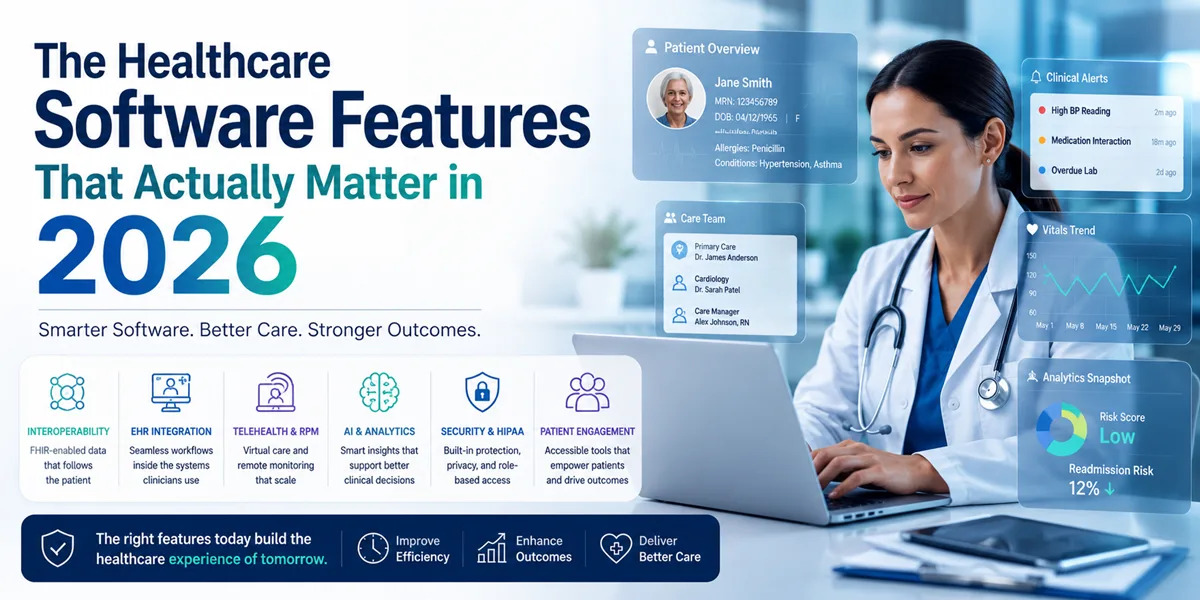
Most health systems no longer lack software. They run dozens of systems that barely speak to one another, and the gaps between them are where care slows down. A nurse re-enters the same vitals in three places. A specialist waits on a fax that never arrives. That friction is why the conversation about healthcare software features has shifted from long capability checklists toward a sharper question: which capabilities actually change what happens at the bedside?
This piece answers that question for 2026. Many healthcare organizations also rely on healthcare IT consulting services to evaluate which capabilities deliver measurable clinical and operational value before investing in new platforms. The healthcare software features worth funding share one trait. They reduce the distance between a clinician's intent and a completed action, and they do it without weakening privacy or accessibility.
What Separates Essential Healthcare Software Features from Nice-to-Haves
Every vendor demo looks impressive. The gap shows up six months later, when the tool either dissolves into daily practice or becomes the thing staff work around. A useful test cuts through the noise: does the capability remove a step someone repeats every shift, or does it add one?
Judge each feature against three questions. Does it save clinician time on a task done many times a day? Does it move data to the person who needs it without a manual hand-off? Does it hold up when volume spikes and the network is under strain? Capabilities that pass all three deserve budget. Those that pass none are decoration, however polished the interface.
This lens matters because clinical teams already carry heavy documentation loads. Adding a feature that demands more attention than it returns pushes clinicians toward burnout and toward the workarounds that quietly defeat any rollout. The features that follow all clear this bar. They give back more than they ask.
The order of these features is deliberate. Interoperability comes first because it decides how much value every later capability can deliver. Analytics starved of complete data produce confident nonsense. A patient app that shows a stale medication list erodes the trust it was built to earn. Treat the list below as a dependency chain, not a shopping cart, and the trade-offs during a build become far easier to reason about.
Interoperability and FHIR: Data That Follows the Patient
Interoperability sits underneath everything else. A platform can offer sharp analytics and elegant patient apps, but if it cannot pull a complete record from the systems around it, clinicians see a partial picture and make decisions on incomplete information.
The standard that makes this practical is Fast Healthcare Interoperability Resources (FHIR). FHIR breaks the record into discrete, addressable pieces, so an application can request exactly the medication list or the latest lab result rather than a whole document. That granularity is why regulators and vendors have converged on it, and why patient-facing apps built on it have spread quickly. In 2024, nearly all hospitals let patients electronically view and download their health information, and 70% enabled app-based access through apps configured to FHIR specifications. That figure sets the 2026 baseline: FHIR support is expected, not exceptional.
For buyers, the practical measures are specific. Ask whether the platform exposes and consumes FHIR resources natively, supports bulk data export for population work, and connects to a national exchange framework rather than relying on point-to-point feeds. The push toward nationwide exchange networks makes that last point sharper each year, because a platform that cannot join a shared framework leaves its data stranded. A platform that treats interoperability as a checkbox will pass a demo and fail in production.
EHR Integration That Goes Beyond a Login Link
Interoperability at the standards level means little if the day-to-day EHR experience stays fragmented. Deep EHR integration writes back to the chart, respects the existing clinical context, and surfaces information inside the workflow the clinician already uses instead of a separate window.
Shallow integration is easy to spot. It launches a second application, asks for another login, and leaves the clinician to copy results by hand from one screen to the other. Real integration reads the active patient, passes context automatically, and returns structured data the EHR can store and act on. When you evaluate healthcare software features, weigh integration depth heavily, because it decides whether staff adopt the tool or abandon it within a quarter.
Telehealth and Remote Patient Monitoring Built for Real Workflows
Telehealth stopped being an emergency measure years ago. What matters now is whether virtual visits behave like a native part of the care model rather than a bolted-on video call. Scheduling, documentation, billing codes, and the clinical note all have to flow through the same system a clinician uses for in-person care.
Remote patient monitoring (RPM) raises the stakes. Connected devices for blood pressure, glucose, and cardiac rhythm stream data continuously, and that stream is only useful if the platform turns it into signal. A monitoring tool that dumps every reading into an inbox creates alert fatigue and misses the reading that mattered. The feature that earns its place applies thresholds, trends the data, and escalates the exceptions to a human at the right moment.
Judge these capabilities on the handling of edge cases. Consider what happens when a patient's connection drops mid-visit, when a device reports an implausible value, or when a reading crosses a danger threshold at 2 a.m. Platforms that answer those questions clearly are ready for real patients. The rest are ready for a controlled demo.
Reimbursement and staffing shape these features as much as clinical need does. A monitoring program only pays for itself when the platform captures the data that supports a billable code and routes tasks to the right member of the care team. Look for configurable care protocols, clear assignment of who reviews which alerts, and reporting that documents the time spent on remote management. Features designed with the business model in view survive the budget review that kills so many well-intentioned pilots.
Clinical Decision Support and Analytics That Earn Clinician Trust
Artificial intelligence (AI) has moved from pilot decks into working clinical decision support (CDS), and 2026 is the year the difference between helpful and intrusive becomes obvious. Good CDS surfaces a drug interaction, flags a sepsis risk pattern, or suggests a guideline-based next step at the moment of the decision. Poor CDS fires so many alerts that clinicians click past all of them, including the one that would have prevented harm.
The dividing line is explanation. A recommendation that shows its reasoning and the data behind it invites a clinician to weigh it. A black-box output that simply asserts an answer invites distrust, and distrust is fatal to adoption. When you assess AI-driven healthcare software features, insist on transparency, a clear record of how a model was validated, and controls that let clinical leaders tune sensitivity to their own population.
Analytics carry the same burden of proof. Descriptive dashboards that report what already happened are common. The valuable layer is predictive and operational: forecasting bed demand, spotting patients likely to be readmitted, and directing staff attention before a problem grows. Analytics that inform a decision someone will actually make are worth the investment. Reports that no one opens are shelfware with a license fee.
Governance is the feature buyers forget to ask about, and it becomes decisive in 2026 as models take on more clinical influence. A serious platform tracks which version of a model produced a given recommendation, monitors performance for drift after deployment, and gives a named owner the authority to pause a model that starts misbehaving. Ask how the vendor handles a model that degrades in production, and how quickly a clinical champion can turn one off. Those answers separate durable systems from demos that age badly.
Security, HIPAA, and the Access Controls Behind Them
Healthcare remains one of the most targeted sectors, and breach volumes stay near record highs year after year. That reality makes security a defining feature set rather than a compliance afterthought. A platform that treats protection as a layer added before an audit will not survive contact with a determined attacker.
HIPAA compliance is the floor, not the ceiling. Meeting it means encrypting data in transit and at rest, keeping detailed audit logs, maintaining signed business associate agreements, and holding to strict breach-notification timelines. Strong platforms build these controls in from the first sprint, and they prove it with documentation, penetration-test results, and independent attestations such as HITRUST or SOC 2.
Role-based access control (RBAC) turns policy into daily practice. RBAC ensures a billing clerk sees billing data, a nurse sees the clinical record, and no one sees more than the job requires.
Well-designed RBAC also handles the messy real world: temporary access for a covering physician, emergency break-glass access with a full audit trail, and clean removal of permissions the moment someone changes roles. Ask a prospective partner to walk through those scenarios in detail. The quality of the answer reveals how seriously security shaped the product. Teams offering mature healthcare software development services treat this as foundational work, not a premium add-on.
Patient Engagement and Accessibility as Design Requirements
The most sophisticated platform fails if patients cannot, or will not, use it. Patient engagement features carry real clinical weight: scheduling, secure messaging, medication reminders, and clear results delivery all shape whether people follow through on care. A patient who can book, prepare, and follow up without a phone call is a patient more likely to stay on plan.
Accessibility decides who is included in that experience. Following the Web Content Accessibility Guidelines (WCAG) is not a legal nicety; it determines whether a patient using a screen reader, a patient with limited vision, or a patient on an older phone can complete a task. Support for multiple languages, readable contrast, captioned video visits, and interfaces that work on modest hardware widen the population a tool actually serves. When engagement and accessibility guide a healthcare software development effort from the first wireframe, adoption follows. When they arrive as a late retrofit, the rework costs more than doing it right would have.
These features also feed the loop back to everything above. An engaged patient generates cleaner data, uses monitoring devices more consistently, and gives clinical decision support better inputs to work with. Design for the person on the other side of the screen, and the rest of the platform performs better.
Building Platforms Ready for What 2026 Demands
The healthcare software features that matter in 2026 are the ones that shorten the path between a clinician's judgment and a completed action, while protecting the patient's data and dignity at every step. Interoperability, real EHR integration, workflow-native telehealth and monitoring, explainable decision support, security built in from the start, and accessible patient engagement form a connected whole, not a menu to pick from.
Organizations that treat them that way build platforms clinicians defend rather than resist. To scope these capabilities against your own environment, work with a healthcare app development company that builds custom healthcare software solutions and can demonstrate these capabilities in real-world production environments.