A company launches a discount scheme. The marketing team communicates the offer, distributors receive instructions, and sales representatives are asked to promote it across their territories.
The campaign looks ready.
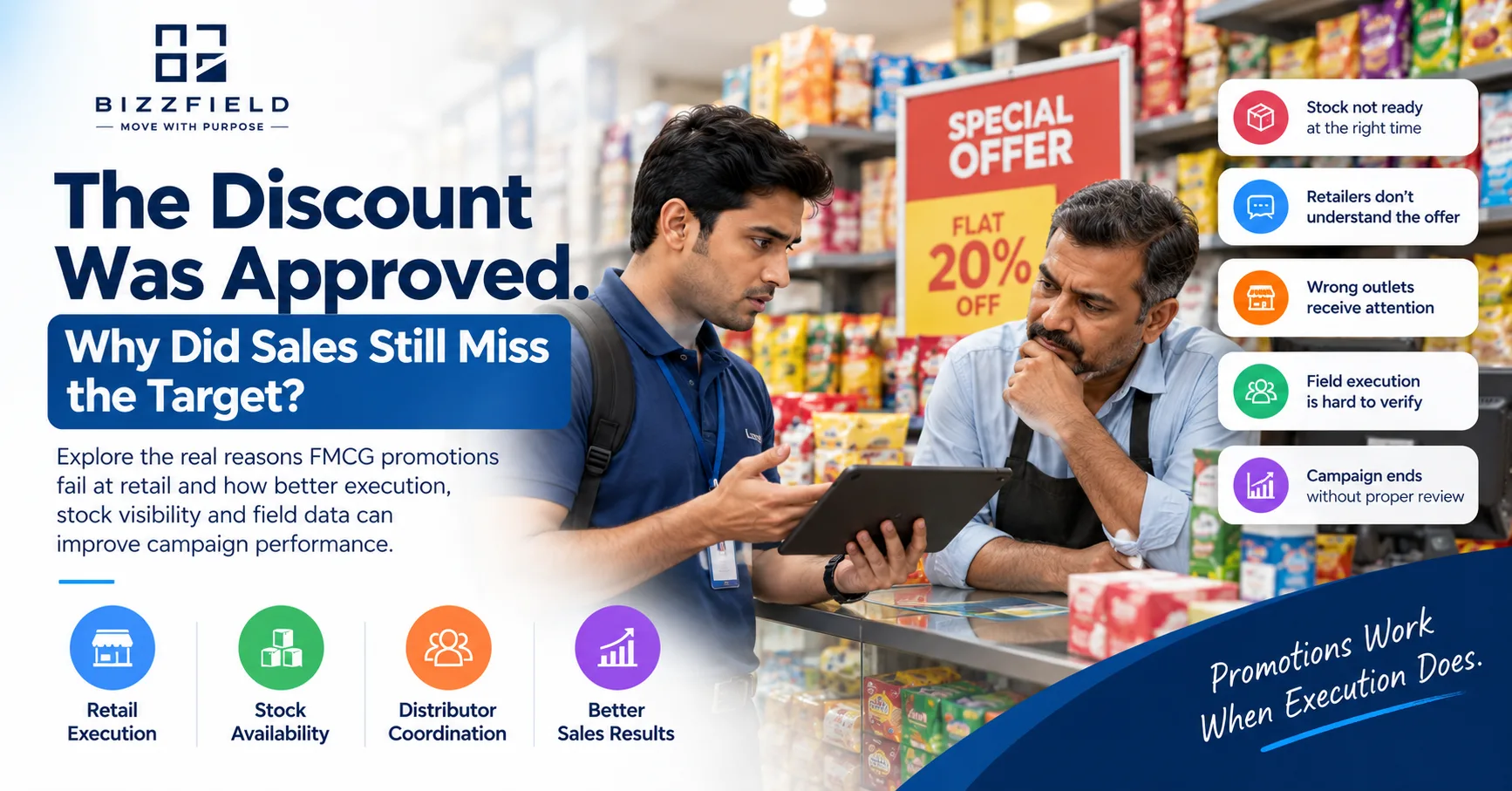
A few weeks later, however, sales are below expectations. Some retailers did not participate, others were short of stock, and several representatives could not clearly explain which offer applied to which product.
The discount was approved. The campaign was launched. But the expected sales impact never arrived.
For FMCG brands, this gap between planning a promotion and executing it at the retail counter can be expensive. A successful promotion depends on much more than an attractive offer. It requires the right stock, clear communication, retailer participation, consistent field execution, and a reliable way to measure results.
1. An Attractive Offer Cannot Fix Poor Execution
Price promotions can encourage shoppers to try products, purchase larger quantities, or choose one retailer over another. However, a discount does not guarantee that customers will buy more.
The outcome depends on factors such as the product category, customer preferences, competing offers, retailer participation, and product availability.
NielsenIQ's May 2026 analysis of pricing and promotion trends in India highlights the importance of measuring promotion effectiveness and understanding whether campaigns generate genuine incremental value.
This distinction matters. Sales recorded during a promotion do not automatically represent additional sales created by that promotion. Some customers may simply purchase earlier than planned or switch from another pack size or brand within the same company's portfolio.
Brands therefore need to look beyond the total number of units sold during a campaign and ask a more useful question: how much additional business did the promotion actually generate?
2. Five Reasons FMCG Promotions Lose Momentum at Retail
Stock is not ready when the offer begins
A promotion may generate interest, but retailers cannot sell products they do not have.
If distributors have insufficient inventory, replenishment is delayed, or the wrong stock has been supplied, the campaign can lose momentum before it reaches its intended audience.
Before launching an offer, companies should check product availability at the distributor level and identify priority outlets that need replenishment. Stock planning should account for the products, territories, and outlets expected to participate.
Retailers do not understand the offer
A scheme can appear straightforward in a head-office presentation and still create confusion at the retail counter.
Retailers may be unsure about eligible products, minimum order quantities, offer validity, or the conditions needed to receive a benefit. Sales representatives may also receive information late or rely on outdated instructions.
Communication should be consistent across the company, distributor, and field team. Every representative should know what the offer covers, where it applies, when it ends, and how a retailer can participate.
The wrong outlets receive attention
Not every outlet has the same demand, customer profile, or purchasing capacity.
A broad campaign may direct representatives towards outlets that have little interest in the promoted product while higher-potential retailers receive insufficient attention.
Brands should identify relevant outlet segments before launch. This helps field teams focus on retailers who are more likely to benefit from the offer while ensuring that the product is available when demand increases.
Field execution is difficult to verify
Instructions are only useful when they translate into action.
A company may ask representatives to communicate a scheme, check stock availability, or visit participating retailers. Without a structured way to record these activities, managers may struggle to distinguish completed tasks from unresolved issues.
Sales teams need a clear process for recording visits, retailer responses, product availability, order status, and follow-up requirements.
The campaign ends without a proper review
Some companies measure a promotion by comparing sales during the campaign with the previous month.
That comparison can be misleading if the periods differ in seasonality, distribution coverage, pricing, or other market conditions.
A better review examines sales against a reasonable baseline, participation across eligible outlets, fulfilment, promotional costs, and whether the effect continues after the offer ends.
3. Make Distributor Coordination Part of the Campaign Plan
Promotions often involve multiple teams, each responsible for a different part of execution. Marketing defines the offer, supply teams plan inventory, distributors manage stock and fulfilment, and field representatives communicate with retailers.
When these activities are disconnected, small gaps can become larger problems.
KPMG's India CX Report 2025 identifies misalignment between promotional schemes and stock norms as a negative influence on distributor onboarding experiences for 32% of distributors.
The finding illustrates why promotional planning and stock readiness should not be treated as separate activities.
Before launch, the relevant teams should agree on the promotion period, eligible products, inventory requirements, retailer communication, order fulfilment arrangements, and escalation process for stock issues.
During the campaign, they should review exceptions rather than waiting until the end to discover what went wrong.
4. What Should Sales Managers Measure During a Promotion?
A useful campaign review does not need dozens of metrics. It needs a focused set of measures that explain both execution and commercial outcomes.
Outlet participation: How many eligible outlets actually participated, and which priority outlets were missed?
Product availability: Were the promoted products available when retailers needed them?
Order conversion: Did relevant retailer interactions result in orders, and what reasons explain unsuccessful visits?
Order fulfilment: Were booked orders delivered correctly and within the expected period?
Incremental sales: How did sales compare with a reasonable baseline after accounting for other important factors?
Post-campaign behaviour: Did participating retailers continue to reorder, or did sales fall back once the offer ended?
These measures should be interpreted together. For example, high participation with weak incremental sales may indicate that the offer was not compelling enough. Strong order demand with poor fulfilment may point to inventory or distribution problems.
The goal is to identify the cause before deciding whether to change the offer, increase coverage, adjust stock, or improve retailer communication.
5. How Sales Technology Can Improve Campaign Execution
When campaign instructions, stock information, outlet visits, and orders sit in separate systems, managers may not see problems until reports arrive.
Sales force automation (SFA) software can help businesses organise field activities, plan outlet visits, record order information, and improve visibility into what is happening across territories.
For example, BizzField SFA supports workflows such as beat planning, outlet management, digital order booking, and field sales reporting.
These capabilities can help teams coordinate retail visits and monitor execution, provided the required information is recorded accurately and reviewed consistently.
Technology is not a substitute for good campaign planning. It works best when each team knows what information to capture, who is responsible for resolving issues, and how the resulting data will influence decisions.
6. A Practical Checklist for the Next FMCG Promotion
Before launching the next campaign, sales and distribution teams can use a simple three-stage process.
Before the campaign: Confirm eligible products and outlets, brief distributors and representatives, check inventory requirements, communicate offer conditions, and establish the baseline for measuring results.
During the campaign: Track retailer participation, product availability, orders, fulfilment issues, and unresolved queries. Assign responsibility for problems and review priority exceptions regularly.
After the campaign: Compare performance against the baseline, assess incremental sales and promotional costs, review outlet-level participation, and examine whether retailers continue ordering.
This approach also creates useful learning for future campaigns. If a promotion performs well in one territory but poorly in another, managers can investigate whether the difference relates to outlet mix, stock readiness, communication, or customer demand before repeating the offer.
The Real Test of a Promotion
A promotion should not be judged only by whether it was approved, announced, or completed on schedule.
Its success depends on whether the intended retailers could participate, the right products were available, field teams executed the plan, and the business generated worthwhile incremental results.
For FMCG companies, the opportunity lies in connecting commercial planning with what actually happens at the retail counter.
The next time a campaign misses its target, the first question should not automatically be whether the discount was large enough.
It should be whether the entire route from promotion planning to retailer execution worked as intended.