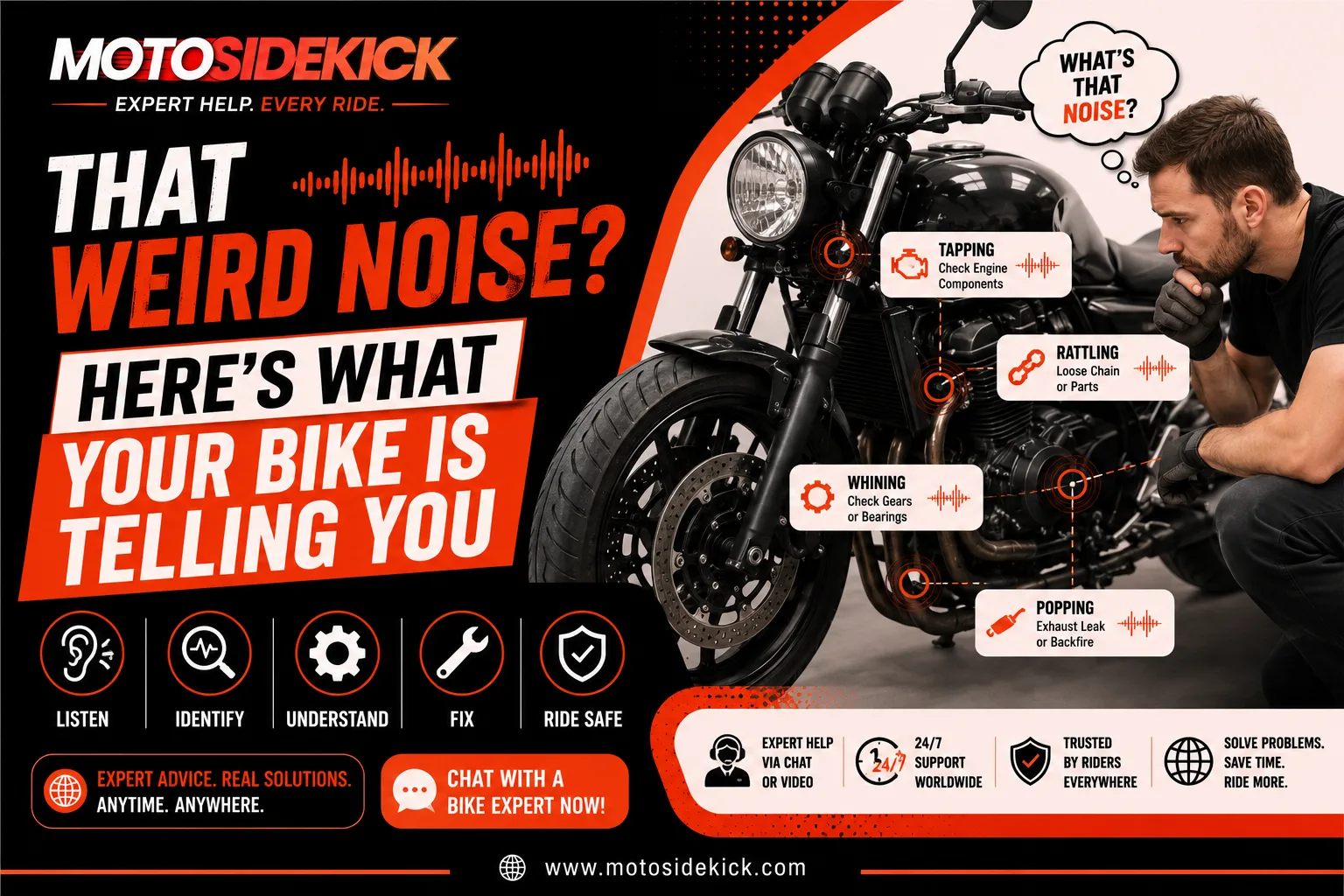
Your bike is always talking to you; most riders just haven’t learned to listen yet. That soft tick at idle, the grind under braking, the rattle by the chain: none of it is random. Each one means something specific, and almost all of them are cheaper to deal with today than they will be in a month. Here’s what the eight noises we hear about most on MotoSidekick usually mean, and how to tell the difference between “ride on” and “pull over now.”
The Tick I Almost Ignored
A few years ago, one of MotoSidekick’s very first live video sessions started with a rider we’ll call Mike, on a 2015 Yamaha FZ-09 with about 22,000 miles on the clock. He messaged in around 7 p.m. on a Tuesday, camera pointed at his engine, and asked if the ticking sound coming from the top end was “just a Yamaha thing.” He’d read that somewhere on a forum and was about to let it go.
The expert rider on the call had him pull the oil dipstick on camera instead. Turned out the oil was two quarts low and had gone from amber to nearly black. That tick had nothing to do with being “a Yamaha thing”; it was the valve train running dry, and left alone for another thousand miles, it could have turned a routine oil change into a full top-end rebuild. Mike topped off the oil that night, booked a proper oil and filter change for the weekend, and the tick was gone within 50 miles.
That’s really the whole point of this guide: almost every motorcycle noise is diagnosable long before it gets expensive, once you know what you’re listening for.
What Does a Clicking or Ticking Engine Noise Mean?
A clicking or ticking sound that speeds up with your RPM is usually the valve train telling you it isn’t getting enough lubrication. Sometimes that’s as simple as low oil. Sometimes it’s oil that’s overdue for a change, or valve clearances that have drifted out of spec over time. On an older or higher-mileage bike, it can also point to a worn cam chain tensioner.
Before you assume the worst, check the obvious stuff first. Pull the dipstick; oil that’s low or has gone dark and burnt-smelling is by far the most common cause of a ticking motorcycle engine. Pay attention to where the sound is coming from, too: a tick up near the valve cover points to the valves, while something lower down might be the primary drive instead. And check your mileage against the manual. Most manufacturers want valve clearances checked somewhere between 8,000 and 16,000 miles, so if you’re past that window, the tick might simply be your bike asking for its scheduled checkup.
It’s rarely an emergency. It’s also rarely something that fixes itself, so it’s worth a quick look, or a live video diagnosis, before your next ride.
Why Is My Motorcycle Grinding When I Brake?
This one’s less subtle. A grinding noise under braking almost always means the pads are worn down to metal, and the backing plate is now scraping directly against the rotor. Motorcycle brake pads are thin to start with, so the gap between “worn” and “metal-on-metal” closes faster than most riders expect.
A little detective work will confirm it. Look at the pad through the caliper; if there’s less than a couple of millimeters of friction material left, it’s time. If the grinding only happens on the front brake, that usually points to the front pads; only on the rear, and it’s the rear pads (or occasionally the caliper itself). And if you feel any pulsing or wobbles in the lever along with the noise, the rotor may already be scored and could need attention too.
Brake pads themselves are a fairly minor, routine expense. Catching them early keeps it that way, instead of adding a rotor replacement on top. This is one of those noises where fixing it the same day you hear it protects your wallet and your safety in equal measure.
What’s Causing That Rattle Near My Chain?
A rattle or slap near the rear wheel is almost always the chain; either it’s got too much slack, the sprockets have worn into that telltale “shark fin” shape, or the chain itself is simply stretched past its useful life. This isn’t just an annoying noise, either. A chain that fails at speed can lock the rear wheel or come off the sprocket entirely, which makes this one worth checking sooner rather than later.
Checking it yourself only takes a few minutes:
- Put the bike on its center stand or a rear stand.
- Find the middle of the lower chain run, between the two sprockets.
- Push up and pull down on the chain. Most bikes call for somewhere between 1 and 1.5 inches of total movement, but confirm the exact number for your make and model.
- Look at the sprocket teeth while you’re at it. Hooked or pointed teeth instead of squared-off ones mean the sprocket is worn too.
If you do need to replace the chain, it’s usually worth doing the sprockets at the same time. A brand-new chain paired with worn sprockets tends to wear out again fast, so replacing all three together saves you from doing this twice.
Why Does My Bike Pop or Backfire When I Let Off the Throttle?
Popping on deceleration usually comes down to a lean fuel mixture or an exhaust leak, unburned fuel igniting in the hot exhaust instead of inside the cylinder where it belongs. On a carbureted bike, that often means the carbs need adjustment or a sync. On a fuel-injected bike, it’s more commonly a leak at a header joint, or an aftermarket exhaust that’s changed the fuel mapping the bike was originally tuned for.
Worth checking: any black soot streaks around the header-to-cylinder joints or slip-fit connections in the exhaust, which usually point straight to the leak. If you recently swapped in a new exhaust or air filter, that popping is often just the bike telling you it needs to be re-tuned for the new airflow. Left alone long enough, the repeated small “explosions” from persistent popping can actually damage an exhaust valve, so it’s worth chasing down rather than writing off as personality.
What Does a Whining or Squealing Engine Noise Mean?
Different from the tick above, a whine or squeal usually traces back to a belt-driven accessory (an alternator or water pump on liquid-cooled bikes), a dry or worn primary chain, or, if the noise tracks with road speed instead of engine RPM, a wheel bearing.
That distinction is the fastest way to narrow it down. If the sound changes with your throttle and RPM, it’s probably engine-internal. If it changes with how fast you’re rolling regardless of what the engine’s doing (even present while coasting in neutral), a wheel bearing is more likely. And a squeal that only shows up cold and fades as the engine warms up often just means a belt tensioner needs adjusting.
None of these tend to be urgent in the first few days, but none of them fix themselves either. A wheel bearing left too long, in particular, can turn into a genuine safety issue.
Why Is My Motorcycle Knocking When I Accelerate?
A knock or ping under load, climbing a hill, cracking the throttle open, is typically engine detonation: the fuel-air mixture igniting unevenly, or too early, inside the cylinder. The usual suspects are fuel with a lower octane rating than the bike needs, carbon buildup in the combustion chamber, or an ignition timing issue.
Start with your owner’s manual. Plenty of performance and high-compression motorcycle engines need premium fuel, and running regular is enough to cause exactly this knock. If you’ve been running the same tank for a while, try a full tank of the recommended octane before assuming anything’s mechanically wrong. If the knock persists even on the right fuel, that points more toward carbon deposits or a timing issue worth a proper look.
This is one noise where “wait and see” is genuinely the wrong call, sustained detonation can damage pistons and rings the longer it goes unaddressed.
What Does a Clunk From My Transmission Mean When I Shift?
A clunk shifting from neutral into first is actually normal on a lot of motorcycles, just mechanical clearance in the clutch basket, not a defect. Where it gets more interesting is if that clunk is new, louder than it used to be, or shows up alongside missed shifts or gears popping out under acceleration. That combination can point to worn dogs on the transmission gears, a stretched clutch cable, or oil that’s overdue for a change (since most motorcycles share engine oil with a wet clutch).
The quickest way to tell the difference: if it’s only that first-gear clunk from neutral and everything else shifts clean, it’s probably just normal clearance. If gears are hard to find, grinding, or popping out while you’re riding, that’s worth diagnosing before your next ride rather than after.
Can I Actually Diagnose Motorcycle Engine Problems From Home?
More often than you’d think, yes. A surprising number of motorcycle engine problems can be figured out from your own driveway, with nothing more than a smartphone camera and someone who knows what they’re listening for. That’s the whole idea behind MotoSidekick: point your phone at the engine, describe or play the sound over live video, voice, or chat, and an expert rider or AI-guided Sidekick helps you work out what’s actually going on before a single tool comes out of the garage.
A lot of motorcycle diagnosis really is a process of elimination rather than a matter of equipment. Does the noise track with RPM or road speed? Is it worse cold or warm? Where exactly is it coming from? Answering those three questions gets you most of the way to an answer without a dyno or a diagnostic computer in sight. MotoSidekick’s live video diagnostics just put an experienced ear on the call with you while you figure it out, so you know whether you’re looking at a five-minute fix or a shop appointment.
When Should I Stop Riding Immediately?
A few combinations mean stop now, not at the next gas station: a loss of braking power, a wobble or clunk from the chain or rear wheel, a sudden change in engine sound paired with a loss of power, or any burning smell. Those point to something that could affect your control of the bike, not just its long-term health.
Plenty of other noises are safer to ride on carefully to a service appointment, a top-end tick, a squeal that fades as the engine warms, an occasional pop on deceleration. And if you’re genuinely not sure which category you’re in, that uncertainty alone is a good reason to get a second opinion before your next ride, whether that’s over video chat, from a mobile mechanic near you, or in person.
How Does Regular Maintenance Keep These Noises From Happening at All?
Most of what’s above traces back to a handful of basics: oil changed on schedule, a chain kept tensioned and lubricated, brake pads checked before they hit metal, and fuel that matches what the manufacturer actually recommends. None of it requires a mechanical background, it just requires a checklist and some consistency.
MotoSidekick’s guided maintenance tools walk you through exactly that, matched to your bike’s specific year, make, and model, so you’re never guessing at when a chain adjustment or valve check is actually due. Honestly, the riders who hear the fewest surprise noises tend to be the ones with the most boring, predictable maintenance routine, and that’s a good thing.
Key Takeaways
- A clicking engine noise usually means low or old oil, check that before assuming the worst.
- Grinding brakes mean metal-on-metal contact, and it’s worth handling the same day, not the same week.
- A chain rattle is a safety issue as much as a noise issue, check the slack and sprocket wear regularly.
- Popping on deceleration often points to a lean mixture or exhaust leak, especially after exhaust or filter changes.
- Engine knock is one of the few noises where waiting can cause real damage, check your fuel octane first.
- Not sure if a noise is safe to ride on? A live video diagnosis with MotoSidekick can usually clear that up in a few minutes.
Frequently Asked Questions
- Is it normal for a motorcycle to make some noise?
- Yes, motorcycles are mechanically louder than cars by design, with exposed valve trains, chains, and air-cooled fins that all contribute to normal operating sound. The goal isn’t silence; it’s knowing your bike’s normal baseline well enough that something new stands out immediately.
- How much does it cost to diagnose a motorcycle noise?
- Traditional shop diagnostics usually come with a separate assessment fee before any repair even starts. MotoSidekick’s AI chat diagnostics are free to try, and live video sessions connect you with an expert rider for a fraction of a typical shop visit.
- Can a bad noise mean my motorcycle isn’t safe to ride?
- Yes, in specific situations, grinding brakes, a loose or rattling chain, or any sudden loss of power alongside a new sound. Those are exactly the combinations covered above under “When Should I Stop Riding Immediately.”
- Should I trust an AI diagnosis over a mechanic?
- Think of it as the first step, not the last one. MotoSidekick’s AI-powered chat can quickly narrow down likely causes based on your bike’s make, model, and symptoms, then connect you to a live expert rider by video when the issue needs a trained ear or eye. It’s built to work alongside human expertise, not replace it for anything safety-critical.
- Do I need special tools to check chain slack or brake pad wear at home?
- Not really. Checking chain slack and eyeballing brake pad thickness both take under five minutes with tools most riders already have, or none at all. MotoSidekick’s guided fixes walk through both, step by step, for your specific bike.
- Ready to figure out what your bike is telling you?
- Chat with a Sidekick for free, or connect live with an expert rider who knows your exact make and model. See how MotoSidekick works, find a mobile mechanic near you, or sign up now to get started. You can also swap notes with other riders on the MotoSidekick forum.
Follow MotoSidekick on Facebook, Instagram, and TikTok for more real-time repair tips.
About the Author
Andrew Carlone is a co-founder of MotoSidekick, the online motorcycle repair and maintenance platform connecting riders with expert mechanics and AI-powered diagnostics via live video, voice, and text. Andrew and his brother Chris built MotoSidekick after seeing how often riders were overpaying for basic guidance, or riding around on problems they didn’t even know how to identify, and set out to put an expert eye on every rider’s bike, instantly, from their phone.