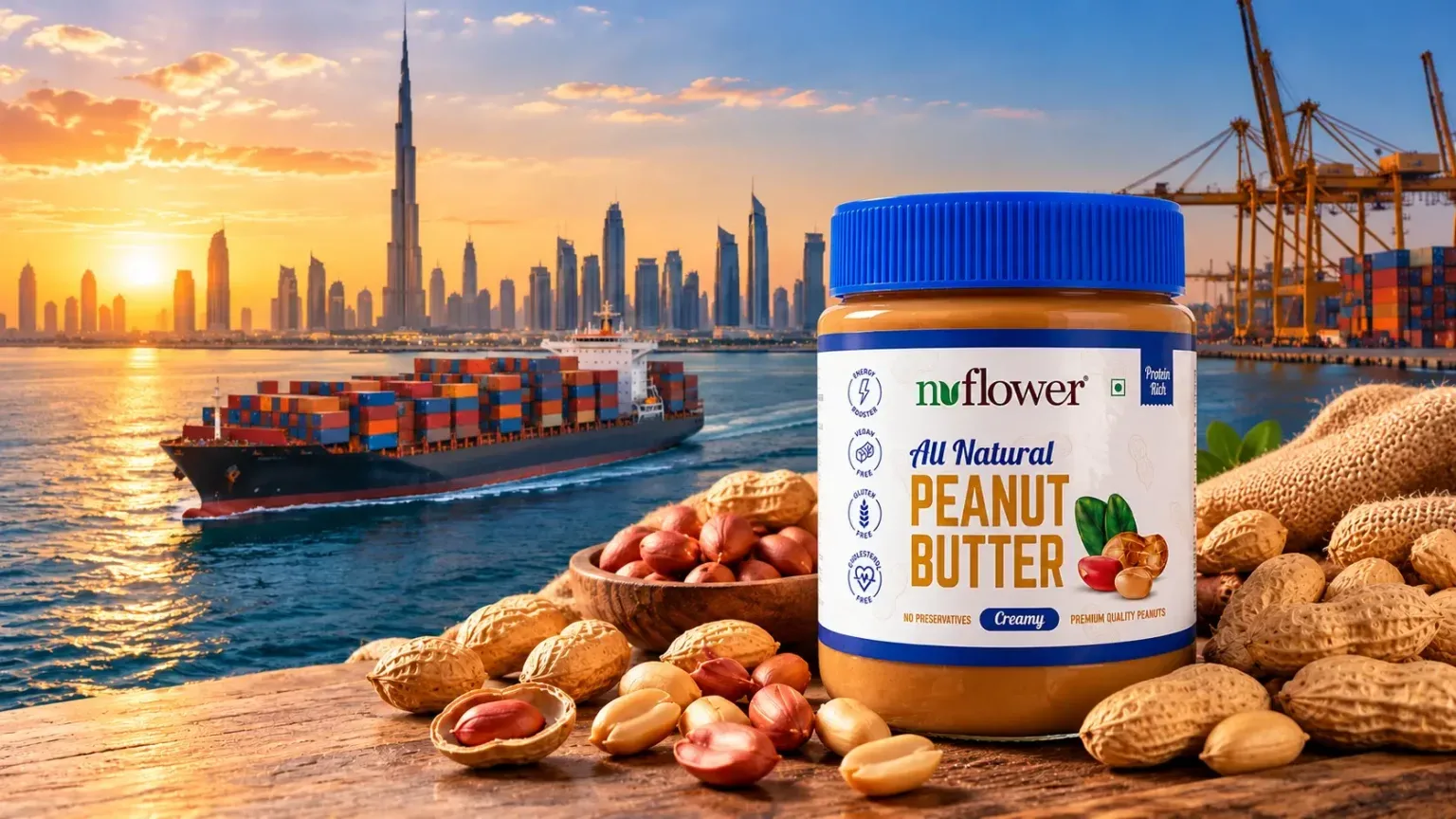
Importers, brand owners and distributors in the UAE who want to build an own-label peanut butter range can source from several origins. Finding a product is usually the easy part. The harder task is finding a supply partner who understands what the market requires before a shipment is booked.
Delays at clearance can come from documentation as much as from the product itself. A specification can be correct and the price competitive, and the consignment can still be held because the paperwork was treated as an afterthought.
This guide sets out why peanut butter manufacturers in India are worth considering as a sourcing option for UAE importers, what importing peanut butter into the UAE generally involves, and what to plan for when distributing from Dubai into the wider Gulf.
-
- Why UAE importers consider India
- Private label and white label supply models
- What the import process involves
- Certification and market expectations
- Serving the wider GCC from Dubai
- Supplier qualification
- FAQs
Why UAE Importers Consider India for Peanut Butter
Four factors make India worth evaluating alongside other origins. How much each one matters will depend on the buyer’s range, volumes and target markets.
Proximity: India’s west coast ports face the UAE across the Arabian Sea, a far shorter sea route than shipments from the Americas. Peanut butter has a defined shelf life, so shorter transit leaves more of it available for distribution and time on shelf.
Raw material position: According to APEDA, India’s agricultural export development authority, India is the second-largest groundnut producer in the world. Manufacturers can therefore usually source peanuts domestically, which keeps the supply chain short and reduces reliance on imported raw material.
Contract manufacturing orientation: Some Indian peanut butter manufacturers, Nuflower among them, produce for other brands as well as, or instead of, selling under their own labels. Where a supplier works this way, buyers may find more room to adjust formulations, pack formats and order quantities. This varies from one supplier to another and should be confirmed during qualification.
Trade agreement: The India-UAE Comprehensive Economic Partnership Agreement (CEPA) has been in force since 1 May 2022. Goods that meet its rules of origin can qualify for preferential tariff treatment on entry to the UAE. Importers should confirm the treatment for the specific tariff line, and the origin documentation needed, with their customs broker before pricing a programme.
Private Label and White Label Supply Models
Indian manufacturers offer both models, and the choice affects timeline, cost and differentiation.
- White label. An existing manufacturer formulation supplied under the buyer’s brand. Faster to launch, lower development cost, and suited to entering a category quickly or testing a market.
- Private label. A formulation developed or adapted to the buyer’s specification. Longer lead time and higher initial investment, producing a product competitors cannot source.
Some programmes begin with peanut butter white labelling to establish listings and volume, then move to a private specification once the category is proven.
Discuss your supply model: Share your target market, pack format and volume expectations, and we will outline the options and indicative timelines.
What the Import Process Involves
The UAE applies federal food standards, but product registration and consignment clearance run through both federal and emirate-level systems, and requirements also differ by product category. The points below are a general outline. The importer of record should confirm the current requirements for the specific product and emirate of entry before anything ships.
- Product and label registration: The UAE importer applies for registration online. ZAD is the federal system and can be used to register products for any of the seven emirates. Importers in Dubai can also use Dubai Municipality’s FIRS portal for registration and label approval, while in the other emirates label assessment is handled by the local food control department. Registration is made product by product, so any change to the label, recipe or pack should be checked with the importer in case it needs an amended registration.
- Labelling: Prepackaged food labels must be in Arabic, or in Arabic and English, in line with UAE.S GSO 9 (Labeling of Prepackaged Food Stuffs). Arabic stickers are accepted, but they must be approved by UAE authorities and applied before export, not on arrival. Production and expiry dates must be printed on the original label. Arabic labelling is therefore part of the manufacturer’s scope of supply.
- Shelf life and dating: Expiry dating follows UAE.S 150-1 (Expiration Dates for Food Products), and dates cannot be added or changed once a consignment arrives. Some points of entry also apply a remaining shelf life rule. Sharjah Airport, for example, rejects food consignments where more than half of the shelf life has already passed. Importers and retailers may set their own minimums as well, so the production date should be agreed in the purchase order rather than left to the factory calendar.
- Analytical documentation: Food consignments are generally accompanied by a health certificate issued by a government authority in the exporting country and a certificate of origin, along with certificates of analysis and any conformity documents the importer asks for. Aflatoxin limits for foods are set under UAE.S GSO 841, so batch-level aflatoxin testing is worth agreeing as a condition of supply. The exact document set should be confirmed with the importer for the product and emirate.
Label errors, short remaining shelf life and incomplete or mismatched documents are all avoidable causes of delay, and each can be dealt with at the specification stage.
Certification and Market Expectations
Certification requirements depend on the product category and the claims carried on pack. In the UAE, halal certificates are a standing requirement for meat and poultry. Peanut butter is plant-based, but if a halal claim or logo appears on pack, the supplier must hold a halal certificate from a certification body registered with the Ministry of Industry and Advanced Technology (MoIAT). Buyers should check with the importer of record whether any further halal documentation is expected for their formulation.
For buyers, the practical question is recognition as much as the certificate itself. Each market approves halal certifiers through its own system: the UAE registers certification bodies through MoIAT, while Saudi Arabia’s SFDA runs its own approval of foreign halal centres. A certificate accepted in one market is not automatically accepted in another, so buyers serving several countries should confirm recognition for each.
Retail buyers may also ask for facility-level food safety certification as part of supplier approval. This is a buyer requirement rather than a regulatory one, and it varies by retailer, so it should be confirmed with each customer.
Serving the Wider GCC From Dubai
Dubai’s role as a trade hub makes it a practical base for regional distribution. Under the GCC Common Customs Law, goods in a UAE free zone are treated as foreign goods, so duty is not paid while stock is consolidated and stored there. Any duty due is assessed when the goods are imported into the UAE mainland or another GCC market.
Holding stock in a UAE free zone does not give it free movement across the Gulf. Goods sent from a free zone to another GCC market are treated as an import into that market. Even for goods already cleared in the UAE, the GCC single-entry policy is applied in practice mainly to unopened containers transshipped between member states, and repacked or partial shipments may face an additional 5 percent duty at destination. Tariff preferences under the India-UAE CEPA apply to imports into the UAE and do not extend to other GCC markets.
Where the free zone model helps:
-
- Consolidating one larger shipment instead of several country-level shipments, improving freight economics
- Holding buffer stock close to demand with duty deferred
- Preparing destination-specific shipments from a single inventory pool, subject to each market’s labelling rules
- Supplying destinations beyond the Gulf from the same stock
Landed cost should therefore be modelled per destination market rather than once for the region.
GCC Standardization Organization (GSO) standards are the main reference point for food labelling across the Gulf, which makes multi-market distribution simpler. National rules are not always aligned with them, however, so each destination’s requirements should be checked separately.
Supplier Qualification
Questions that help show whether a manufacturer is ready to supply the Gulf.
-
- Can the manufacturer supply the full documentary pack as standard rather than on request?
- Is Arabic labelling, including any approved sticker, applied at the facility before export?
- Which body issues any certification carried, and is it recognised in every intended market?
- Are batch-level analytical certificates, including aflatoxin results, issued as a condition of supply?
- What production date can be committed relative to shipping?
- What is the minimum order quantity per pack format, not just per formulation?
- Can jar, pouch, sachet and bulk formats be produced in the same facility?
Frequently Asked Questions
What is the difference between private label and white label peanut butter?
White label applies an existing manufacturer formulation under the buyer’s brand. Private label involves a formulation developed to the buyer’s specification. White label is faster and cheaper to launch; private label produces a product competitors cannot source.
Does peanut butter require halal certification for the UAE?
Halal certificates are a standing requirement for meat and poultry. For a plant-based product such as peanut butter, a certificate is needed when a halal claim or logo is carried on pack, and it must come from a certification body registered with MoIAT. Buyers serving other Gulf markets should confirm that the certifier is recognised in each one.
Can one UAE shipment supply the whole Gulf region?
Not freely. Each onward market treats goods from a UAE free zone as its own import, and duty-free movement between GCC states applies in practice mainly to unopened containers. The free zone is still useful for consolidation, deferred duty and holding stock close to demand.
What typically causes shipment delays?
Labelling inconsistencies, insufficient remaining shelf life, and incomplete or mismatched documentation. These are documentary rather than product issues and are preventable at specification stage.
What order quantities do Indian manufacturers support?
This varies by manufacturer and by pack format. Suppliers set up for contract manufacturing may be open to trial runs or multi-SKU programmes, so ask for minimums per format at the quotation stage.
For UAE importers, unit price matters, but it is not the only test. Just as important is whether the manufacturer understands UAE and wider Gulf requirements before production begins.
Establish the documentary position early, treat Arabic labelling as part of the manufacturer’s scope, confirm certification recognition for every market served, and model landed cost by destination rather than regionally. Suppliers should be evaluated on the completeness of their documentation as much as on their quotation.
Nuflower Foods & Nutrition manufactures private label and white label peanut butter at export volume from India, supporting importers and brand owners across the Gulf with labelling applied at origin and full documentary support. Request a quotation today and get started.