If you sell software or manage customer data from Australia, you have probably met the question in a sales call: "Do you have a SOC 2 report?" For many Australian SaaS, fintech and technology companies, that one question can decide whether a deal moves forward or stalls at security review.
This guide explains SOC 2 in plain language: what it is, who needs it, how the two report types differ, what it realistically costs and how long it takes, and the routes Australian businesses use to get a report.
What Is SOC 2?
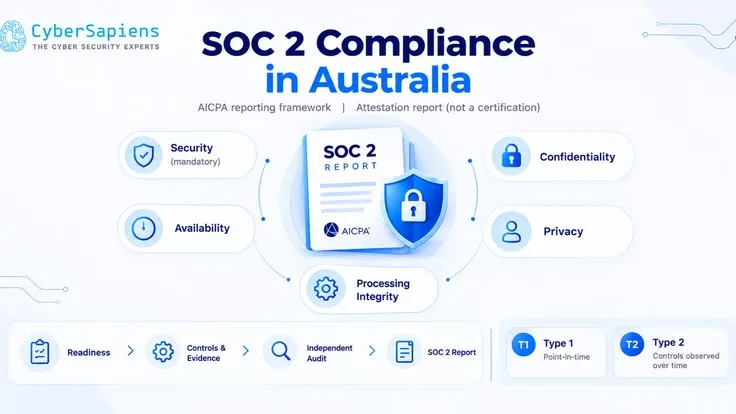
SOC 2 (System and Organization Controls 2) is a reporting framework developed by the American Institute of Certified Public Accountants (AICPA). It assesses how an organisation designs and operates controls to protect customer data, measured against five Trust Services Criteria:
- Security: the mandatory baseline in every SOC 2 report
- Availability: whether systems are reliably accessible as promised
- Processing Integrity: whether data is processed completely, accurately and on time
- Confidentiality: how confidential information is protected
- Privacy: how personal information is collected, used and disposed of
Most first-time reports cover Security only, then add other criteria as customer expectations grow. Each extra criterion adds implementation and audit effort.
SOC 2 is a report, not a certificate
People say "SOC 2 certification" all the time, and it is fine as shorthand. Technically, though, SOC 2 is an attestation report. An independent, licensed audit firm examines your controls and issues a formal opinion. That report is what enterprise procurement teams ask to see, so when comparing providers, check that a genuine audit engagement sits behind the work.
Is SOC 2 Mandatory in Australia?
No. SOC 2 is not a legal requirement in Australia, and no Australian regulator mandates it. Demand is commercial. US enterprise buyers, and increasingly APAC buyers, treat a current SOC 2 report as a gate in vendor due diligence. Without one, a vendor can be filtered out before pricing is even discussed.
There is also no Australian-domiciled version of the framework. Every SOC 2 report traces back to an AICPA-based audit engagement, which Australian companies access through the routes described later in this guide.
Six Signs Your Business Needs SOC 2
SOC 2 is most valuable when security due diligence is slowing your growth. These are the common signals:
- An enterprise prospect has asked for it. A named buyer, especially a US or regulated-industry one, requesting a report is the strongest signal to act.
- You handle customer data in the cloud. SaaS, PaaS and managed service providers are exactly who the framework was designed for.
- You process sensitive or regulated data. Financial or health data raises the level of assurance customers expect.
- You are selling into North America. SOC 2 is the default vendor standard in US procurement.
- Competitors already hold a report. In some categories, not having one becomes a visible disadvantage in every comparison.
- Security questionnaires are draining your sales team. Custom questionnaires can consume many staff hours per deal, and a current report can replace much of that work.
If two or more of these sound familiar, it is worth starting. A SOC 2 compliance checklist is a sensible first step to see where you stand.
SOC 2 Type 1 vs Type 2
Both report types test the same controls, from access management to change management and incident response. The difference is how long the auditor observes them.
SOC 2 Type 1
- What it evaluates: Control design at a single point in time
- Observation period: A single date
- Typical timeline: About 6 to 8 weeks if controls already exist
- Relative cost: Lower
- Buyer confidence: Moderate, often seen as an interim step
- Best for: First-time programmes and urgent deal pressure
SOC 2 Type 2
- What it evaluates: Control design and operating effectiveness over a period
- Observation period: Typically 3 to 12 months
- Typical timeline: Around 9 to 12 months from a standing start
- Relative cost: Often 25 to 50% higher than Type 1
- Buyer confidence: High, the report most enterprise buyers expect
- Best for: Ongoing enterprise sales and vendor renewals
Which should you choose? If a deal is waiting, a Type 1 can act as a quick bridge while your Type 2 observation window runs. If you are planning for sustained enterprise sales, Type 2 is the destination. You do not have to complete Type 1 first, and many companies go straight to Type 2.
Why a "45-day SOC 2 Type 2" is not realistic
Type 2 depends on a mandatory observation window. Auditors must see your controls operating over time, and that evidence has to be gathered as it happens, not rebuilt afterwards. Six months is generally treated as the minimum enterprise buyers accept. Anyone promising a Type 2 in 45 days is either describing a Type 1 or overselling.
How Long Does SOC 2 Take?
Timelines vary with your starting maturity, but the work usually falls into four phases:
- Readiness assessment and gap analysis (4 to 8 weeks): Define scope, map controls to the criteria and identify gaps.
- Gap remediation (1 to 4 months): Write policies, deploy tooling and implement controls such as least-privilege access and role-based access control.
- Observation window, Type 2 only (3 to 12 months): Controls operate and generate evidence continuously.
- Audit fieldwork and report (4 to 8 weeks): The auditor tests evidence and issues the final report.
In short, expect roughly 6 to 8 weeks for a Type 1 where controls already exist, and 9 to 12 months for a Type 2 from a standing start. The observation window is not a flaw in the process. It is what makes the report credible.
How Much Does SOC 2 Cost in Australia?
Cost is the question buyers ask most and providers answer least clearly. Two points help:
- The audit fee is usually only a fraction of the real first-year spend, often cited at around 30 to 40%. Readiness work, remediation, tooling and internal staff time make up the rest.
- Costs vary widely, so treat any published range as indicative rather than a quote.
The indicative market ranges below are in USD for a first-year, all-in programme. The CyberSapiens figures are AUD ranges for its consultancy-plus-audit-partner model.
Early-stage startup (Security criteria only)
- Market all-in cost, Year 1: USD $20,000 to $50,000
- CyberSapiens range: AUD $8,000 to $20,000
- Annual renewal: USD $10,000 to $30,000
Small to mid SaaS (20 to 50 staff, multiple criteria)
- Market all-in cost, Year 1: USD $60,000 to $150,000
- CyberSapiens range: AUD $12,000 to $30,000
- Annual renewal: USD $25,000 to $50,000
Large enterprise (complex environment)
- Market all-in cost, Year 1: USD $150,000 to $250,000+
- CyberSapiens range: AUD $30,000+
- Annual renewal: USD $40,000 to $100,000+
What drives the price
- Auditor tier: Big 4 firms commonly charge two to five times what boutique specialists do for a comparable report.
- Criteria in scope: Security is mandatory, and each additional criterion adds effort.
- Observation period: Longer Type 2 windows mean more evidence to collect and test.
- Existing maturity: A working ISO 27001 management system can cover a large share of SOC 2 controls.
- Automation vs manual effort: Tooling can reduce ongoing evidence collection work, though it does not replace the audit.
For a deeper breakdown by company size and auditor tier, see the full guide to SOC 2 cost in Australia.
Three Ways Australian Companies Get a SOC 2 Report
1. A Big 4 firm (PwC, Deloitte, KPMG, EY). This gives the strongest brand signal at the highest cost. It suits large enterprises whose buyers specifically expect a Big 4 name on the report.
2. An overseas specialist audit firm, engaged directly. Audit fees tend to be lower, but you manage readiness, remediation and evidence yourself, often across time zones. This works best for companies with a mature in-house compliance team.
3. An Australian consultancy working with an audit partner. A local team leads readiness, control implementation and audit preparation, while the formal attestation is issued by an independent audit firm. This is a common fit for mid-market companies that want hands-on support at a lower cost. CyberSapiens, for example, works with Accorp Partners as its audit partner for this model.
Whichever route you choose, the useful questions to ask are: Who issues the report? What exactly is included in the fixed price? Who collects evidence? What happens at renewal?
SOC 2 and ISO 27001: Do the Work Once
SOC 2 and ISO 27001 overlap significantly, with a commonly cited figure of 60 to 70% of shared controls. Access management, encryption, incident response and vendor risk are all covered by both. That has two practical effects:
- If you already hold ISO 27001, much of your SOC 2 readiness work is done. Risk assessments, policies and evidence habits map onto the Trust Services Criteria, so you mainly close the genuine gaps.
- If you need both, implementing them together means one set of controls supports two credentials: the ISO 27001 certificate that European and APAC buyers often expect and the SOC 2 report US buyers ask for.
SOC 2 and HIPAA
Australian companies selling health-related products to US customers often ask whether SOC 2 and HIPAA are the same. They are not.
- HIPAA is a US law protecting health information, and there is no official HIPAA certificate.
- SOC 2 is an independent audit report on your security controls.
- HIPAA applies to you only if you handle protected health information for a US covered entity, typically as a business associate. A request from a US customer to sign a Business Associate Agreement is the usual trigger.
Because the controls overlap, many companies build them once and map them to both.
How to Get Started: A Simple Checklist
- Confirm the trigger. Identify which customers or deals are asking for SOC 2, and which report type they expect.
- Define scope. Decide which systems and which Trust Services Criteria are in scope. Starting with Security alone is common.
- Run a gap analysis. Compare your current controls with the criteria to see what needs to be built.
- Remediate. Document policies, deploy tooling and implement the missing controls.
- Choose Type 1, Type 2 or both. Match the report to your deal pressure and long-term sales plans.
- Select your audit route. Compare a Big 4 firm, an overseas specialist and a consultancy-plus-audit-partner model on cost, effort and support.
- Plan for renewal. SOC 2 is not one-off. Reports are renewed annually, so build evidence collection into everyday operations.
Frequently Asked Questions
Is SOC 2 legally required in Australia? No. Demand comes from enterprise procurement, particularly US buyers, rather than regulation.
Is SOC 2 a certificate? Technically it is an attestation report issued after an independent audit. "Certification" is common shorthand.
How long does SOC 2 take? A Type 1 typically takes 6 to 8 weeks when controls already exist. A Type 2 usually takes 9 to 12 months from a standing start because of the observation window.
Do I need a Type 1 before a Type 2? No. Most companies can go straight to Type 2. Type 1 is useful as a short-term bridge under deal pressure.
Does ISO 27001 help with SOC 2? Yes. The frameworks share a large proportion of controls, which can lower both cost and timeline.
Who issues the SOC 2 report for Australian companies? A licensed independent audit firm. Many Australian businesses use a local consultancy for readiness and implementation, with the attestation delivered through an audit partner.
Final Thoughts
For Australian technology companies, SOC 2 is less about regulation and more about trust and revenue: it is the evidence enterprise buyers use to decide whether your security can be relied on. The most reliable way to approach it is to be realistic about timelines, clear about what is in the price, and honest about which report your customers actually need.
If you are weighing your options, a good first step is a readiness conversation to map your current controls, any ISO 27001 overlap and the fastest credible path to a report. CyberSapiens offers free SOC 2 consultations for Australian businesses, with fixed-price quotes.