
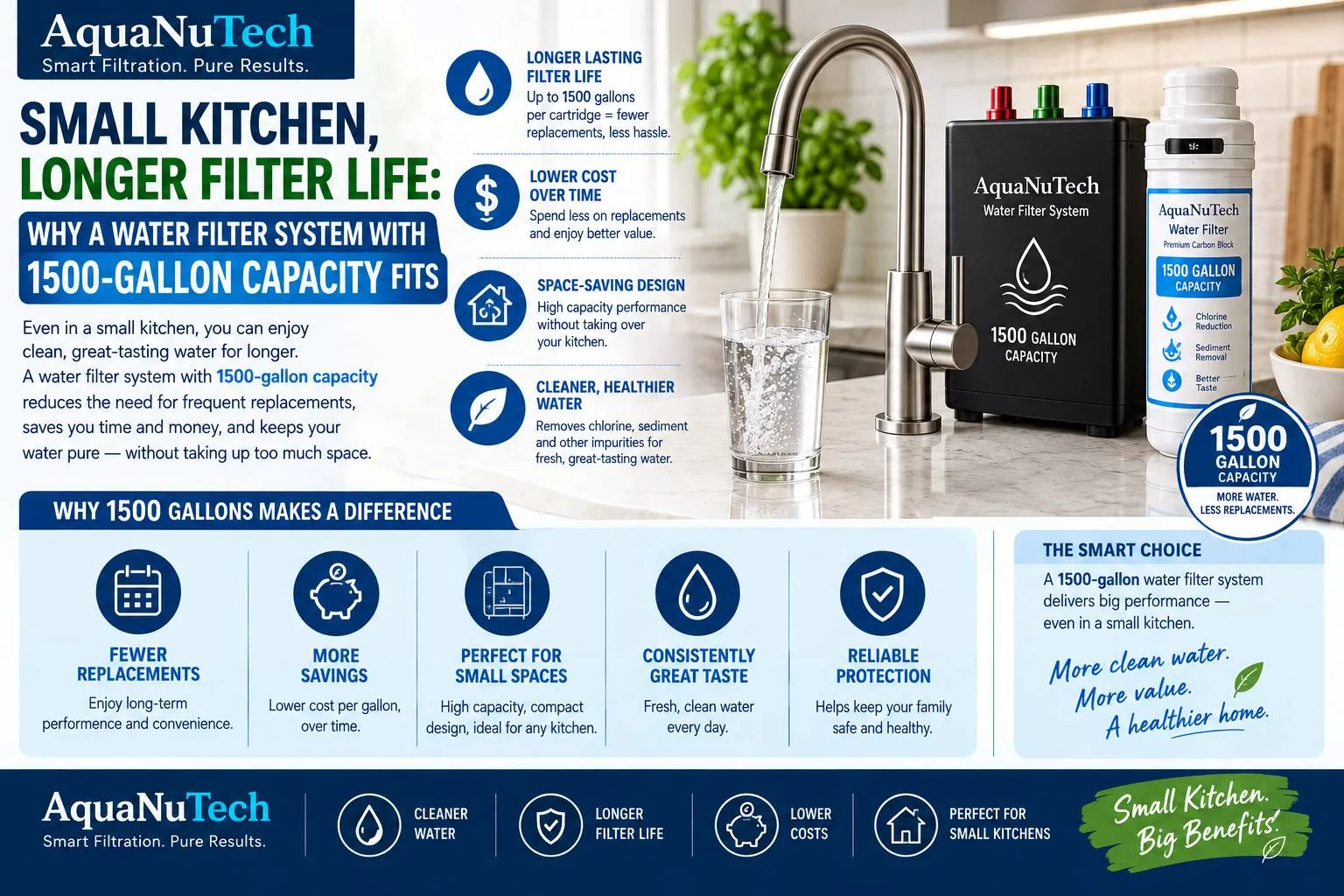
How much cabinet space should better drinking water take away from a small kitchen? Ideally, very little. Yet many filtration setups demand more room than expected once the cartridge, tubing, disposal, and shutoff valves compete for the same cabinet. A water filter system with 1500-gallon capacity can be a practical answer because it combines higher usable capacity with an under-sink format. For apartments, condos, and smaller homes, a compact filtration system for small kitchens can improve water treatment without giving up the worktop or most of the storage below it.
Why Filter Capacity Affects More Than Replacement Frequency
Capacity is easy to treat as a simple product number. In practice, it shapes maintenance. A household may use filtered water for drinking, cooking, coffee, rinsing produce, and filling reusable bottles. That creates steady demand.
A water filter system with 1500-gallon capacity gives that household more room between cartridge changes than a lower-capacity option, assuming similar water conditions and use. It can also reduce the frustration of keeping spare cartridges on hand or finding that water flow has dropped at an inconvenient time.
Capacity still needs context. Incoming water quality, sediment levels, household size, and usage all affect filter life. The gallon rating works best as part of the decision, not as the decision by itself.
How Under-Sink Design Preserves Usable Kitchen Space
Small kitchens punish poor equipment placement. A countertop filter occupies preparation space every day. A wide under-sink housing can be just as awkward because it may block cleaning supplies or make the plumbing difficult to reach.
AquaNuTech uses compact under-sink filtration in its product range, an approach that keeps filtration close to the supply line while leaving the countertop clear.
When comparing a compact filtration system for small kitchens, homeowners should inspect the cabinet before looking only at product dimensions:
- Measure clear height around the sink bowl and drain.
- Check the garbage disposal and shutoff valve positions.
- Leave enough clearance to remove the cartridge by hand.
- Make sure tubing can run without sharp bends.
- Keep access to plumbing available after installation.
A system that fits by a fraction of an inch may still be a poor choice if every filter change requires emptying the cabinet.
What Filtration Performance Should Buyers Check?
Long filter life is useful only when the filtration itself matches the household’s water concerns. Capacity claims need closer reading here.
A water filter system with 1500-gallon capacity should also be assessed by its filtration media, contaminant-reduction claims, certifications, flow performance, and replacement design. Carbon-block filtration can address chlorine taste and odor along with specific contaminants covered by the product’s tested scope. Ultrafiltration can add a finer treatment stage in systems designed for it.
AquaNuTech pairs its high-capacity approach with carbon-block filtration and also offers an ultrafiltration configuration. That gives buyers more to compare than cartridge life alone. It connects capacity with the treatment process, which is more useful when deciding between similar under-sink systems.
Why Easy Filter Access Is Important in Tight Cabinets
Maintenance often gets ignored during purchase. The mistake becomes obvious months later, when the cartridge needs replacement, and there is barely enough room to grip it.
A compact filtration system for small kitchens should leave working clearance around the filter head and cartridge. Quick-change construction can make servicing easier, but only when the installer leaves enough space from the start.
This also affects where other equipment goes. If a kitchen has a disposal, instant-hot-water tank, or pull-out waste bin, the filter should not interfere with those components. Planning the cabinet as one working system makes more sense than treating each appliance separately.
How Integrated Water Systems Reduce Fixture Clutter
Limited space exists above the counter too. Separate drinking-water faucets, hot-water dispensers, and standard kitchen taps can crowd a small sink deck.
A water filter system with 1500-gallon capacity can work well within an integrated setup where filtered water connects to a dedicated or multifunction faucet. Pairing filtration with other water functions can reduce separate fixtures while keeping the treatment equipment below the sink.
For a compact filtration system for small kitchens, compatibility deserves close attention. Faucet connections, available cabinet depth, electrical access for hot-water equipment, and cartridge clearance should all be checked before installation. Good planning prevents a compact product from becoming part of a cramped system.
Conclusion: Match Filter Capacity to the Space Available
Choosing filtration for a small kitchen requires more than finding the smallest housing. The system still needs enough capacity for normal household use, dependable filtration, sensible maintenance, and clearance for future servicing.
A compact filtration system for small kitchens works best when the cabinet remains functional after installation. Homeowners should compare water needs with cabinet measurements, filtration specifications, and replacement access rather than focusing on one feature.
When those elements work together, a water filter system with 1500-gallon capacity can offer longer cartridge use and effective under-sink filtration without consuming the limited space a smaller kitchen needs for everyday use.