
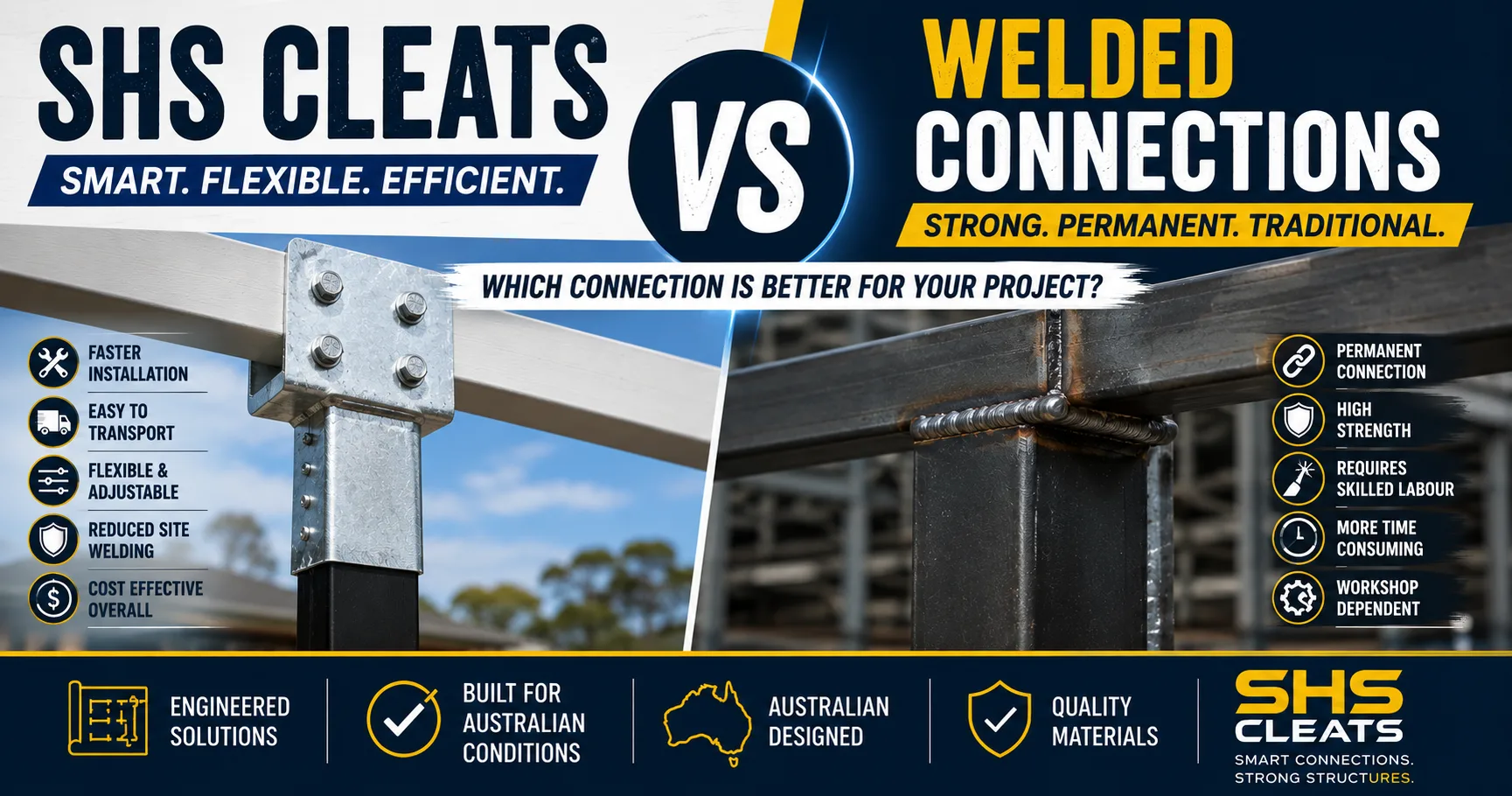
SHS Cleats vs Welded Connections: Which Is Better for Steel Construction?

When designing or constructing a steel structure, the connection between structural members is just as important as the members themselves. A connection needs to transfer the required forces safely while also being practical to fabricate, transport, install and maintain.
Two approaches commonly considered for steel connections are prefabricated SHS cleats and welded connections.
Neither solution is automatically better for every project. The right choice depends on the structural design, connection requirements, site conditions, fabrication process, installation method and environmental exposure.
For builders, fabricators and engineers working with Square Hollow Section (SHS) posts, understanding the differences between these approaches can help when planning a practical connection system.
This guide compares SHS cleats and welded connections across installation, fabrication, flexibility, transportation, maintenance, cost and structural considerations.
What Is an SHS Cleat?
An SHS cleat is a fabricated steel connection component designed to create a connection between a Square Hollow Section steel member and another structural component.
Depending on the application, an SHS cleat may be used to connect:
- Timber beams
- Steel beams
- PFC sections
- Floor bearers
- Roof members
- Bracing components
- Other structural members
The exact configuration depends on the intended application.
For general information about SHS cleat solutions, visit SHSCleats.com.
What Is a Welded Steel Connection?
A welded connection joins steel components directly using a welding process.
For example, a steel plate or cleat can be welded directly to an SHS post during fabrication.
Once the welding process has been completed and the connection has been inspected, the resulting assembly becomes a relatively fixed component.
Welded connections are widely used in structural steel fabrication and can be highly effective when appropriately designed and fabricated.
They can be particularly useful when:
- A permanent connection is preferred
- The assembly is manufactured in a controlled workshop
- Complex geometry needs to be fabricated
- The connection requires a specific welded detail
However, welding also introduces additional fabrication requirements that need to be considered.
SHS Cleats vs Welded Connections: At a Glance
ConsiderationSHS CleatsWelded ConnectionsOn-site weldingCan be reduced depending on designMay be requiredFabricationPre-fabricated componentFabricated and welded assemblyInstallationCan be relatively straightforwardMay require welding equipment/personnelAdjustabilityCan offer positioning flexibility depending on systemUsually fixed after weldingTransportationComponents can be transported separatelyLarger welded assemblies may be heavierQuality controlControlled component manufacturingRequires controlled welding proceduresModificationDepends on designChanges may require cutting and reweldingWeather considerationsUseful where site welding is undesirableWelding conditions must be controlledEngineeringRequired for structural applicationRequired for structural applicationThe table provides a general comparison only. The actual performance of either connection depends on its engineering design.
1. Installation
Installation is one of the biggest practical differences between the two approaches.
SHS Cleats
Where a cleat system is designed for mechanical installation, the component can be positioned and fixed without carrying out extensive welding on site.
This can be useful when:
- Site welding is inconvenient
- Access is limited
- Construction schedules are tight
- Multiple similar connections are required
For builders, reducing fabrication work at the construction site can simplify the installation process.
Welded Connections
A site-welded connection requires appropriate equipment, qualified personnel and suitable working conditions.
The welding process may also require:
- Surface preparation
- Welding equipment
- Power supply
- Welding consumables
- Appropriate PPE
- Inspection
- Protective coating repair
For workshop fabrication, these requirements can generally be controlled more easily than they can on an exposed construction site.
2. Fabrication Process
The fabrication process can also influence the choice of connection.
SHS Cleats
With prefabricated cleats, some of the manufacturing work is completed before the components reach the construction site.
This can provide consistency across multiple connections.
For projects involving many similar posts, standardised components can also make installation more predictable.
Welded Connections
Welded connections require the plate, cleat or other component to be accurately positioned and welded to the SHS section.
The quality of the finished connection depends on factors such as:
- Welding procedure
- Welder competency
- Joint preparation
- Material compatibility
- Heat input
- Welding position
- Inspection
For complex connections, workshop fabrication can be an effective approach because the process can be performed under controlled conditions.
3. Adjustability and Site Tolerances
Construction sites are not always perfectly predictable.
There may be small differences between the design dimensions and the actual site conditions.
This is where connection flexibility can become important.
SHS Cleats
Depending on the particular cleat system, components may provide some flexibility in positioning before final fixing.
This can be useful when dealing with:
- Beam levels
- Post positioning
- Minor construction tolerances
- Different structural arrangements
However, adjustment should always remain within the limits of the product and engineering design.
Welded Connections
Once a component has been welded into position, its location is generally fixed.
If the beam position later needs to change, modification may require:
- Cutting the existing connection.
- Repositioning the component.
- Rewelding.
- Inspecting the new weld.
- Restoring corrosion protection.
This can add time and labour to the project.
4. Transportation and Handling
Transportation is another factor that is sometimes overlooked during connection design.
A welded connection can turn multiple individual components into one larger assembly.
For example, an SHS post with several welded cleats attached may become significantly more difficult to handle and transport.
Prefabricated cleats can instead be transported separately and assembled at the required stage.
This can be particularly useful for:
- Long steel posts
- Large structures
- Remote projects
- Projects with restricted access
- Structures requiring multiple connection components
5. Site Welding Conditions
Welding is highly dependent on the working environment.
Outdoor construction can introduce challenges such as:
- Wind
- Rain
- Moisture
- Dust
- Restricted access
- Difficult working positions
These factors can make site welding more complicated than workshop welding.
Weather protection and appropriate welding procedures may be necessary.
A mechanically fixed cleat system can potentially reduce some of these site constraints where the engineering design permits it.
6. Quality Control
Both systems require appropriate quality control.
SHS Cleats
Prefabricated components can be manufactured under controlled production conditions.
Important checks can include:
- Dimensions
- Hole positions
- Plate thickness
- Surface finish
- Material specifications
- Component identification
Welded Connections
Welded connections require additional welding-related quality checks.
Depending on the project, inspection may consider:
- Weld size
- Weld continuity
- Surface condition
- Defects
- Welding procedure
- Welder qualifications
- Non-destructive testing where specified
The required level of inspection should be established by the project specifications and responsible engineer.
7. Corrosion Protection
Corrosion protection is particularly important for outdoor steel structures.
SHS Cleats
A manufactured cleat can be supplied with an appropriate protective finish, depending on the product and application.
Galvanised components are commonly used in outdoor construction because the zinc coating provides corrosion protection.
Welded Connections
Welding can damage or remove protective coatings around the weld area.
After fabrication, the affected area may need appropriate surface preparation and coating repair.
This means the complete corrosion-protection system needs to be considered—not simply the steel component itself.
8. Maintenance and Future Modifications
The ability to inspect, repair or modify a connection can become important over the life of a building.
A fixed welded connection may require cutting and rewelding if a structural modification becomes necessary.
A mechanically fixed cleat system may offer greater flexibility for certain future modifications, depending on the design.
However, structural connections should never be modified without appropriate engineering assessment.
9. Cost: Which Is Cheaper?
There is no universal answer.
The purchase price of a cleat and the cost of welding are only two parts of the overall calculation.
Consider the total installed cost, including:
- Material
- Fabrication
- Welding
- Labour
- Transportation
- Site equipment
- Installation
- Inspection
- Surface treatment
- Maintenance
- Potential rework
For a project with hundreds of identical connections, a prefabricated cleat system may offer significant installation efficiencies.
For a one-off complex steel assembly, welding may sometimes be the more practical solution.
The project-specific comparison should therefore consider the complete construction process.
10. When Might SHS Cleats Be a Better Choice?
A prefabricated cleat system may be worth considering when the project requires:
- Efficient installation
- Reduced site welding
- Repeated connection configurations
- Easier component handling
- Greater positioning flexibility
- Consistent manufactured components
- Steel-to-timber connections
- Practical outdoor assembly
This does not mean an SHS cleat is automatically the right solution. The connection still needs to meet the project's structural requirements.
11. When Might Welded Connections Be More Appropriate?
Welding can be advantageous when:
- A permanent connection is required
- The geometry is highly customised
- The entire assembly can be fabricated in a workshop
- Complex steelwork requires integrated fabrication
- The engineering design specifically calls for welded joints
For large fabricated steel assemblies, welding remains an important and widely used construction technique.
SHS Cleats or Welded Connections: A Practical Decision Guide
Before choosing between the two approaches, ask:
Question 1: Is site welding practical?
If not, a mechanically fixed connection may be worth investigating.
Question 2: Are there many identical connections?
If yes, prefabricated cleats may improve installation efficiency.
Question 3: Is the connection highly customised?
If yes, a welded fabrication may provide greater design flexibility.
Question 4: Will the connection need adjustment?
If positioning flexibility is important, investigate a cleat system designed to accommodate it.
Question 5: Is the project outdoors?
Consider weather, corrosion protection and site welding conditions.
Question 6: How will the structure be transported?
Large welded assemblies can be more difficult to transport than separate components.
Question 7: What does the engineer specify?
This is ultimately the most important question.
The structural design should determine the required connection type and capacity.
Common Mistakes When Comparing Connection Methods
Looking Only at Material Price
The cheapest component does not necessarily produce the lowest installed cost.
Ignoring Installation Labour
Welding, grinding, coating and inspection can add significant labour.
Forgetting Transportation
Large welded assemblies may require additional handling and transport considerations.
Ignoring Corrosion Protection
Welding and coating should be considered together.
Choosing Based on Convenience
A connection must satisfy structural requirements before installation convenience is considered.
Modifying a Designed Connection
Never drill, cut, weld or alter a structural connection without appropriate engineering approval.
Which Connection Method Is Better?
There isn't a single answer.
SHS cleats and welded connections are both useful structural connection approaches, but they solve slightly different practical problems.
SHS cleats can be attractive where installation efficiency, modular assembly, positioning flexibility and reduced site welding are important.
Welded connections can be advantageous where permanent, highly customised or integrated steel fabrication is required.
The best choice depends on the individual project.
The most reliable approach is to evaluate the connection during the design stage, considering structural capacity, fabrication, installation, transportation, environmental exposure, inspection and total cost.
Final Takeaway
The choice between SHS cleats and welded connections should not be treated as a simple competition between two products.
It is a construction decision.
A good connection should be:
- Structurally appropriate
- Practical to fabricate
- Safe to install
- Suitable for its environment
- Accessible for inspection
- Compatible with the surrounding structure
- Economically sensible over its service life
For projects using Square Hollow Section posts, SHS cleats can provide an alternative to traditional welded connection arrangements where the product and engineering design are appropriate.
For more information about SHS connection solutions, visit SHSCleats.com.