Learning to sail is very different from simply knowing how a sailboat works. You need to make decisions aboard a moving vessel, understand wind and weather, communicate with a crew, handle lines and sails, and practice navigation in real conditions. For many students, a structured Sea of Cortez Sailing Academy experience provides an immersive way to develop those skills.
The Sea of Cortez is particularly suited to hands-on sailing education because students can combine classroom concepts with practical time aboard a cruising sailboat. A well-designed program can also introduce sailors to coastal cruising, seamanship, anchoring, navigation, safety procedures, and life aboard a vessel.
What Is a Sea of Cortez Sailing Academy?
A Sea of Cortez Sailing Academy is a sailing education program based in or operating around the Sea of Cortez, typically combining instructor-led lessons with practical sailing experience. Depending on the school and course, training may cover basic sailing, coastal cruising, navigation, safety, boat handling, and certification-oriented instruction.
The important distinction is that sailing education is not simply a boat ride with an instructor. Students should actively participate in operating the vessel and progressively build practical competence.
Training may include:
- Sail trimming and basic sail theory
- Steering and boat handling
- Points of sail
- Tacking and jibing
- Knots and line handling
- Anchoring procedures
- Navigation and chart work
- Weather awareness
- Marine safety
- Crew communication
- Docking and maneuvering
- Passage planning
Programs affiliated with recognized sailing organizations may also structure instruction around established certification standards. Students should always check the exact certifications, prerequisites, assessment requirements, and course inclusions before booking.
Why Learn to Sail in the Sea of Cortez?
The Sea of Cortez offers an unusual combination of open water, island cruising, desert landscapes, sheltered anchorages, and varied sailing environments. That makes it possible to connect theoretical lessons with practical situations rather than learning everything exclusively in a classroom.
For beginners, this can make abstract concepts easier to understand. Instead of simply discussing wind direction, for example, students can observe how the sails respond when the boat changes course.
For intermediate sailors, the environment can provide opportunities to refine existing skills, including:
- Sail management
- Navigation
- Anchoring
- Watchkeeping
- Passage planning
- Crew coordination
- Coastal cruising techniques
The learning experience can also be more immersive when students stay aboard the training vessel. Living aboard introduces another dimension of seamanship: organization, watch routines, galley use, equipment care, and adapting to limited space.
What Skills Do You Learn During Sailing School?
A quality sailing course teaches both boat-handling skills and the decision-making required to operate safely. Students generally progress from fundamental sailing techniques toward more independent tasks, with instructors correcting technique and explaining why particular procedures matter.
For example, a beginner might first learn how to identify the wind and control a sail. Later, that same student may be asked to choose an appropriate course, adjust sail trim, communicate a maneuver to the crew, and execute the maneuver safely.
Core sailing skills
Students may practice:
- Steering and maneuvering — learning how the vessel responds to helm inputs, sail trim, and changing conditions.
- Sail handling — raising, lowering, reefing, trimming, and securing sails.
- Points of sail — understanding how the boat behaves relative to the wind.
- Tacking and jibing — changing direction while controlling sails and crew movement.
- Anchoring — selecting an anchorage and deploying ground tackle appropriately.
- Navigation — using charts, instruments, visual references, and basic plotting techniques.
- Safety procedures — understanding emergency equipment, communication, and crew responsibilities.
The goal is not merely to memorize procedures. Effective instruction helps sailors understand why a procedure is used so they can make better decisions when conditions change.
How Does a Liveaboard Sailing Course Work?
A liveaboard sailing course combines instruction, practical sailing, and accommodation aboard the training vessel. Rather than returning to a hotel after every lesson, students spend several days immersed in the rhythms of cruising, allowing instruction to continue through everyday boat operations.
A typical experience can include classroom-style instruction, sailing exercises, navigation work, anchoring practice, meal preparation, and overnight stays aboard the vessel.
The liveaboard format can be especially useful for adults who want concentrated instruction because several consecutive days provide repeated opportunities to practice the same skill.
A live aboard catamaran course can also introduce students to the characteristics of multihull cruising, including:
- Wide beam and stable platforms
- Twin-engine maneuvering
- Multiple hull systems
- Different sail-handling considerations
- Anchoring and boat positioning
- Shared onboard responsibilities
However, catamarans and monohulls handle differently. Students intending to charter a particular type of vessel should consider training on a comparable boat whenever possible.
Catamaran Training vs. Monohull Training
Both vessel types can provide excellent sailing education, but the experience and handling characteristics differ. The better choice depends on the type of sailing a student ultimately wants to pursue.
Training formatParticularly useful forKey learning considerationsMonohullTraditional sailing and keelboat skillsHeeling, sail balance, helm response, monohull handlingCatamaranMultihull cruising and charter preparationTwin engines, wide beam, stability, maneuvering characteristicsPrivate instructionFocused skill developmentCustomized pace and individual feedbackGroup/liveaboard courseImmersive learning and crew practiceShared duties, communication, longer practical exposureSomeone planning future multihull vacations may benefit from catamaran-specific training. A sailor interested in traditional keelboats may prefer monohull instruction.
Is a Bareboat Charter the Same as Sailing School?
No. Sailing school is designed to develop skills under instruction, while a bareboat charter generally means operating a vessel without a professional skipper. The qualification, experience, and documentation required for a charter can vary according to the operator, vessel, destination, and local regulations.
A bareboat charter sea of cortez experience can therefore be a later step for sailors who have developed sufficient competence.
Before chartering, sailors should honestly evaluate their ability to:
- Navigate without constant instructor supervision
- Handle the vessel in confined spaces
- Respond to changing weather
- Anchor securely
- Manage crew responsibilities
- Understand onboard systems
- Deal with common emergencies
Certification can demonstrate training, but certification alone should not be treated as a substitute for practical judgment and experience.
What Should Beginners Look for in a Sailing Academy?
Beginners should prioritize instructor qualifications, course structure, vessel suitability, safety practices, hands-on training, and transparent course inclusions. The best program is not necessarily the one with the longest list of certifications; it is the one that gives students meaningful practice while maintaining a clear and structured learning progression.
Before enrolling, ask:
- Which certification or curriculum does the course follow?
- How much time is spent actually sailing?
- What size and type of boat is used?
- How many students share the vessel?
- Are meals and accommodation included?
- What safety equipment is provided?
- What experience must students have beforehand?
- How are weather-related changes handled?
- What exactly is assessed at the end of the course?
If your objective is future chartering, also ask whether the course provides meaningful practice with docking, anchoring, navigation, and maneuvering rather than focusing primarily on sailing theory.
What About Bare Boat Catamaran La Paz Training?
Students interested in chartering from La Paz should consider whether their training covers the practical skills needed to manage a cruising catamaran independently. Bare Boat Catamaran La Paz searches often reflect an interest in combining destination cruising with vessel independence, but charter readiness involves more than simply knowing how to trim sails.
A useful preparation pathway is:
Learn → Practice → Demonstrate → Build experience → Charter independently
This progression matters because responsibility increases significantly when an instructor is no longer aboard.
La Paz can also be a useful base for sailors who want exposure to both sailing education and the broader cruising environment of Baja California Sur.
What Common Mistakes Should New Sailing Students Avoid?
The most common mistakes involve treating sailing as purely technical rather than as a combination of boat handling, observation, communication, and judgment. New sailors can also underestimate the importance of weather, safety routines, and repetition.
Avoid these common errors:
- Trying to memorize everything instead of understanding principles
- Focusing only on steering
- Ignoring sail trim
- Waiting until an emergency to learn safety procedures
- Assuming calm conditions will always continue
- Neglecting navigation practice
- Overlooking communication between crew members
- Treating certification as proof of unlimited experience
A good instructor should encourage questions. If something feels unclear, ask before the boat moves into a more demanding situation.
How Do You Choose the Right Sailing Course?
Choose a course based first on your end goal: learning basic sailing, earning a recognized certification, preparing for chartering, improving existing skills, or gaining concentrated cruising experience. Then compare the vessel, instructor qualifications, student-to-instructor ratio, course duration, practical hours, curriculum, and included services.
For someone starting from scratch, a structured beginner course may be appropriate. An intermediate sailor might benefit more from navigation, coastal cruising, or advanced boat-handling instruction.
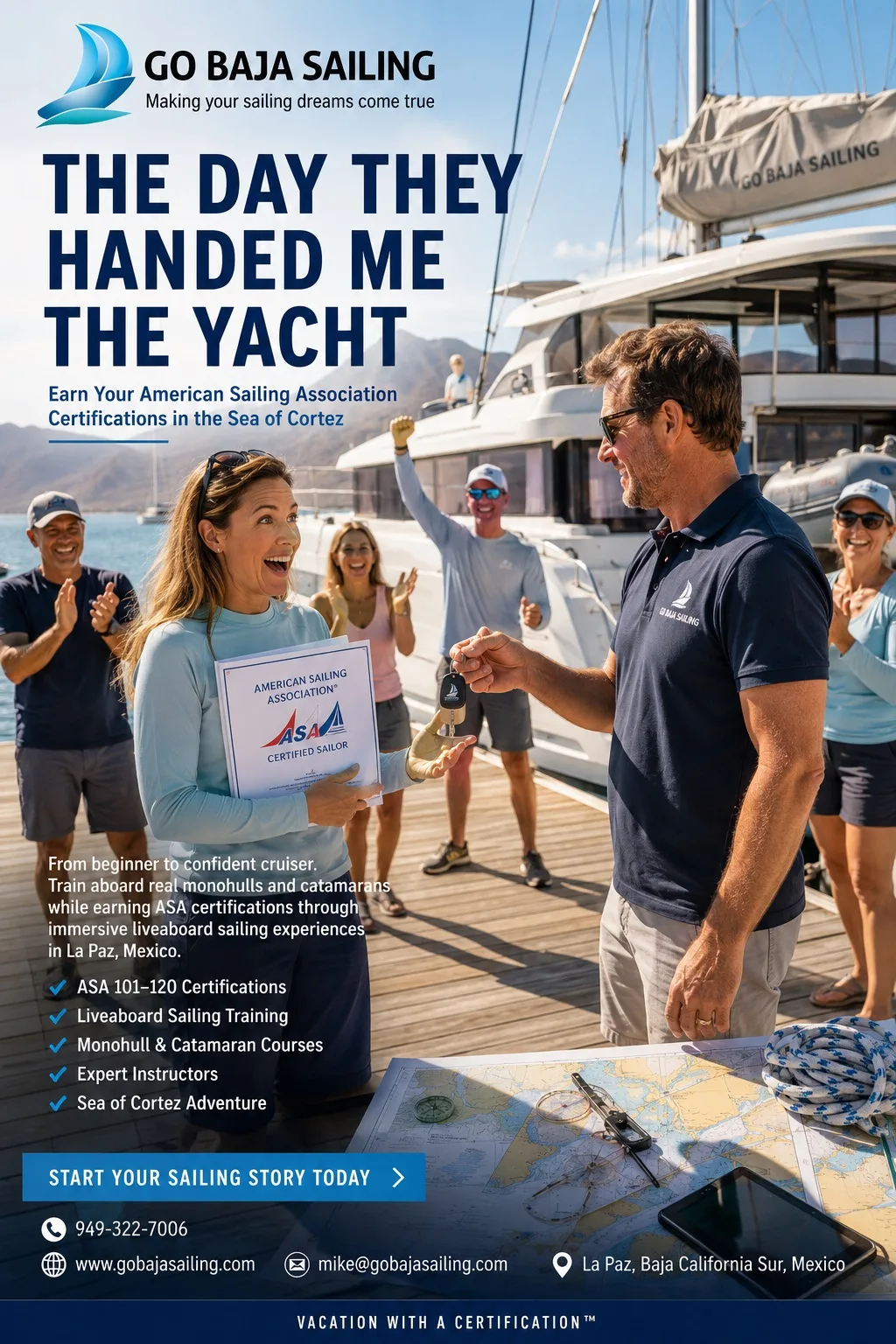
For students seeking an immersive experience in Baja, Go Baja Sailing offers ASA-oriented sailing education in the La Paz area, including liveaboard training options designed around practical instruction aboard cruising vessels.
Is a Sea of Cortez Sailing Academy Experience Worth It?
For aspiring sailors who learn best by doing, an immersive sailing academy experience can be a valuable way to connect theory with real boat operations. The greatest benefit is not simply completing a course; it is developing repeatable skills and better judgment that can continue to improve through independent sailing.
A strong course should leave students better prepared to understand their vessel, communicate with a crew, recognize changing conditions, and make conservative decisions when uncertainty arises.
For recreational sailors, that foundation can make future cruising more enjoyable. For aspiring charterers, it can provide an important step toward responsible independent boat handling.
Frequently Asked Questions
Is the Sea of Cortez good for learning to sail?
Yes. The Sea of Cortez provides a varied cruising environment where students can practice practical sailing, navigation, anchoring, and seamanship while experiencing Baja's coastal and island environments. Course suitability still depends on weather, instructor planning, vessel type, and the student's experience level.
Do I need previous sailing experience?
Not necessarily. Many introductory sailing courses are designed for beginners, while advanced programs require prior experience or certification. Always check the specific prerequisites before enrolling because course requirements differ between schools and certification levels.
Can I earn an ASA certification in Baja?
Yes, sailing schools operating as American Sailing Association-affiliated programs can offer applicable ASA courses and assessments. The exact certifications available depend on the school and instructor. Students should verify the current course list, prerequisites, and certification requirements before booking.
Is catamaran training different from monohull training?
Yes. Although fundamental sailing principles overlap, catamarans have different handling characteristics, including greater beam, twin engines, and different maneuvering behavior. Sailors planning to charter a catamaran should consider receiving practical training on a comparable multihull.
What is a liveaboard sailing course?
A liveaboard sailing course combines accommodation and instruction aboard the training vessel. Students spend multiple days living on the boat while practicing sailing, navigation, anchoring, safety procedures, and onboard routines. This format provides repeated practical exposure rather than isolated day lessons.
Can sailing school prepare me for a bareboat charter?
It can provide important preparation, but charter readiness depends on your actual skills, experience, certification, and the charter company's requirements. Sailors should be comfortable with navigation, docking, anchoring, boat systems, safety procedures, and decision-making before operating a charter vessel independently.
Is La Paz suitable for sailing instruction?
La Paz is an established cruising destination in Baja California Sur and provides access to the waters of the Sea of Cortez. Its location can support sailing instruction that combines practical boat handling with coastal and island cruising experiences.
What should I bring to a sailing course?
Bring lightweight clothing suitable for changing conditions, non-slip footwear appropriate for boats, sun protection, personal toiletries, medications if required, and a reusable water bottle. Avoid overpacking because storage space aboard cruising vessels is limited.
How long does it take to become a competent sailor?
There is no single timeframe. Basic skills can develop during an intensive course, but competence comes from repeated practice in different conditions. Certification provides structured training, while continued sailing builds judgment, confidence, and experience.
What is the biggest benefit of learning aboard a cruising sailboat?
The biggest advantage is context. Students learn how individual skills connect: navigation affects route planning, weather affects sail choices, anchoring affects overnight plans, and communication affects every maneuver. That integrated experience helps transform isolated lessons into practical seamanship.
Final Takeaway
A Sea of Cortez Sailing Academy experience is best understood as practical seamanship training rather than simply a vacation on a sailboat. The strongest programs combine structured instruction, qualified teaching, meaningful time at the helm, navigation practice, safety education, and exposure to real cruising routines.
Whether the goal is a first sailing certification, improved confidence, or eventual chartering, the most valuable investment is learning how to make sound decisions aboard the boat—not merely learning how to make the boat move.