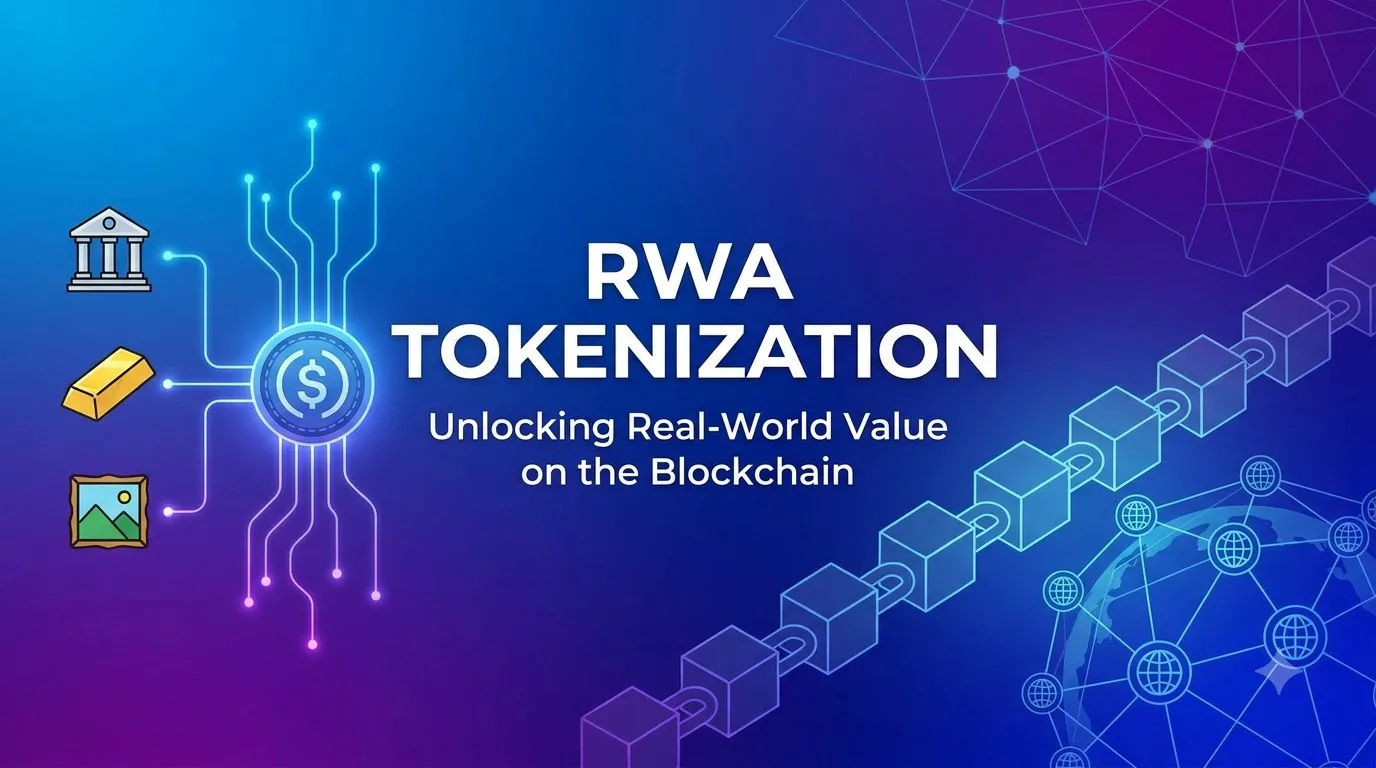
Real-world asset (RWA) tokenization is emerging as one of the most significant applications of blockchain technology beyond cryptocurrencies. It involves creating blockchain-based digital representations of assets such as real estate, private equity, bonds, commodities, invoices, funds, intellectual property, and other financial or physical assets. Instead of relying entirely on conventional databases, paper records, brokers, and centralized settlement systems, businesses can use blockchain networks to represent ownership rights and automate parts of the asset lifecycle through programmable tokens and smart contracts.
The market is moving from experimentation toward practical institutional adoption. CoinGecko reported that tokenized RWAs reached approximately $19.3 billion by the end of the first quarter of 2026, more than tripling from the beginning of 2025. Tokenized Treasuries remained the largest category, while commodities, tokenized stocks, and ETFs also expanded. McKinsey has separately estimated that tokenized financial assets could reach around $2 trillion in market capitalization by 2030 in its base case, excluding cryptocurrencies and stablecoins.
For businesses, however, RWA tokenization is not simply about putting an asset on a blockchain. Its real value comes from redesigning how assets are issued, financed, transferred, managed, and settled.
What Is RWA Tokenization for Businesses?
RWA tokenization converts rights associated with an underlying real-world asset into blockchain-based tokens. Depending on the legal and technical structure, a token may represent ownership, a claim on an asset, an economic interest, debt, revenue rights, or shares in a legal entity that owns the underlying asset.
For example, a property worth $10 million could potentially be placed into a legally structured investment vehicle and represented through a large number of digital tokens. Rather than requiring an investor to purchase the entire property or participate through a traditional fund structure, eligible investors could acquire fractional interests represented by tokens.
The blockchain itself does not automatically make someone the legal owner of an asset. The connection between the token and the underlying asset must be established through enforceable legal agreements, appropriate custody arrangements, identity verification, compliance procedures, and clearly defined ownership rights. This distinction is fundamental because successful RWA tokenization requires coordination between blockchain infrastructure and traditional legal and financial systems.
The Bank for International Settlements describes tokenization as the generation and recording of digital representations of traditional assets on programmable platforms. It highlights the potential for tokenization to reduce transaction costs and enable new financial arrangements, while also emphasizing the importance of governance, regulation, and risk management.
Why Businesses Are Exploring RWA Tokenization
The strongest business case for RWA tokenization comes from improving inefficient processes rather than simply introducing blockchain technology. Traditional asset markets often involve multiple intermediaries, fragmented records, restricted operating hours, lengthy settlement cycles, and significant administrative costs.
Tokenization can create a shared digital record of ownership and transactions while allowing smart contracts to automate predetermined actions. For example, a tokenized investment could automatically distribute income according to predefined rules, enforce transfer restrictions, or update ownership records after a compliant transaction.
This programmability can reduce manual intervention and create more efficient workflows. The BIS notes that tokenization can integrate information about an asset with rules governing transfers, making it possible to create more sophisticated economic arrangements.
Another major attraction is potentially broader access to investment opportunities. Fractionalization can reduce the minimum capital required for certain assets, although businesses must still comply with applicable securities, investment, tax, and financial regulations. Tokenization therefore does not eliminate regulatory requirements; instead, it provides a new technological infrastructure through which regulated asset ownership and distribution can potentially operate.
Key Benefits of RWA Tokenization for Businesses
Greater Liquidity
Many real-world assets are valuable but difficult to trade quickly. Commercial real estate, private company shares, infrastructure projects, and private credit investments can remain locked for long periods because traditional markets have limited buyers and complex transaction processes.
Tokenization can potentially create a more flexible secondary market by representing ownership interests digitally. A broader investor base and blockchain-based transfer infrastructure may make it easier to discover buyers and sellers, although actual liquidity depends on market demand, regulatory restrictions, exchange infrastructure, and the quality of the underlying asset.
Research published by the BIS on U.S. tokenized real estate markets found evidence that tokenization can help address liquidity gaps. The study observed increased trading activity following certain external shocks, while also noting that liquidity mechanisms such as buybacks can introduce additional insolvency risks.
Fractional Ownership
Tokenization can divide an asset into smaller economic interests. This is particularly relevant for commercial properties, private funds, artwork, infrastructure, commodities, and other high-value assets.
For businesses, fractionalization can expand the potential investor pool while enabling asset owners to raise capital without necessarily selling the entire underlying asset. For investors, it can provide access to asset classes that were historically difficult to access with smaller amounts of capital.
However, fractionalization should not be confused with guaranteed liquidity or unrestricted ownership. The legal rights attached to each token and the jurisdictions in which tokens can be offered remain critical.
Faster Settlement and Operational Efficiency
Traditional transactions can require several intermediaries, reconciliation processes, documentation checks, and settlement procedures. Blockchain-based systems can reduce some of this complexity by maintaining a synchronized transaction record and automating selected workflows.
Smart contracts can be programmed to handle actions such as dividend distributions, interest payments, vesting schedules, compliance checks, and transfer restrictions. This can reduce administrative workload and potentially lower operational costs.
Improved Transparency and Traceability
Blockchain transactions can provide a persistent and auditable record of token movements. For businesses managing large numbers of investors or assets, this can improve transaction traceability and simplify certain reporting and reconciliation activities.
Transparency is particularly valuable for assets where investors need regular information about ownership, distributions, or transaction history. Nevertheless, blockchain transparency does not automatically guarantee transparency about the underlying asset. Businesses still need reliable reporting, independent valuation, custody controls, and trusted data sources.
New Financing Opportunities
RWA tokenization can also create alternative approaches to raising capital. Businesses can potentially tokenize debt, invoices, receivables, real estate interests, investment funds, or other financial claims and distribute them to eligible investors.
This creates opportunities to connect traditional assets with digital capital markets. As tokenized assets become more interoperable with blockchain-based financial applications, they may also be used as collateral or integrated into broader financial ecosystems.
Major Business Use Cases for RWA Tokenization
Real Estate
Real estate is one of the most frequently discussed applications because properties are valuable, illiquid, and naturally suited to fractional ownership structures. Developers and property owners can potentially tokenize economic interests in residential, commercial, hospitality, or infrastructure assets.
Tokenized real estate can support fractional investment, automated income distribution, digital ownership records, and potentially more efficient secondary transactions.
Tokenized Funds and Treasuries
Financial institutions are increasingly experimenting with tokenized investment funds and government securities. A prominent example is BlackRock's USD Institutional Digital Liquidity Fund (BUIDL), tokenized by Securitize. The fund surpassed $1 billion in assets under management in March 2025 and provides qualified investors with on-chain access to U.S. dollar-denominated yield, daily dividends, and near-real-time transfers.
The example demonstrates how tokenization can move beyond theoretical applications and become part of institutional financial infrastructure.
Private Equity and Private Credit
Private-market investments traditionally involve long holding periods, extensive paperwork, and limited transferability. Tokenization can provide digital representations of fund interests or credit positions while embedding eligibility and transfer rules into the infrastructure.
For fund managers, this could streamline investor onboarding, ownership administration, and distribution processes.
Commodities
Gold and other commodities can also be represented through blockchain-based tokens. Tokenized commodities may provide digital transferability while being backed by identifiable physical reserves or contractual claims.
This model can potentially combine characteristics of traditional commodity ownership with blockchain-based settlement and transfer infrastructure.
Invoices and Receivables
Businesses frequently have capital tied up in unpaid invoices. Tokenization can potentially represent claims on receivables and connect them with investors seeking short-term yield.
This could create alternative financing channels for businesses while providing investors with exposure to real economic cash flows. The quality of the underlying receivables, however, remains essential to the risk profile.
Challenges Businesses Must Address
Despite its potential, RWA tokenization introduces complex challenges. Regulation is arguably the most important. Depending on the asset and jurisdiction, a token may fall under securities, investment, property, commodities, payments, or other financial regulations.
Businesses must therefore determine the legal nature of the token before designing its technical architecture. Know-your-customer and anti-money-laundering requirements, investor eligibility, transfer restrictions, taxation, custody, reporting, and securities compliance may all influence how the platform operates.
Another challenge is the connection between blockchain data and real-world information. A blockchain can record that a token was transferred, but it cannot independently determine whether a property is worth a particular amount or whether a physical commodity actually exists. Oracles, auditors, custodians, valuation providers, and legal entities may therefore become important parts of the broader ecosystem.
Cybersecurity is another critical consideration. Smart contract vulnerabilities, compromised administrative keys, incorrect permissions, oracle manipulation, and inadequate wallet security can expose tokenized assets to serious risks. Businesses should use security reviews, access controls, smart contract audits, monitoring systems, and carefully designed upgrade mechanisms.
Interoperability also remains important. Tokenized assets may exist across multiple blockchain networks, while investors and financial institutions may use different infrastructure. Securitize's work with interoperability infrastructure for tokenized funds illustrates the industry's movement toward multi-chain environments.
How Businesses Can Approach RWA Tokenization
A successful project should begin with the asset and business objective rather than the blockchain. The company should first determine what is being tokenized, what rights the token represents, who can purchase it, how ownership will be legally established, and how investors will exit.
The next stage involves selecting the appropriate legal structure, blockchain network, token standard, custody model, compliance framework, and smart contract architecture. After that, the platform can be developed around functions such as investor onboarding, KYC, token issuance, asset management, payments, reporting, transfers, and secondary-market integration.
Testing and auditing should occur before deployment. Once launched, the system also requires continuous monitoring because regulatory requirements, blockchain infrastructure, market conditions, and security threats can evolve over time.
For businesses seeking external expertise, working with an experienced RWA tokenization development company can help combine blockchain development with token architecture, smart contracts, compliance-oriented workflows, asset management systems, and investor-facing applications. Choosing an experienced RWA tokenization company should involve evaluating its technical capabilities, security practices, blockchain expertise, understanding of asset-specific requirements, and ability to support the platform after launch.
The Future of RWA Tokenization
The future of RWA tokenization is likely to be defined less by speculative crypto markets and more by the integration of blockchain with established financial infrastructure. McKinsey expects tokenized financial assets to potentially reach approximately $2 trillion by 2030 in its base case, while the current growth of tokenized Treasuries, funds, commodities, and other assets indicates that institutional adoption is already developing.
The most successful projects will probably be those that solve measurable business problems: reducing settlement friction, improving asset distribution, increasing transparency, enabling programmable financial products, or opening new channels for capital formation. Businesses should therefore view tokenization as an infrastructure transformation rather than simply a method for creating digital tokens.
Conclusion
RWA tokenization is creating a bridge between traditional assets and blockchain-based financial infrastructure, giving businesses new possibilities for fractional ownership, liquidity, automated asset management, transparent transactions, and alternative capital formation. At the same time, regulatory compliance, legal enforceability, cybersecurity, asset verification, interoperability, and investor protection must remain central to every implementation. As institutional adoption continues to grow, businesses that approach tokenization with a strong combination of legal planning, technical architecture, security, and market strategy can position themselves for the next phase of digital asset infrastructure. Blockchain App Factory provides the best RWA tokenization services, helping businesses build secure and scalable blockchain solutions designed around their asset, business model, and tokenization objectives.
FAQs
1. What is RWA tokenization?
RWA tokenization is the process of representing ownership or economic rights connected to real-world assets through blockchain-based digital tokens.
2. Which assets can businesses tokenize?
Businesses can tokenize real estate, bonds, funds, commodities, private equity, invoices, credit, infrastructure, and other assets where the legal structure supports tokenization.
3. Does RWA tokenization guarantee liquidity?
No. Tokenization can improve transferability and access to markets, but liquidity ultimately depends on investor demand, regulations, market infrastructure, and available buyers.
4. Is RWA tokenization regulated?
Yes, depending on the asset, token structure, and jurisdiction. Securities, AML/KYC, tax, custody, and other regulations may apply.
5. Why use blockchain for real-world assets?
Blockchain can provide programmable ownership records, transparent transaction histories, automated workflows, and potentially faster settlement and asset transfers.