
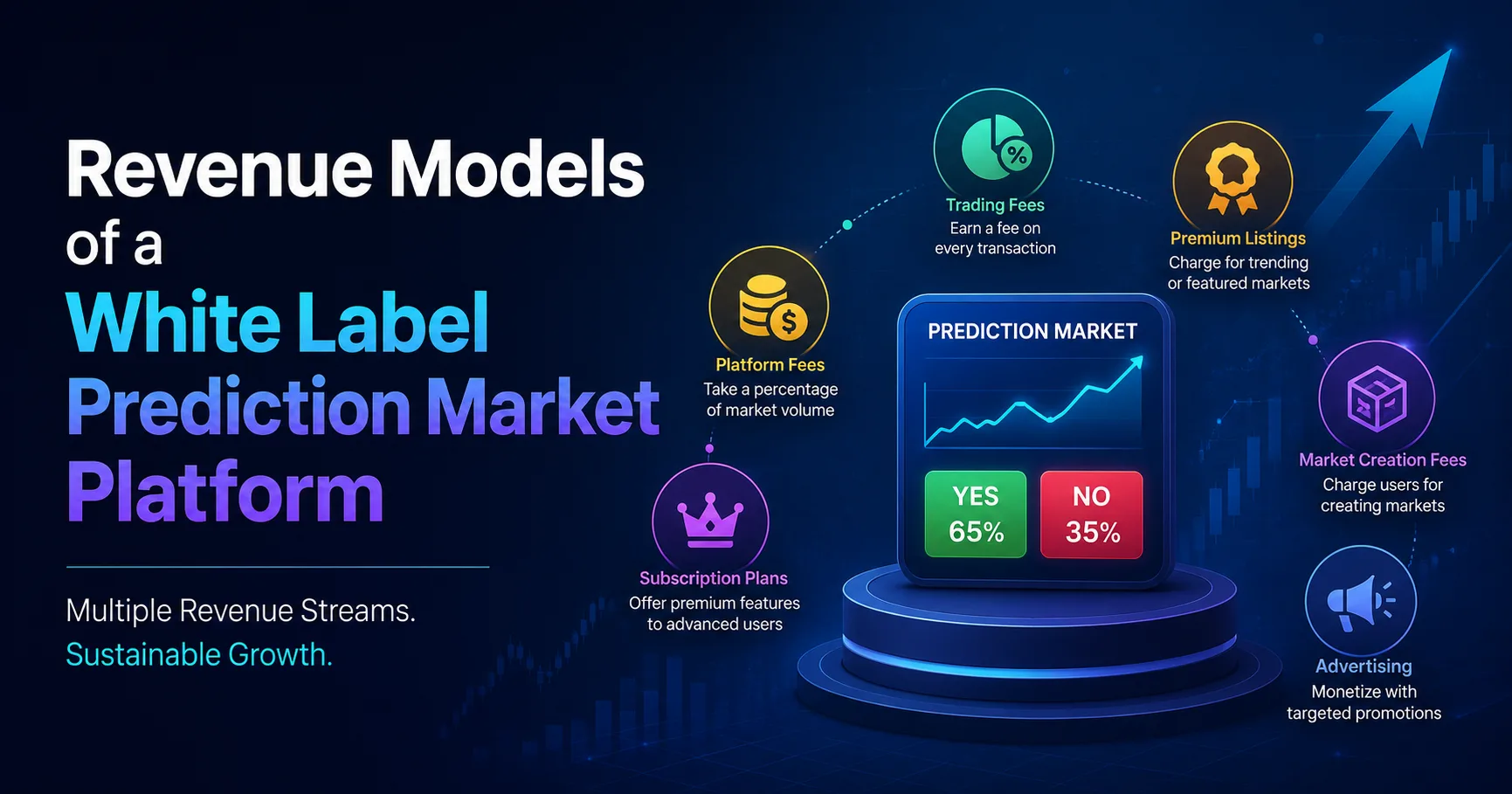
Prediction markets have gone from niche economics experiments to a genuine business category. Election forecasts, sports outcomes, crypto price bets, even award show predictions people want a place to back their opinions with real money. That demand is exactly why so many entrepreneurs now launch on a white label prediction market platform instead of spending a year building matching engines, wallets, and KYC flows from scratch. It cuts launch time down to weeks. But the real question every operator eventually asks is how does this thing actually make money?
Trading Fees Are the Backbone
The most reliable revenue stream is the trading fee. Every time someone buys or sells a position, the platform takes a small cut either as a flat percentage per trade, or baked into the spread between buy and sell prices, similar to how a bookmaker's odds already carry the house edge. Most operators running a white label prediction market lean toward the spread model, since it feels less like a visible tax on every click.
This stream thrives on volume rather than size.
A platform doesn't need a handful of whales placing huge bets; it needs a steady stream of smaller trades happening constantly. High-frequency, low-friction activity is what makes this revenue line compound over time.
Market Creation and Listing Fees
Many platforms let verified users or partner organizations create their own markets, charging a listing fee or a small deposit to do so. This also filters out spam questions that nobody actually wants to trade on. Some platforms go further and charge a premium for "featured" placement on the homepage or inside push notifications essentially advertising revenue dressed up as a listing fee, and it works especially well during high-attention moments like elections or major sports finals.
Subscriptions and Membership Tiers
Freemium is alive and well here too. The base experience stays free anyone can browse markets and place small trades but a paid tier unlocks higher trading limits, advanced analytics, early access to new markets, or reduced fees on larger positions.
This model appeals to serious traders who treat prediction markets almost like a research tool rather than a casual betting app. A monthly or annual subscription also gives the operator predictable recurring revenue that doesn't swing wildly with daily trading volume.
Liquidity Spreads
This one often gets overlooked by newcomers. Many prediction markets run on an automated market maker model rather than a traditional order book. Operators can earn revenue by taking a cut of liquidity provider rewards, or by nudging the pricing curve slightly in their own favor.
It's invisible to the average user, but it adds up quickly on high-volume markets like sports or crypto price predictions, and it sits quietly in the background of nearly every trade that touches the platform's liquidity pools.
Data and API Licensing
Prediction markets generate something genuinely valuable that most people overlook at first: forward-looking probability data built from real money rather than surveys or guesswork. Hedge funds, research firms, and journalists are often willing to pay for API access to this aggregated data.
Selling anonymized, aggregated market data as its own product is a smart way to diversify revenue without needing to grow the user base it just requires monetizing the users a platform already has.
Sponsorships
Once a platform builds real traffic, sponsorship deals become realistic. Brands and media companies have shown interest in sponsoring specific markets or categories, paying to have their name sit next to a trending market during a major event. This isn't usually the main revenue driver, but it's a solid supplementary layer during high-traffic periods.
Licensing the Platform Itself
It's worth mentioning the flip side too. Some businesses don't run a branded platform at all they build and resell the technology. A company with strong infrastructure might license its white label prediction market solution to other businesses, charging setup fees plus an ongoing licensing or revenue-share arrangement. Here, the "platform provider" role itself becomes the business model, one step removed from the end user.
The Real Takeaway
No single revenue stream carries a prediction market platform on its own. The strongest operators stack several together: trading fees for steady baseline income, subscriptions for predictability, data licensing for diversification, and sponsorships as a bonus during big events.
The businesses that struggle are usually the ones that pick one model, assume it scales on its own, and never revisit pricing as their user base matures. A well-run white label prediction market platform treats its revenue model the same way it treats its markets something to test, adjust, and optimize continuously rather than set once and forget.
If you're weighing whether to launch one, the real homework isn't picking a flashy niche. It's figuring out which two or three of these revenue streams actually fit your audience, and building the user experience so those streams feel natural rather than forced.