Healthcare is no longer confined to hospitals, clinics, or physician offices. Today, patients expect to consult doctors from home, share health data through connected devices, receive medication reminders on mobile phones, and communicate securely with care teams regardless of location. At the same time, providers are under increasing pressure to improve outcomes while managing growing patient populations, clinician shortages, and rising healthcare costs. These changes have made remote care one of the fastest-growing areas of digital health.
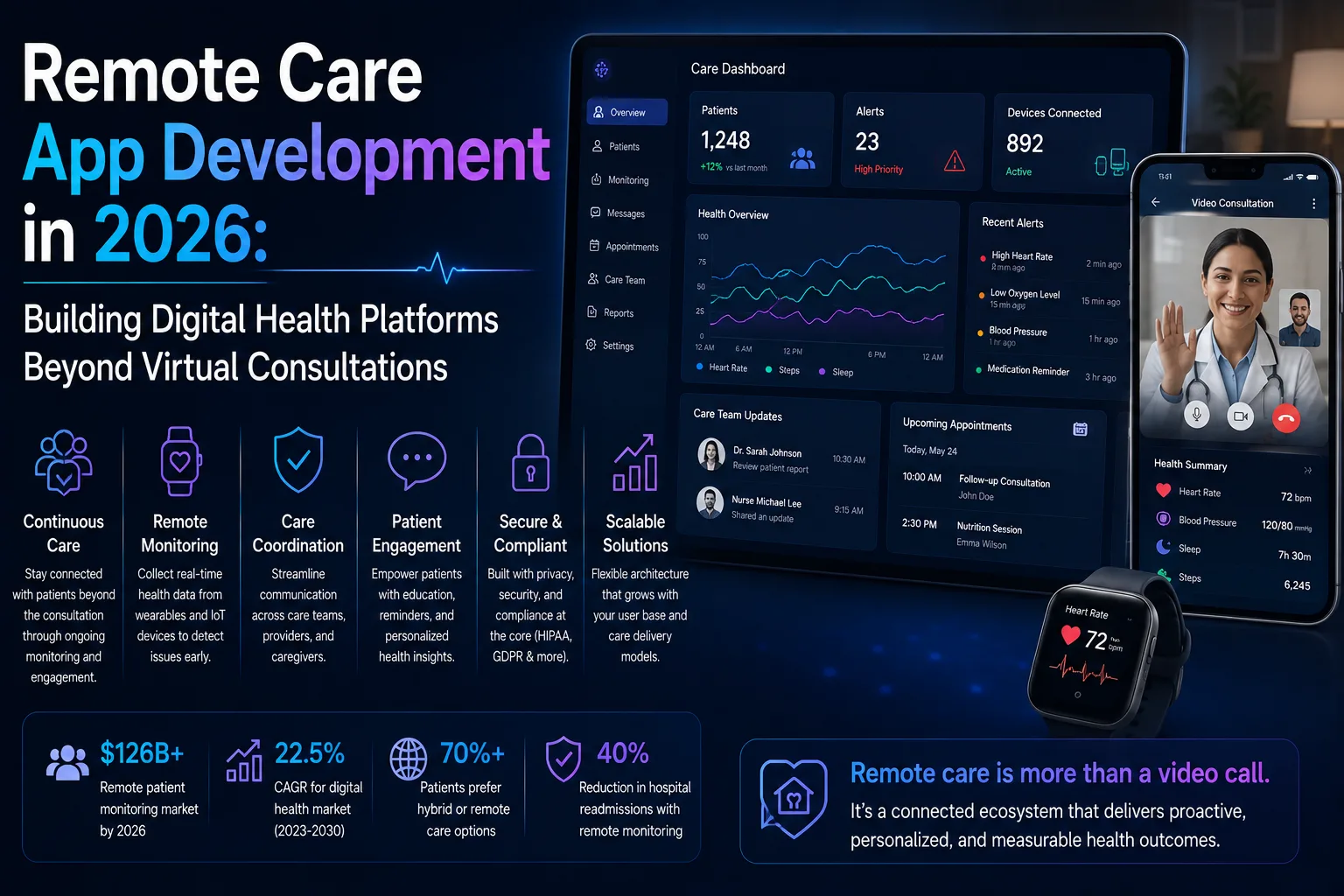
As a result, Remote Care App Development has evolved from building simple telemedicine applications into creating comprehensive care delivery platforms. Modern remote care solutions combine virtual consultations, remote patient monitoring (RPM), wearable device integration, secure messaging, electronic health record (EHR) connectivity, AI-assisted clinical support, patient engagement, and analytics into one connected ecosystem. Instead of replacing traditional healthcare, these platforms extend clinical services beyond hospital walls, allowing providers to monitor patients continuously while reducing unnecessary in-person visits.
Developing this type of software requires expertise across healthcare regulations, interoperability standards, cloud infrastructure, mobile engineering, cybersecurity, connected medical devices, and artificial intelligence. Every technical decision directly affects patient safety, clinician efficiency, regulatory compliance, and long-term scalability.
This guide explores what modern Remote Care App Development involves, the technologies behind successful platforms, the capabilities organizations should prioritize, and the companies helping healthcare providers build the next generation of connected care solutions.
Why Remote Care Is Becoming a Core Healthcare Service
For many years, remote healthcare was viewed primarily as a convenience. Virtual consultations were often reserved for follow-up appointments or patients living in rural areas. That perception has changed significantly.
Healthcare providers now recognize that many aspects of patient care can be delivered safely and effectively outside traditional clinical environments. Patients with chronic diseases can transmit vital signs daily through connected devices. Post-surgical recovery can be monitored remotely. Mental health consultations can be conducted through secure video platforms. Elderly patients can receive continuous support without frequent hospital visits.
This transition offers benefits for both patients and healthcare organizations. Patients spend less time traveling, clinicians gain greater visibility into long-term health trends, and providers can prioritize hospital resources for individuals requiring immediate in-person care.
Modern Remote Care App Development therefore focuses on enabling continuous relationships between patients and providers rather than simply replacing face-to-face consultations with video calls.
What Modern Remote Care App Development Actually Includes
Successful remote care platforms consist of multiple integrated systems working together to support the complete patient journey.
Virtual Consultations
Video consultations remain one of the most recognizable features of remote healthcare, but modern consultation platforms extend beyond video conferencing. Providers increasingly require appointment scheduling, virtual waiting rooms, secure messaging, prescription management, consultation summaries, digital consent, and integrated documentation that automatically synchronizes with Electronic Health Records.
Instead of functioning as standalone communication tools, consultation modules operate as part of broader clinical workflows that support continuity of care.
Remote Patient Monitoring
Remote Patient Monitoring (RPM) has become one of the most valuable components of Remote Care App Development. Connected devices continuously collect physiological information that helps clinicians monitor patients outside clinical settings.
Typical integrations include:
- Blood pressure monitors
- Blood glucose meters
- ECG devices
- Pulse oximeters
- Weight scales
- Smartwatches
- Activity trackers
- Sleep monitoring devices
The objective is not simply collecting health data. Effective platforms organize patient information into actionable insights, allowing clinicians to identify deterioration early and intervene before complications require hospitalization.
Patient Engagement
Remote care only succeeds when patients actively participate in their treatment plans. Strong engagement features encourage long-term adherence through medication reminders, appointment notifications, educational resources, personalized health plans, secure messaging, symptom tracking, and progress visualization.
Rather than serving as passive record-keeping systems, modern applications encourage continuous interaction between patients and care teams, helping improve adherence throughout extended treatment programs.
Care Team Collaboration
Healthcare rarely involves a single clinician. Physicians, nurses, specialists, therapists, pharmacists, caregivers, and administrative staff often participate throughout the patient journey.
Modern remote care platforms therefore include role-based dashboards, task management, secure communication, shared patient records, referral workflows, and collaborative care planning that keeps every stakeholder informed while protecting sensitive patient information.
AI-Assisted Clinical Support
Artificial intelligence is increasingly assisting healthcare professionals rather than replacing them. AI can summarize consultations, identify abnormal patient trends, prioritize high-risk patients, automate documentation, detect changes in remote monitoring data, and help clinicians navigate growing volumes of health information.
These capabilities reduce administrative workload while allowing healthcare professionals to spend more time delivering care instead of managing documentation.
The Architecture Behind a Successful Remote Care Platform
One of the biggest misconceptions about Remote Care App Development is that it revolves around building a mobile application. In reality, the patient-facing app represents only one layer of a much larger healthcare ecosystem. Behind every virtual consultation or health notification is an interconnected infrastructure responsible for processing clinical data, managing user permissions, communicating with medical devices, integrating with hospital systems, and ensuring regulatory compliance.
Organizations planning remote care solutions should think in terms of platform architecture rather than individual features.
Patient Application Layer
The patient application serves as the primary touchpoint between individuals and healthcare providers. It enables users to schedule appointments, join virtual consultations, upload health records, receive medication reminders, monitor treatment progress, communicate with clinicians, and review personalized care plans.
The best patient applications prioritize accessibility. Large navigation elements, multilingual interfaces, voice support, simplified onboarding, and intuitive dashboards become especially important for elderly patients and individuals managing chronic conditions.
Rather than overwhelming users with clinical information, successful applications surface the most relevant actions at the appropriate time, making healthcare interactions feel simple and predictable.
Clinician Dashboard
Healthcare professionals require considerably more functionality than patients. Clinician dashboards aggregate patient histories, consultation schedules, laboratory results, remote monitoring alerts, prescriptions, care plans, and communication channels into one interface.
Instead of reviewing information across multiple disconnected systems, clinicians can access consolidated patient timelines that provide context before, during, and after consultations. Intelligent prioritization also helps providers identify patients who require immediate attention based on changes in vital signs or treatment adherence.
An effective dashboard reduces administrative burden while improving clinical decision-making.
Integration Layer
Healthcare organizations rarely operate with a single software platform. Patient information continuously moves between Electronic Health Records, Laboratory Information Systems (LIS), Picture Archiving and Communication Systems (PACS), pharmacy software, billing applications, scheduling systems, and insurance platforms.
A dedicated integration layer enables these systems to exchange information securely using standards such as HL7 and FHIR. This prevents duplicate records, minimizes manual data entry, and ensures clinicians always have access to current patient information regardless of where it originated.
Strong interoperability remains one of the defining characteristics of successful Remote Care App Development because disconnected systems frequently create delays in clinical workflows and increase the likelihood of incomplete patient records.
Connected Device Layer
Remote healthcare increasingly depends on continuous patient monitoring rather than episodic consultations. Connected medical devices transmit health information directly to healthcare providers, enabling earlier intervention when physiological changes occur.
Typical device integrations include:
- ECG monitors
- Continuous glucose monitors
- Blood pressure devices
- Pulse oximeters
- Digital thermometers
- Weight scales
- Spirometers
- Smartwatches
- Activity trackers
Instead of treating these devices as isolated data sources, modern platforms organize measurements into longitudinal health records that clinicians can interpret over weeks or months.
Security and Compliance Layer
Every component within a remote care platform handles sensitive health information. Security therefore cannot be limited to login authentication alone.
Enterprise healthcare platforms typically include:
- End-to-end encryption
- Multi-factor authentication
- Role-based permissions
- Consent management
- Immutable audit logs
- Secure cloud infrastructure
- Continuous threat monitoring
- Automated backups
- Disaster recovery planning
Building security into platform architecture from the earliest stages significantly reduces operational risk while supporting long-term regulatory compliance.
Technologies Driving Remote Care App Development
Healthcare technology continues evolving rapidly, and modern remote care platforms increasingly combine several emerging technologies instead of relying solely on mobile applications.
Artificial Intelligence
Artificial intelligence is helping clinicians manage growing patient populations more efficiently by analyzing remote monitoring data, summarizing consultations, supporting documentation, identifying patients at elevated risk, and detecting subtle health trends that may otherwise remain unnoticed.
Importantly, AI functions as clinical decision support rather than autonomous diagnosis. Healthcare professionals remain responsible for treatment decisions while intelligent systems reduce repetitive administrative work and highlight information requiring immediate attention.
Internet of Medical Things (IoMT)
The Internet of Medical Things has become central to remote patient monitoring. Connected medical devices provide continuous visibility into patient health outside hospitals, allowing providers to intervene proactively instead of waiting for scheduled appointments.
As device accuracy continues improving, remote care platforms increasingly support preventative care rather than simply managing existing conditions.
Cloud Computing
Healthcare organizations require infrastructure capable of supporting growing patient populations, expanding clinical services, and continuous device connectivity.
Cloud-native architecture enables healthcare platforms to scale efficiently while maintaining high availability, disaster recovery, and secure data synchronization across geographically distributed care teams.
It also simplifies future expansion as organizations introduce additional specialties, connected devices, or AI capabilities.
Predictive Analytics
Rather than reporting what has already happened, predictive analytics attempts to identify patients who may require intervention before symptoms become severe.
By analyzing historical health records, remote monitoring data, medication adherence, appointment history, and behavioral trends, predictive models help clinicians prioritize preventive care and allocate resources more effectively.
As value-based healthcare continues expanding, predictive analytics is expected to become an increasingly important component of Remote Care App Development.
Companies Building the Future of Remote Care
Healthcare organizations evaluating development partners often discover that software companies specialize in different aspects of digital health. Some focus on enterprise hospital systems, while others concentrate on patient engagement, connected medical devices, artificial intelligence, or startup healthcare products.
Idea Usher
Organizations planning comprehensive remote care ecosystems often require expertise spanning multiple technologies rather than mobile development alone.
Idea Usher develops healthcare platforms that combine telemedicine, remote patient monitoring, wearable integration, artificial intelligence, clinician dashboards, cloud infrastructure, and healthcare interoperability into unified ecosystems. This multidisciplinary engineering approach enables healthcare providers to expand digital services over time without rebuilding core platform architecture.
Intellivon
Healthcare providers introducing remote care frequently prioritize integration above new feature development.
Intellivon specializes in connecting remote care applications with Electronic Health Records, hospital information systems, scheduling software, laboratory platforms, billing infrastructure, and other enterprise healthcare systems. Its expertise in HL7, FHIR, and healthcare APIs helps organizations introduce digital care while preserving existing operational workflows.
ScienceSoft
Large healthcare organizations often require enterprise-scale platforms capable of supporting multiple facilities, clinical departments, and thousands of healthcare professionals.
ScienceSoft develops healthcare software focused on interoperability, workflow automation, patient portals, clinician workspaces, telemedicine, and secure healthcare infrastructure, making it a strong option for providers undertaking organization-wide digital transformation.
Yalantis
Connected medical devices have become central to chronic disease management and preventive care.
Yalantis has developed considerable expertise integrating wearable technology, IoMT devices, cloud infrastructure, healthcare analytics, and remote monitoring platforms that transform continuous patient data into actionable clinical insights.
LeewayHertz
Artificial intelligence continues expanding across digital health, creating opportunities for smarter patient monitoring, clinical documentation, predictive care, and operational automation.
LeewayHertz focuses on enterprise AI solutions that combine machine learning, predictive analytics, computer vision, and intelligent automation with healthcare software, helping organizations incorporate advanced AI capabilities into remote care platforms responsibly and securely.
Common Challenges in Remote Care App Development
Building a successful remote care platform involves much more than developing healthcare features. Organizations must solve technical, clinical, regulatory, and operational challenges simultaneously. Understanding these challenges early allows healthcare providers to make better architectural decisions and avoid costly redesigns later in the product lifecycle.
Maintaining Consistent Patient Engagement
Launching a remote care application is only the beginning. The real challenge is encouraging patients to continue using it throughout their treatment journey. Many healthcare apps experience declining engagement after the initial consultation because patients struggle to see ongoing value.
Successful platforms address this by incorporating personalized medication reminders, progress tracking, educational content, secure messaging, appointment notifications, wellness goals, and simplified communication with care teams. These features transform the application into an active participant in patient care rather than a tool used only during appointments.
Managing Continuous Health Data
Remote patient monitoring devices can generate thousands of data points every day. Blood pressure readings, glucose measurements, heart rate variability, sleep quality, physical activity, oxygen saturation, and weight changes all contribute valuable clinical information.
Without proper data management, clinicians quickly experience alert fatigue. Modern Remote Care App Development therefore focuses on intelligent filtering rather than displaying every measurement. Trend analysis, configurable thresholds, AI-assisted prioritization, and personalized alert rules help healthcare professionals concentrate on patients requiring immediate intervention.
Balancing Security With Accessibility
Healthcare applications must remain secure without becoming difficult to use. Patients may include elderly individuals, children, or people with limited technical knowledge, making complicated authentication procedures impractical in many situations.
Development teams must balance strong encryption, multi-factor authentication, role-based permissions, biometric login, and secure session management with user experiences that remain simple and accessible. The best platforms protect sensitive health information while minimizing friction during everyday use.
Supporting Multiple Care Models
Remote healthcare is not limited to one specialty. Primary care, cardiology, endocrinology, behavioral health, rehabilitation, oncology, home healthcare, and post-operative recovery all require different workflows.
Rather than building rigid applications around one service, experienced engineering teams develop configurable platforms that allow healthcare organizations to introduce new specialties, patient pathways, and clinical services without rebuilding core infrastructure.
Regulatory Compliance Across Regions
Healthcare regulations differ significantly across countries and even between regions. Organizations serving multiple markets often need to comply with HIPAA, GDPR, local health information privacy laws, medical device regulations, accessibility requirements, and payer-specific documentation standards.
This makes compliance an ongoing engineering responsibility rather than a one-time implementation task. Remote care platforms should therefore be designed with configurable policies, comprehensive audit trails, secure data governance, and flexible consent management that can adapt as regulatory expectations evolve.
How to Choose the Right Remote Care App Development Partner
Choosing a company for Remote Care App Development should begin with healthcare expertise rather than general software experience. A development team may build excellent consumer applications yet have limited understanding of clinical workflows, healthcare interoperability, or patient safety requirements.
During vendor evaluations, consider the following areas carefully.
Healthcare Domain Knowledge
The strongest partners understand how care is actually delivered. They recognize the needs of clinicians, nurses, administrators, patients, and caregivers, enabling them to design software that fits naturally into everyday healthcare operations rather than disrupting established workflows.
Technical Capabilities
Evaluate whether the company has demonstrated experience with:
- Telemedicine platforms
- Remote patient monitoring
- HL7 and FHIR interoperability
- EHR and EMR integration
- Wearable device connectivity
- AI-powered healthcare
- Cloud-native healthcare infrastructure
- Enterprise cybersecurity
Technical breadth often becomes increasingly valuable as remote care platforms expand over time.
Product Scalability
Healthcare technology rarely remains static after launch. Organizations frequently introduce new specialties, patient populations, connected devices, reimbursement models, and clinical services.
Partners that build modular architectures enable healthcare providers to evolve their platforms incrementally instead of undertaking expensive redevelopment projects every few years.
Long-Term Support
Launching a healthcare application marks the beginning rather than the end of product development. Continuous security updates, operating system changes, interoperability improvements, AI enhancements, regulatory updates, and feature expansion all require ongoing engineering support.
Development companies with long-term healthcare experience generally offer structured product evolution strategies instead of limiting their involvement to initial implementation.
Final Thoughts
Healthcare delivery is becoming increasingly connected, proactive, and patient-centered. Rather than interacting with providers only during scheduled appointments, patients now participate in continuous care journeys supported by mobile applications, connected medical devices, artificial intelligence, secure communication, and real-time clinical insights. This transformation is fundamentally changing how healthcare organizations deliver services beyond traditional clinical environments.
As a result, Remote Care App Development has become one of the most important areas of digital health innovation. Building successful platforms requires expertise that extends far beyond mobile development. Organizations must combine healthcare interoperability, cloud infrastructure, cybersecurity, AI, remote monitoring, patient engagement, and regulatory compliance into scalable ecosystems capable of supporting evolving models of care.
The companies highlighted throughout this guide demonstrate different strengths across this rapidly expanding market. Some specialize in enterprise healthcare integration, others excel in connected medical devices, AI-driven healthcare, patient engagement, or digital health transformation. Understanding these differences helps healthcare providers, hospitals, startups, insurers, and health technology companies select development partners whose capabilities align with both immediate project requirements and long-term strategic goals.
Ultimately, the most successful remote care platforms are those that strengthen the relationship between patients and healthcare providers. Technology should reduce barriers to care, simplify clinical workflows, improve access to timely health information, and support better outcomes across the entire continuum of care. Organizations that invest in flexible, interoperable, and patient-focused remote care platforms today will be better positioned to meet the healthcare demands of tomorrow.