
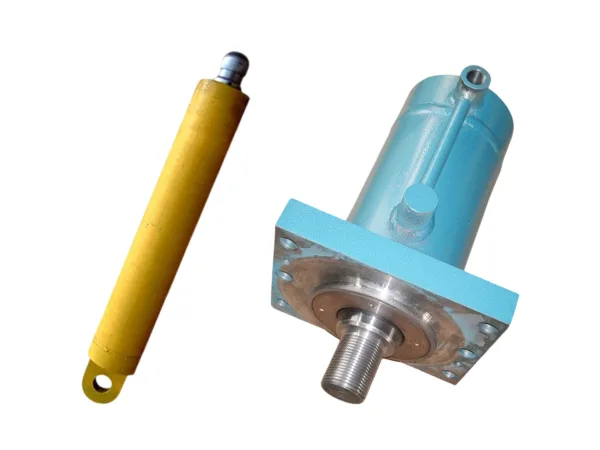
Pneumatic cylinders are among the most widely used actuators in modern industrial automation. Powered by compressed air, these reliable and cost-effective devices convert pneumatic energy into controlled linear or rotary motion, driving countless manufacturing processes from simple clamping operations to complex multi-axis assembly systems. With operating speeds that exceed hydraulic alternatives and a simplicity that enables millions of maintenance-free cycles, pneumatic cylinders are the workhorses of factory automation.
Wuxi Xinluo Hydraulic manufactures pneumatic cylinder components including precision tubes, piston rods, and complete cylinder assemblies for customers worldwide. This comprehensive guide covers pneumatic cylinder fundamentals, types, technical comparisons, and selection criteria to help you optimize your automation system design.
What Is a Pneumatic Cylinder?
A pneumatic cylinder is a mechanical device that uses compressed air to produce linear force and motion in a reciprocating pattern. The basic construction consists of a cylindrical barrel (typically made from aluminum alloy or stainless steel), a piston with seals that divides the barrel into two chambers, and a piston rod that extends through one end of the cylinder to transmit force to the load.
When compressed air — typically at pressures between 1 and 10 bar (15–150 PSI) — is directed into one chamber through a control valve, it pushes the piston toward the opposite end of the cylinder. Simultaneously, air in the other chamber exhausts to atmosphere through the valve. Reversing the air flow reverses the piston direction. This simple operating principle, combined with the ready availability of compressed air in industrial facilities, makes pneumatic cylinders one of the most practical and economical actuation solutions available.
Unlike hydraulic cylinders that use incompressible fluid, pneumatic cylinders operate with a compressible medium (air). This fundamental difference creates distinct performance characteristics: pneumatic systems offer higher speeds and simpler control but lower forces and less precise position control compared to hydraulic systems. Understanding these characteristics is essential for selecting the right actuator technology for each application.
The Role of Compressed Air
Compressed air is often called the "fourth utility" in industrial environments, after electricity, water, and natural gas. Central air compressor systems generate clean, dry compressed air that is distributed through piping networks to every machine in a facility. Pneumatic cylinders tap into this infrastructure, requiring only control valves and tubing to create a complete actuation system. This eliminates the need for dedicated hydraulic power units, fluid reservoirs, return lines, and the associated maintenance of hydraulic systems.
Key Features and Technical SpecificationsPneumatic cylinders are available in an enormous range of sizes, styles, and configurations to meet virtually any automation requirement. Understanding the key technical specifications enables proper cylinder selection and system optimization.
Force and Speed Characteristics
The theoretical force output of a pneumatic cylinder is calculated as: Force = Pressure × Piston Area. For example, a 50 mm bore cylinder at 6 bar produces approximately 1,178 N (about 120 kgf) of theoretical force. In practice, actual output force is reduced by friction losses (typically 10–20% depending on seal type and operating conditions).
Pneumatic cylinder speeds typically range from 50 mm/s to 2,000 mm/s, with some high-speed applications reaching 5,000 mm/s or more. Speed is controlled by restricting exhaust air flow using speed control valves (meter-out circuits are standard for stable motion control). The compressibility of air enables smooth, cushioned motion but also creates challenges for precise intermediate position control.
Bore Sizes and Stroke Lengths
Standard pneumatic cylinders are manufactured in bore sizes from 4 mm (miniature cylinders) to 320 mm (large industrial cylinders). The most common sizes in factory automation are 16 mm, 20 mm, 25 mm, 32 mm, 40 mm, 50 mm, 63 mm, 80 mm, and 100 mm. Stroke lengths are available from 1 mm to several meters, with custom strokes available from manufacturers like Wuxi Xinluo Hydraulic.
ISO Standards and Interchangeability
The global pneumatic cylinder market is standardized through several key ISO specifications:
ISO 6431 — Tie-rod cylinders with profiled barrels (the most common industrial standard); bore sizes 32–320 mm
ISO 15552 — Replaced ISO 6431 with updated dimensions and performance requirements
ISO 6432 — Miniature round-body cylinders; bore sizes 8–25 mm
ISO 21287 — Compact cylinders without tie rods; bore sizes 8–100 mm
These standards define mounting dimensions, port sizes, and performance parameters, ensuring cylinders from different manufacturers are mechanically interchangeable. Wuxi Xinluo Hydraulic manufactures cylinders and components that conform to these international standards.
Sealing Technology
Modern pneumatic cylinder seals are typically made from nitrile rubber (NBR) for standard applications, polyurethane (PU) for improved wear resistance, or fluorocarbon (FKM) for high-temperature or chemical-resistant applications. Seal design has evolved significantly, with low-friction "soft seal" designs reducing breakaway forces to less than 10% of theoretical cylinder force, enabling smoother motion and more precise control.
Manufacturing Process and Quality ControlManufacturing high-quality pneumatic cylinders requires precision production processes and rigorous quality control at every stage.
Barrel Production
Aluminum cylinder tubes are the standard barrel material for most pneumatic cylinders. The tubes are precision extruded or drawn, then honed internally to achieve the required surface finish (Ra 0.2–0.6 μm). For stainless steel cylinders used in food, pharmaceutical, or washdown environments, stainless steel tubes (typically 304 or 316 grade) are machined to specification.
Piston and Rod Assembly
Pistons are machined from aluminum, steel, or engineering plastics depending on the application. Seal grooves are precision-machined to exact dimensions to ensure proper seal function. Piston rods are manufactured from hardened and chrome-plated steel (for standard cylinders) or stainless steel (for corrosion-resistant applications). The rod-to-piston connection must be robust enough to transmit the full cylinder force while maintaining precise alignment.
End Cap and Bearing Design
End caps (also called heads and caps) are manufactured from aluminum die castings, machined aluminum, or steel forgings. They incorporate rod bearings (typically sintered bronze or engineered plastic bearings) that support the piston rod during extension and retract while allowing free linear motion. The bearing design directly affects rod side-loading capability and cylinder service life.
Testing and Quality Assurance
Wuxi Xinluo Hydraulic performs 100% testing on every pneumatic cylinder produced, including pressure testing at 1.5× maximum working pressure, leak testing (both internal and external leakage), functional cycling tests, and dimensional inspection. Statistical process control methods are applied during production to maintain consistent quality across production volumes.
Applications and Industry Use CasesPneumatic cylinders are used in virtually every manufacturing industry, from microelectronics assembly to heavy automotive production. Their versatility, speed, and cost-effectiveness make them the default actuation choice for most automation applications.
Factory Automation and Assembly
The single largest application area for pneumatic cylinders is factory automation. Assembly stations use pneumatic cylinders for part feeding, orientation, insertion, pressing, riveting, and screwdriving operations. Pick-and-place systems employ multiple cylinders to move components between workstations with cycle times measured in seconds. The simplicity and reliability of pneumatic cylinders enable 24/7 production with minimal maintenance.
Packaging and Processing
Food packaging, beverage filling, pharmaceutical tablet pressing, and cosmetic product assembly all rely heavily on pneumatic cylinder technology. In these industries, stainless steel or specially coated cylinders meet hygienic requirements while providing the speed and flexibility that modern packaging lines demand. IP67-rated cylinders withstand frequent washdown with cleaning chemicals and high-pressure water.
Material Handling
Conveyor diverters, part clamps, lifting devices, and indexing mechanisms in material handling systems use pneumatic cylinders for their fast response and clean operation. Vacuum generators powered by compressed air create suction for gripping and moving flat or smooth-surfaced objects, complementing pneumatic cylinder actuation in pick-and-place systems.
Robotics and End-of-Arm Tooling
While electric servos dominate robot joint actuation, pneumatic cylinders remain the preferred choice for end-of-arm tooling (EOAT). Grippers, suction cup arrays, welding gun clamps, and deburring tools all leverage pneumatic cylinders for their lightweight, high-speed characteristics. The low mass of pneumatic tooling reduces the load on robot arms, enabling faster movements and smaller robot selections.
Process Control Valves
Pneumatic actuators using cylinder technology control valves in process industries including chemical processing, water treatment, oil and gas, and power generation. Spring-return (single-acting) pneumatic actuators provide fail-safe valve positioning — critical for safety systems that must default to a known state during power loss.