
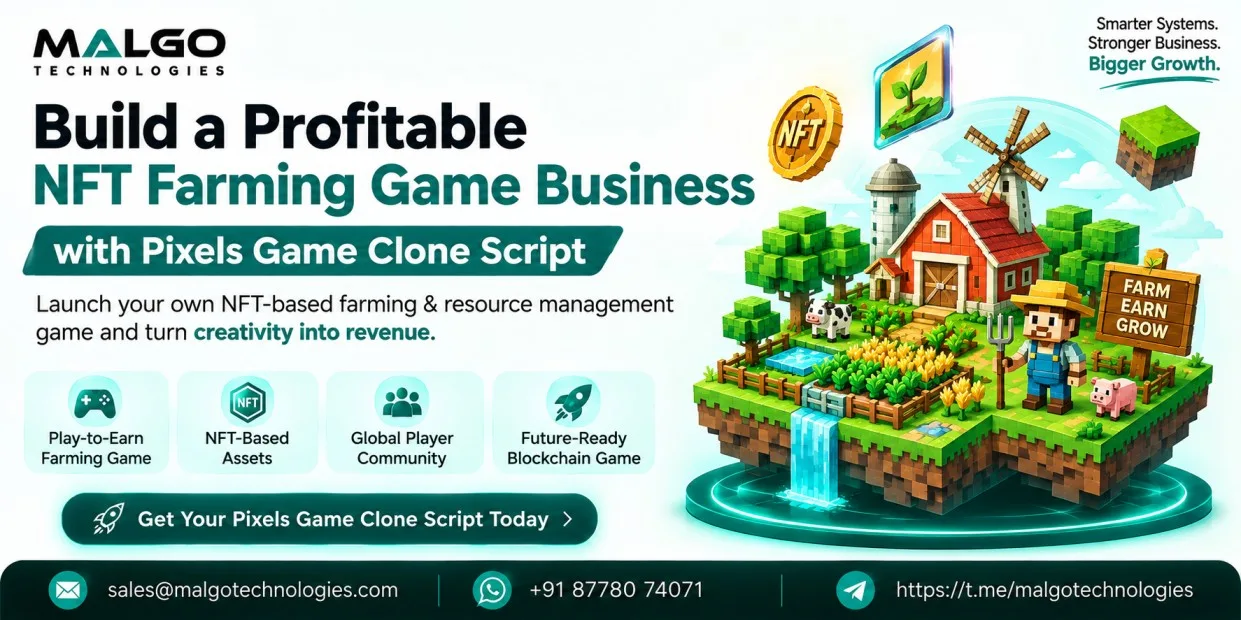
Blockchain gaming is moving beyond simple digital collectibles. Players increasingly expect interactive worlds where gameplay, digital ownership, social experiences, and in-game economies work together. Farming games are particularly well suited to this model because they naturally create repeat activities such as planting, harvesting, crafting, upgrading, trading, and exploring.
A Pixels Clone Script provides a ready-made foundation for entrepreneurs who want to develop a farming-focused P2E gaming platform inspired by the mechanics of successful blockchain games. With the right customization, it can become the starting point for an original gaming ecosystem rather than a direct copy of an existing title.
What Is a Pixels Clone Script?
A Pixels Clone Script is a customizable gaming solution designed around farming, social interaction, digital assets, and blockchain-enabled gameplay.
Instead of developing every component from the ground up, businesses can use a prebuilt framework and customize major elements such as:
- Farming mechanics
- NFT assets
- Land and resource systems
- Player progression
- Quest structures
- Marketplace functionality
- Token utilities
- Game interface
- Characters and artwork
- Social and community features
The important distinction is that a professional clone development strategy should create an original product. Existing game names, artwork, characters, branding, proprietary code, and other protected assets should not simply be duplicated.
Why Build a Farming-Based P2E Game?
Farming gameplay offers a strong foundation for long-term engagement because it creates repeatable actions and progression.
A player might begin by managing a small plot, collecting basic resources, and completing introductory quests. As gameplay progresses, the player can unlock new crops, equipment, land, crafting options, and social activities.
Blockchain technology can add another layer by allowing selected digital assets to have verifiable ownership.
This combination creates a gameplay cycle such as:
Farm → Harvest → Craft → Upgrade → Complete Quests → Earn Rewards → Expand
The objective should be to make the gameplay loop enjoyable even without focusing entirely on financial incentives.
Core Features of a Pixels-Inspired Farming Platform
NFT Land Ownership
Land can become one of the most important digital assets in the ecosystem.
Different plots can have different characteristics, resources, environments, or customization opportunities. Developers can also introduce progression systems that allow players to improve their land through gameplay.
NFT Farming Assets
NFTs can represent useful in-game items such as tools, equipment, decorations, special resources, or collectibles.
The best NFT systems give assets a clear purpose instead of creating digital items simply for speculation.
Farming & Harvesting
The farming system should be simple enough for newcomers while offering depth for experienced players.
Players can plant crops, manage production cycles, harvest resources, and use collected materials for crafting or quests.
Crafting System
Crafting gives resources a reason to exist.
Players can combine harvested materials to create equipment, decorations, consumables, or other game items. This also creates natural resource sinks within the game economy.
Quest & Achievement System
Daily missions, seasonal objectives, achievements, and special challenges can provide players with reasons to return.
A well-balanced quest system can also introduce new players to different parts of the ecosystem.
NFT Marketplace
A marketplace can allow eligible digital assets to move between players.
Depending on the business model, the marketplace may support assets such as land, tools, collectibles, equipment, and cosmetic items.
Token Utility
A P2E platform may incorporate one or more tokens for specific gameplay purposes.
Potential utilities include:
- Crafting
- Upgrades
- Special activities
- Marketplace transactions
- Event participation
- Governance
- Access to selected content
The token should serve a meaningful function within the game instead of being treated only as a reward mechanism.
Creating a Sustainable P2E Economy
The economic design can determine whether a blockchain game remains healthy after launch.
An economy that continuously distributes rewards without sufficient demand can become difficult to sustain. Developers therefore need to balance reward generation with reward consumption.
For example, players may generate resources through farming and quests. Those resources can then be consumed through crafting, equipment upgrades, land development, customization, and other gameplay systems.
This creates an internal economic loop:
Player Activity → Resource Creation → Utility → Resource Consumption → Continued Gameplay
NFT supply, token emissions, reward frequency, asset utility, and player progression should all be modeled before the platform goes live.
Customization Is the Key to Differentiation
Simply launching a farming game with blockchain functionality is unlikely to create a strong identity.
Customization allows entrepreneurs to develop a distinctive product around a particular audience.
A customized platform can introduce:
- Original characters
- Unique visual design
- Custom game lore
- New farming environments
- Specialized crop systems
- Competitive farming events
- Guild-based gameplay
- Cooperative quests
- Seasonal content
- Player customization
- Original NFT collections
This transforms the underlying script into a unique gaming brand.
Social Features Can Improve Player Retention
Farming does not have to be a solo activity.
Players can visit each other's farms, exchange resources, participate in guilds, cooperate on quests, compete in events, and communicate through community systems.
Social gameplay can create stronger reasons for players to return because progress becomes connected to other members of the ecosystem.
Security and Technical Infrastructure
Blockchain games involve wallets, digital assets, transactions, and smart contracts, so security should be integrated into the development process from the beginning.
A professional platform should consider:
- Smart-contract testing
- Access-control protection
- Transaction validation
- Backend security
- Wallet integration safeguards
- Database protection
- Anti-bot mechanisms
- Load testing
- Smart-contract audits where appropriate
Testing should cover both the traditional game infrastructure and blockchain components.
Mobile-Friendly Game Experience
Accessibility can play an important role in user adoption.
A responsive web platform and mobile-friendly interface can make it easier for players to participate across different devices.
At the same time, blockchain interactions should remain straightforward. Players should be able to understand basic game actions without needing extensive knowledge of wallets, tokens, or blockchain technology.
Steps to Launch a Pixels Clone-Based Game
1. Define the Game Concept
Start by determining the target audience, game genre, core gameplay loop, NFT strategy, and unique selling proposition.
2. Design the Economy
Map out resources, rewards, sinks, NFT utility, progression, and token functions before implementation.
3. Customize the Game
Adapt the interface, characters, environment, farming mechanics, quests, marketplace, and blockchain functionality to your brand.
4. Integrate Blockchain Features
Add the required wallet, NFT, token, and marketplace components based on actual gameplay requirements.
5. Test the Platform
Conduct gameplay, security, performance, smart-contract, and usability testing before public release.
6. Build the Community
Introduce the project through educational content, community campaigns, early-access programs, and feedback channels.
7. Continue Updating the Game
Long-term success requires ongoing content. New crops, areas, quests, assets, events, and social features can keep the experience fresh.
How Can a Pixels Clone Game Stand Out?
The strongest differentiation usually comes from the player experience, not from adding more blockchain features.
Consider building around a specific niche such as casual farming, competitive agriculture, cooperative guild gameplay, collectible NFTs, social simulation, or creator-driven virtual worlds.
Before launch, answer one important question:
What makes your farming game worth returning to every day?
That answer should influence the gameplay loop, economy, community strategy, and content roadmap.
Frequently Asked Questions
What is a Pixels Clone Script used for?
It can provide a customizable foundation for developing a blockchain farming game with features such as NFT assets, farming mechanics, quests, marketplaces, and token utilities.
Can the script be customized?
Yes. A professional solution can be adapted to the project's branding, gameplay mechanics, blockchain architecture, NFT structure, and business requirements.
Can NFTs be integrated into farming gameplay?
Yes. NFTs can represent land, equipment, collectibles, tools, characters, or other assets when they provide genuine gameplay utility.
Is a Pixels clone the same as duplicating the original game?
No. The safer development approach is to create an original game inspired by familiar gameplay concepts while avoiding unauthorized duplication of protected content or intellectual property.
What is important for P2E game sustainability?
Balanced tokenomics, useful digital assets, engaging gameplay, economic sinks, player retention, security, and continuous content development are key considerations.
Conclusion
A Pixels Clone Script can accelerate the foundation of a farming and P2E gaming platform, but the underlying software is only one part of the business.
The real opportunity lies in developing an original game with compelling farming mechanics, meaningful NFT utility, sustainable economic design, social interaction, strong security, and a clear reason for players to keep coming back.
Build around the player first, use blockchain where it adds genuine value, and continuously improve the ecosystem. That approach can turn a Pixels-inspired concept into a distinctive and scalable Web3 gaming platform.