Bachelor of Science in Visual Communication
The media landscape is shifting faster than ever before. Every day billions of pieces of visual content fight for a split second of human attention. "Raw talent alone is not enough in this environment," she said. "You need to have a strategic blend of creative storytelling and technical expertise to really make an impact."
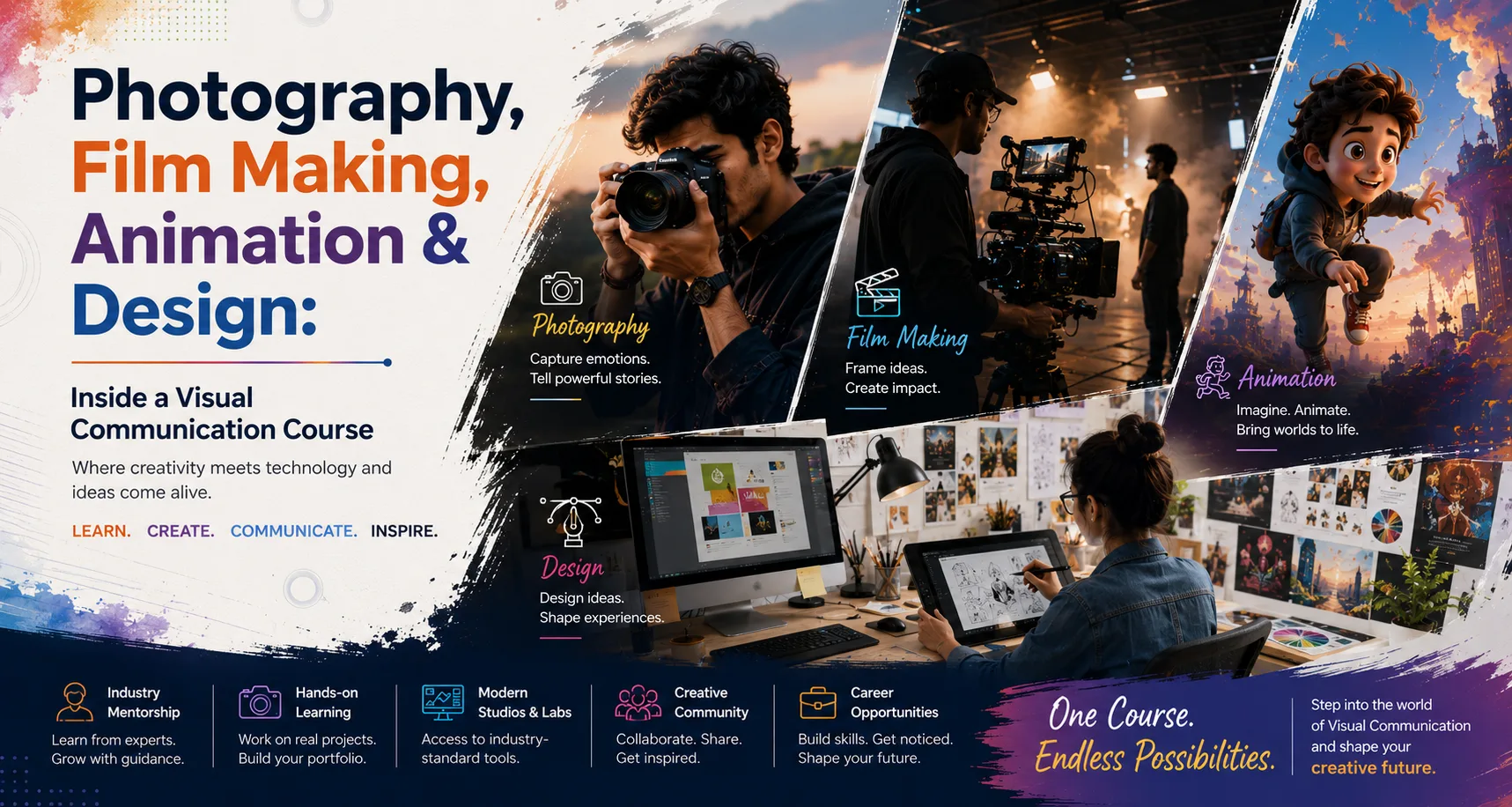
This is where a Bachelor of Science in Visual Communication comes in, with a comprehensive pathway to the creative careers the industry demands. This is what happens behind the scenes of a modern visual communication program, bringing out how foundational skills drive the future of media production.
1. Photography: The Foundation of the Visual Frame
Any moving image or digital layout begins with the understanding of the static frame. Visual communication starts with an anatomy of light, composition and human perception.
Students learn not just how to operate a camera but how angles and focal lengths and levels of exposure can create psychological responses. Training includes studio lighting setups as well as candid photojournalism to make sure every image shot tells a clear, intentional story.
2. Movie Making: The Art of Time-Based Storytelling
The transition from one frame to twenty-four frames per second is complicated by motion, sound and time. Students learn to conceptualize, write, shoot and edit complex stories in filmmaking modules.
This process includes working in multi-camera production environments and learning post-production tools. You will learn to balance the technical mechanics of the camera with the emotional rhythm of editing to create immersive visual experiences that will captivate modern audiences.
3. Animations The Art of Giving Form to Imagination
Animation is a mixture of absolute reality and infinite imagination. Students learn principles of motion, rigging and spatial physics, whether they’re working with old school 2D sequencing, or complex 3D asset modeling.
This field deals with believable character behavior and dynamic environments. Learning animation provides creators with a competitive advantage as more and more industries are using motion graphics in digital marketing, UI/UX interfaces, and entertainment.
4. Design: the strategic arrangement of communication
Design is the skeleton of all visuals. It determines how an audience scrolls a web page, interacts with a brand or reads a poster.
According to the curriculum:
Typography: Choosing and sizing typefaces to improve readability and set up hierarchy.
Color Theory: The intentional use of specific colors to invoke certain feelings and guide the eye.
Layout Principles: Utilizing grid systems, white space and alignment to structure information clearly.
The Liberal Arts Edge
Good technical execution needs to be married to a broad understanding of the world. The creative labs are a means for media professionals to develop the cultural context required to construct profound, universally resonant narratives through critical thinking, history and human behavior.
Real-World Readiness and Industry Infrastructure
A high-tier media education requires an environment that mirrors the professional world. In the creative fields, theory must directly translate into daily hands-on application.
For instance, the Kumaraguru College of Liberal Arts and Science curriculum combines rigorous creative theory with intensive studio practice. Students test out their skills on the fly in iMac editing suites, audio recording rooms and multi-camera production floors. The constant dipping makes the switch from the university to the fast-paced media agency completely smooth.
In today’s media environment, there’s a need for creators who are adept at bouncing between design apps, camera gear and idea-generation meetings. The programs at kumaraguru college of liberal arts and science combine photography, filmmaking, animation and design into one seamless pathway that shapes the next generation of creative entrepreneurs and media leaders.
Are you prepared to turn your creative vision into a media career? What excites you most about visual communication? Share your thoughts below!