
Market Overview
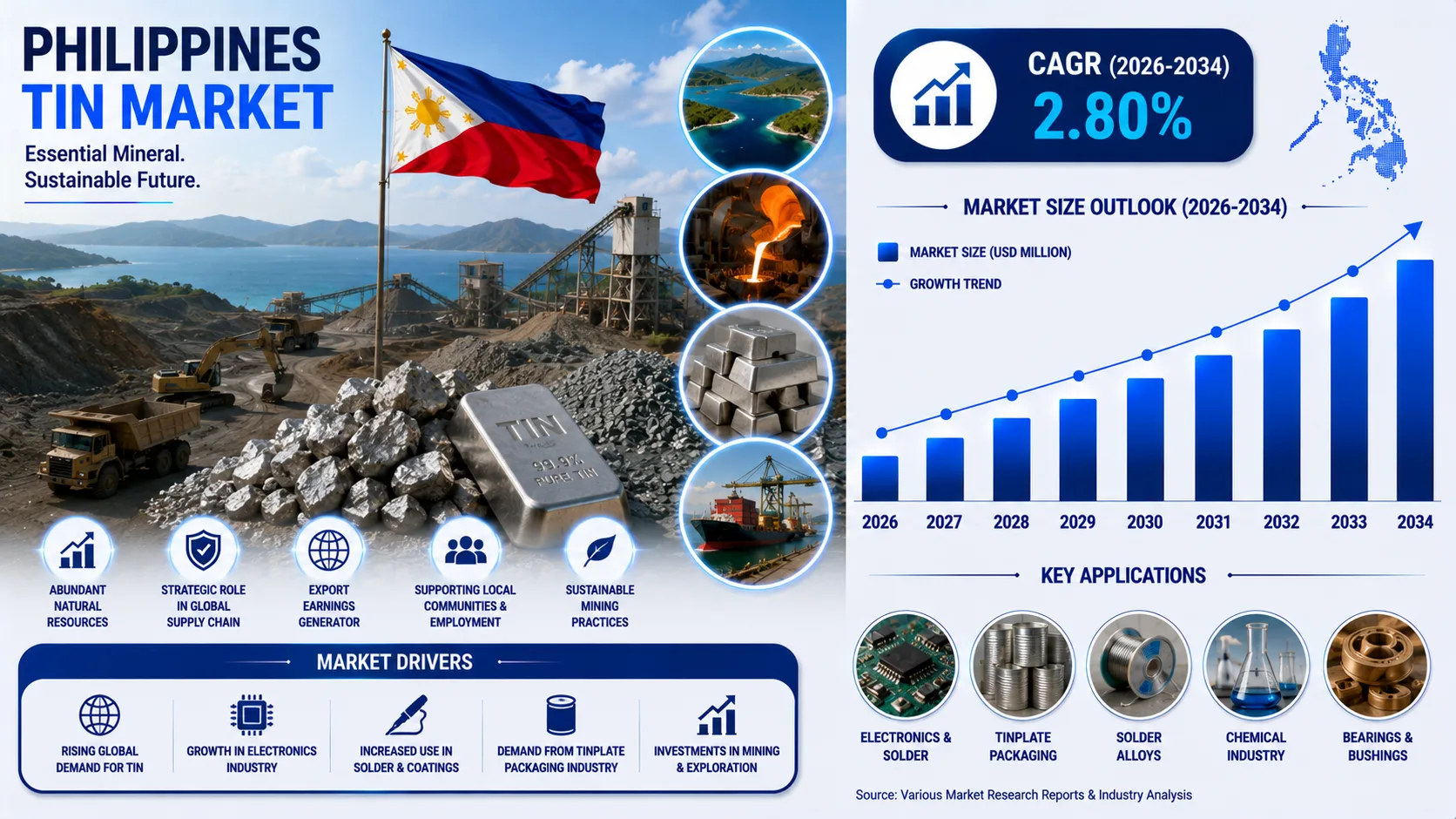
The Philippines tin market size reached 1.91 Kilo Tonnes in 2025 and is projected to reach 2.46 Kilo Tonnes by 2034, growing at a compound annual growth rate (CAGR) of 2.80% from 2026-2034. The market is driven by expanding electronics manufacturing activities, increasing adoption of tin-based soldering materials in consumer electronics and automotive applications, and growing demand from the food packaging sector. Rising industrial development and infrastructure investments, coupled with technological advancements in tin processing and alloy production, continue to strengthen domestic consumption patterns. Additionally, supportive government policies promoting manufacturing growth and export competitiveness further reinforce market expansion, contributing to the Philippines tin market share. The market is strategically important to the Philippines' manufacturing sector as it enables the nation to support electronics production, automotive assembly, and food packaging industries.
Request a Sample Report for In-Depth Market Insights: https://www.imarcgroup.com/philippines-tin-market/requestsample
Philippines Tin Market Summary
- The Philippines tin market encompasses a range of product types (metal, alloy, compounds), applications (soldering, tin plating, chemicals, others), and end-use industries (automotive, electronics, packaging (food and beverages), glass, others), serving diverse industrial requirements.
- These products are valued for their role in enabling electronics manufacturing, providing corrosion protection, ensuring food safety in packaging, and supporting industrial processes across various sectors.
- The ecosystem includes tin processors, manufacturers, distributors, electronics assemblers, automotive producers, packaging companies, and regulatory bodies.
- Major segments identified in the market include product type (metal, alloy, compounds), application (soldering, tin plating, chemicals, others), end-use industry (automotive, electronics, packaging (food and beverages), glass, others), and region (Luzon, Visayas, Mindanao).
- The market is benefiting from expanding electronics manufacturing and export activities, growing automotive sector and vehicle electronics integration, and rising demand from food and beverage packaging applications.
- Metal dominates the market with a share of 46% in 2025, soldering leads applications at 40%, electronics represents the largest end-use at 35%, and Luzon commands 48% regional share.
PORTER'S FIVE FORCES ANALYSIS
- Competitive Rivalry: Moderate, with regional processors, international trading entities, and specialized suppliers competing on quality, reliability, and pricing. Business implication: Companies must differentiate through supply chain reliability, technical expertise, and customer relationships.
- Supplier Power (Tin Materials): Moderate. Suppliers of tin materials have some leverage, but the presence of multiple international suppliers and the ability of large processors to secure long-term contracts moderates this power. Business implication: Manufacturers should maintain diverse supplier relationships.
- Buyer Power (Manufacturers): High. Large electronics and automotive manufacturers can negotiate favorable terms due to volume purchasing and multiple supplier options. Business implication: Suppliers must focus on quality consistency, reliability, and technical support.
- Threat of Substitutes: Moderate. Alternative materials (aluminum, polymers, conductive adhesives) compete, but tin's unique properties support its position. Business implication: The industry should emphasize tin's advantages in soldering and corrosion protection.
- Threat of New Entrants: Moderate. Higher barriers for established processors (capital, technology), but lower barriers for trading and distribution entities. Business implication: Established players should build defensible positions through processing capabilities and customer relationships.
MARKET GROWTH DRIVERS
Expanding Electronics Manufacturing and Export Activities
The Philippines maintains a robust electronics manufacturing sector that significantly contributes to national export revenues and industrial employment, supporting the growth of the Philippines Tin Market. Major international electronics brands utilize Philippine manufacturing facilities to produce consumer devices, computing equipment, and electronic components for global markets. In November 2025, Samsung Electro-Mechanics Philippines announced a PhP50.7 Billion investment to expand its high-technology manufacturing facility in Laguna, reflecting stronger electronics production and downstream demand for tin-based solder materials. Furthermore, Philippine electronics exports grew 38.19% year-on-year to US$4.50 Billion in October 2025, led by semiconductor components and medical and industrial instrumentation, generating additional demand for tin-based soldering materials used in circuit board assembly.
Growing Automotive Sector and Vehicle Electronics Integration
The Philippine automotive industry demonstrates steady expansion, driven by increasing domestic vehicle ownership and manufacturing investment. Modern automobiles incorporate extensive electronic components requiring tin-based solder connections for engine management systems, infotainment units, and safety systems. The proliferation of advanced driver-assistance features and connected vehicle technologies amplifies tin consumption per vehicle unit. Domestic automotive assembly operations generate incremental demand for high-quality tin materials meeting automotive-grade specifications. As per sources, in December 2024, Toyota Motor Philippines invested ₱5.5 Billion to revive Tamaraw production, strengthening local automotive parts manufacturing and enhancing the national automotive value chain.
Rising Demand from Food and Beverage Packaging Applications
The Philippine food and beverage industry demonstrates sustained growth, driven by expanding population and rising disposable incomes. Tin-plated steel containers offer superior corrosion resistance, food safety properties, and extended shelf-life characteristics valued by manufacturers and consumers alike. Growing urbanization and changing lifestyle patterns drive demand for tinplate packaging materials across retail and commercial channels. Export-oriented food processing operations require packaging solutions meeting international quality standards. The category benefits from established distribution infrastructure and continued investment in food processing capacity expansion. In November 2025, the government temporarily reduced import duty on key tin-mill blackplate materials to stabilize supply chains and support local tin plate manufacturing for the food packaging industry.
PHILIPPINES TIN MARKET SEGMENTATION
Product Type Insights:
- Metal
- Alloy
- Compounds
Application Insights:
- Soldering
- Tin Plating
- Chemicals
- Others
End-Use Industry Insights:
- Automotive
- Electronics
- Packaging (Food and Beverages)
- Glass
- Others
Regional Insights:
- Luzon
- Visayas
- Mindanao
COMPETITIVE LANDSCAPE
The Philippines tin market features a moderately fragmented competitive structure characterized by the participation of established regional processors, international trading entities, and specialized industrial suppliers serving diverse end-use segments. Market participants differentiate through product quality specifications, supply reliability, technical support capabilities, and pricing competitiveness across various application categories. Distribution networks and customer relationships developed over extended operating periods provide competitive advantages for established market participants. The competitive environment encourages continuous improvement in processing efficiency, quality control systems, and customer service responsiveness. Strategic partnerships between domestic processors and international suppliers enhance material availability and market reach.
Key players mentioned in the report context include:
- The report provides a comprehensive analysis of the competitive landscape with detailed profiles of all major companies, including regional processors, international trading entities, and specialized industrial suppliers operating in the Philippines tin market.
REGIONAL ANALYSIS
- Luzon: Dominates with a 48% share, driven by concentrated industrial activity, superior infrastructure development, proximity to major commercial centers, numerous electronics manufacturing facilities, automotive component producers, and packaging operations, with special economic zones attracting foreign investment.
- Visayas: A growing market with increasing industrial activity, supported by improving infrastructure and expanding manufacturing capabilities.
- Mindanao: An emerging market with growth driven by industrial development, improving infrastructure, and increasing manufacturing activities.
RECENT INDUSTRY DEVELOPMENTS
August 2026: Tin prices remained elevated globally, supporting the broader metals and materials industry. Benchmark tin was trading at around USD 53,781 per tonne on 24 July 2026, approximately 57.9% higher year-on-year. The increase is relevant for Philippine tin users because higher international prices can raise input costs for solder, electronics, packaging and other tin-containing products.
June 2026: The Philippines' metallic-mining sector recorded strong growth in overall production value. The value of metallic mineral production reached PHP 82.78 billion in Q1 2026, up 28.6% year-on-year from PHP 64.35 billion. While the country's major output gains were concentrated in nickel and other metals, the stronger mining environment supported continued attention toward domestic mineral-resource development.
February 2026: The Philippines continued expanding its mineral-export activity. Total Philippine exports increased 7.9% year-on-year to USD 7.1 billion in January 2026, while mineral products accounted for USD 732.3 million, or 10.3% of total exports. The stronger mineral trade environment supported demand for metals used throughout electronics and industrial supply chains.
January 2026: Global tin supply remained under pressure as demand from electronics and emerging technologies strengthened. Industry analysis highlighted the increasing importance of tin for soldering applications in electronics and AI-related infrastructure, while supply remained concentrated among a limited number of producing countries.
Key Aspects Required for the Philippines Tin Market
- Market Performance: 1.91 Kilo Tonnes in 2025, with a projected trajectory to 2.46 Kilo Tonnes by 2034.
- Market Outlook: A 2.80% CAGR through 2034 indicates steady growth across product types and applications, driven by electronics manufacturing, automotive integration, and packaging demand.
- Growth Drivers: Expanding electronics manufacturing and export activities; growing automotive sector and vehicle electronics integration; rising demand from food and beverage packaging applications; transition toward lead-free soldering solutions; and integration of advanced tin alloy technologies.
- Competitive Landscape: A moderately fragmented market with regional processors, international trading entities, and specialized suppliers. Differentiation occurs through product quality, supply reliability, and technical expertise.
- Value Chain Analysis: From tin material sourcing and processing through distribution and manufacturing to end-use in electronics, automotive, and packaging, with regulatory compliance and technology shaping market dynamics.
- Industry Trends: Transition toward lead-free soldering solutions; integration of advanced tin alloy technologies; expansion of domestic tin processing capabilities; growing electronics manufacturing and export activities; and rising demand from food and beverage packaging applications.
- Strategic Recommendations: Invest in advanced tin processing and alloy production capabilities; develop lead-free soldering solutions; strengthen supply chain relationships with electronics and automotive manufacturers; expand domestic processing capacity; and leverage government support for manufacturing growth.
Note: If you need any specific information that is not covered currently within the scope of the report, we will provide the same as a part of customization.
Speak to an analyst: https://www.imarcgroup.com/request?type=report&id=42137&flag=C
Report Format, Delivery, and Customization Details
- Report Format Mode: PDF and Excel (Editable version in PPT/Word format available on special request)
- Report Delivery Mode: Online Delivery, Physical Delivery
- Report Delivery Time: Report Delivered Over Email within 24 to 48 hours. If requested by the client, a physical copy will be delivered within three to ten days.
- Report Confirmation Mode: Yes via Email
- Report Customization Mode: Yes via Email / Call
- Report Table of Content: Yes
- Report List of Figures: Yes
- Report Methodology Mode: Yes
- Request For Sample Report: Yes
About Us
IMARC Group is a global management consulting firm that helps the world's most ambitious changemakers to create a lasting impact. The company provides a comprehensive suite of market entry and expansion services. IMARC offerings include thorough market assessment, feasibility studies, company incorporation assistance, factory setup support, regulatory approvals and licensing navigation, branding, marketing and sales strategies, competitive landscape and benchmarking analyses, pricing and cost research, and procurement research.
Contact Us
IMARC Group
134 N 4th St, Brooklyn, NY 11249, USA
Email: [email protected]
Tel. No: (D) +91 120 433 0800
United States: +1-201-971-6302