When no sperm appears in the ejaculate (azoospermia), surgical sperm retrieval offers hope for biological fatherhood. But with multiple techniques available—PESA, TESA, and Micro-TESE—choosing the right one depends on the underlying cause. Understanding the differences helps you make informed decisions. If you're facing azoospermia, a fertility centre in Tanjore provides expert evaluation and personalized treatment planning.
What is azoospermia?
Azoospermia means no sperm in the ejaculate, affecting about 1% of all men and 10-15% of infertile men.
Two main types:
Obstructive azoospermia (OA):
- Testes produce sperm normally
- Blockage prevents sperm from reaching ejaculate
- Causes: Vasectomy, congenital absence of vas deferens (CBAVD), infection, prior surgery
- Hormone levels typically normal
- Testes size normal
Non-obstructive azoospermia (NOA):
- Testes don't produce sperm (or produce very little)
- Causes: Genetic factors (Klinefelter syndrome, Y-chromosome microdeletions), hormonal imbalances, prior chemotherapy/radiation, undescended testicles, varicocele
- Hormone levels may be abnormal (elevated FSH)
- Testes may be small or soft
Key point: The type of azoospermia determines which sperm retrieval procedure is most appropriate.
A male infertility doctor in Chennai can diagnose the type through comprehensive evaluation.
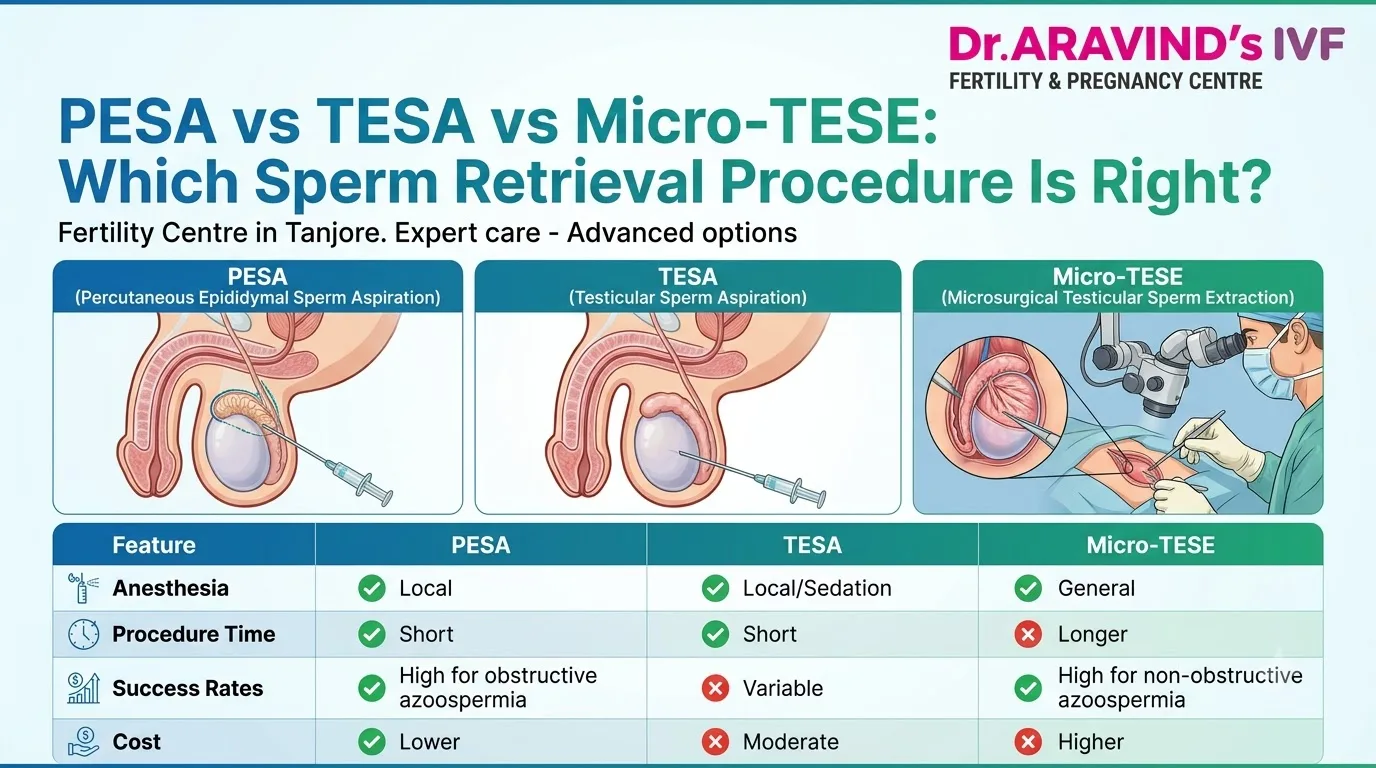
PESA (Percutaneous Epididymal Sperm Aspiration)
What it is:
- Fine needle inserted through scrotal skin directly into the epididymis (coiled tube behind testicle where sperm mature and are stored)
- Epididymal fluid containing sperm is aspirated
- Performed under local anesthesia or light sedation
- Takes 10-30 minutes, day-care procedure
Best suited for:
- Obstructive azoospermia with normal sperm production
- Men with vasectomy, CBAVD, or epididymal blockage
- First-line procedure for OA
Success rates:
- Sperm retrieval: 60-80% in obstructive azoospermia
- Not typically used for non-obstructive cases (low success)
Advantages:
- Minimally invasive
- Quick recovery (1-2 days)
- Lower cost (₹45,000-50,000)
- Can be repeated if needed
Limitations:
- Only works if sperm production is normal (obstructive cases)
- May not retrieve enough sperm for multiple IVF cycles
- Sperm may be less mature than testicular sperm
Recovery:
- Mild discomfort for 1-2 days
- Ice packs, supportive underwear
- Avoid strenuous activity for 1 week
TESA (Testicular Sperm Aspiration)
What it is:
- Fine needle (slightly larger than PESA needle) inserted directly into testicular tissue
- Small amount of testicular tissue and fluid aspirated using negative pressure
- Performed under local anesthesia or light sedation
- Takes 10-30 minutes, day-care procedure
Best suited for:
- Obstructive azoospermia (if PESA fails or not feasible)
- Non-obstructive azoospermia (though success rates lower than Micro-TESE)
- Men needing sperm retrieval for IVF/ICSI
Success rates:
- Obstructive azoospermia: 70-90%
- Non-obstructive azoospermia: 10-23% (significantly lower than Micro-TESE)
Advantages:
- Minimally invasive
- Quick procedure
- Lower cost (₹35,000-40,000)
- Can be done under local anesthesia
- Less tissue damage than open biopsy
Limitations:
- Lower success rate in non-obstructive cases compared to Micro-TESE
- May not retrieve enough sperm for multiple cycles
- "Blind" procedure—can't visualize sperm-producing areas
Recovery:
- Mild discomfort for 2-3 days
- Ice packs, supportive underwear
- Avoid strenuous activity for 1 week
Micro-TESE (Microdissection Testicular Sperm Extraction)
What it is:
- Most advanced sperm retrieval technique
- Open microsurgical procedure under general anesthesia
- Testis opened with midline incision and examined under operating microscope (16-25x magnification)
- Larger, opaque seminiferous tubules (indicating active sperm production) selectively identified and biopsied
- Biopsy specimens immediately examined by embryologist in adjacent laboratory
- Takes 2-4 hours, may require overnight stay
Best suited for:
- Non-obstructive azoospermia (especially difficult cases)
- Men with prior failed TESA or conventional TESE
- Genetic causes (Klinefelter syndrome, Y-chromosome microdeletions)
- Cases where maximizing sperm retrieval is critical
Success rates:
- Non-obstructive azoospermia: 45-55% (significantly higher than TESA's 10-23%)
- Obstructive azoospermia: 90-100% (though PESA or TESA usually sufficient)
Advantages:
- Highest sperm retrieval rate for non-obstructive azoospermia
- Microscopic visualization allows selective biopsy of sperm-producing areas
- Minimizes tissue removal and testicular damage
- More sperm retrieved (can freeze for future IVF cycles)
- Recommended by AUA/ASRM and EAU guidelines for NOA
Limitations:
- More invasive (open surgery, general anesthesia)
- Longer procedure (2-4 hours)
- Higher cost (₹1.5-1.7 lakh)
- Requires specialized microsurgical expertise
- Longer recovery (1-2 weeks)
Recovery:
- Discomfort for 3-5 days
- Ice packs, supportive underwear
- Pain medication as needed
- Avoid strenuous activity for 2-3 weeks
- Follow-up in 1-2 weeks
Comparison table: PESA vs TESA vs Micro-TESE
FeaturePESATESAMicro-TESEBest forObstructive azoospermiaObstructive or non-obstructiveNon-obstructive azoospermiaAnesthesiaLocal or light sedationLocal or light sedationGeneral anesthesiaProcedure time10-30 minutes10-30 minutes2-4 hoursSperm retrieval rate (OA)60-80%70-90%90-100%Sperm retrieval rate (NOA)Not typically used10-23%45-55%InvasivenessMinimally invasiveMinimally invasiveOpen microsurgeryCost (approx.)₹45,000-50,000₹35,000-40,000₹1.5-1.7 lakhRecovery1-2 days2-3 days1-2 weeksSpecial equipmentFine needleFine needleOperating microscope
Which procedure is right for you?
Obstructive azoospermia:
- First choice: PESA (minimally invasive, high success, lower cost)
- If PESA fails: TESA or MESA (Microsurgical Epididymal Sperm Aspiration)
- Micro-TESE rarely needed unless other methods fail
Non-obstructive azoospermia:
- First choice: Micro-TESE (highest success rate, 45-55%)
- Alternative: TESA (lower success, 10-23%, but less invasive and lower cost)
- Conventional TESE (without microscope) is less effective than Micro-TESE
Prior failed sperm retrieval:
- If TESA failed: Micro-TESE offers better chance of success
- If PESA failed: TESA or Micro-TESE
Genetic causes (Klinefelter, Y-chromosome microdeletions):
- Micro-TESE preferred (highest retrieval rates in these challenging cases)
A best ivf centre in India with experienced microsurgeons and embryologists maximizes success rates.
What happens after sperm retrieval?
Retrieved sperm are used with ICSI (Intracytoplasmic Sperm Injection):
- Single sperm injected directly into each egg
- Enables fertilization even with minimal sperm
- Success rates similar to standard IVF (40-50% per cycle, varies by female age)
Sperm freezing:
- If more sperm retrieved than needed, can freeze for future IVF cycles
- Avoids repeat surgical procedures
- Especially valuable for Micro-TESE (invasive, higher cost)
If no sperm found:
- Micro-TESE concludes without further testicular damage
- Options: Repeat Micro-TESE (in select cases), donor sperm, or adoption
- Genetic counseling recommended for certain causes
A fertility centre in Tanjore coordinates sperm retrieval with IVF/ICSI cycle for optimal timing and outcomes.
Learn more about male infertility treatments in India.
What you should remember
- PESA, TESA, and Micro-TESE are sperm retrieval procedures for azoospermia (no sperm in ejaculate)
- Obstructive azoospermia: PESA or TESA (high success, minimally invasive)
- Non-obstructive azoospermia: Micro-TESE (highest success rate, 45-55%)
- Retrieved sperm used with ICSI for fertilization
- Success depends on azoospermia type, cause, and surgical expertise
- A fertility centre in Tanjore or best ivf centre in India provides expert evaluation and personalized treatment
Next steps: If diagnosed with azoospermia, consult a specialist for comprehensive evaluation (hormone testing, genetic testing, ultrasound) to determine the type and most appropriate sperm retrieval procedure.
Frequently asked questions
Q1: Which sperm retrieval procedure has the highest success rate?
For obstructive azoospermia, PESA and TESA have high success rates (60-90%). For non-obstructive azoospermia, Micro-TESE has the highest success rate (45-55%) compared to TESA (10-23%). The best procedure depends on your specific type of azoospermia. A male infertility doctor in Chennai can recommend the most appropriate option.
Q2: Is Micro-TESE worth the higher cost and invasiveness?
For non-obstructive azoospermia, yes. Micro-TESE's success rate (45-55%) is significantly higher than TESA (10-23%), making it worth the additional cost and invasiveness for many men. It also retrieves more sperm (can freeze for future cycles) and minimizes testicular damage through selective biopsy. For obstructive cases, PESA or TESA are usually sufficient and more cost-effective. A best IVF centre in India can provide personalized recommendations.
Q3: How painful are these procedures?
PESA and TESA are minimally invasive, performed under local anesthesia, with mild discomfort for 1-3 days post-procedure. Micro-TESE is done under general anesthesia (no pain during procedure), with moderate discomfort for 3-5 days afterward, managed with pain medication. Most men return to normal activities within 1-2 weeks. A fertility centre in Tanjore provides detailed post-procedure care instructions.
Q4: Can retrieved sperm be frozen for future use?
Yes. If more sperm are retrieved than needed for the current IVF cycle, excess sperm can be cryopreserved (frozen) for future use. This is especially valuable for Micro-TESE, avoiding repeat invasive procedures. Frozen sperm maintain viability for many years. This option should be discussed with your best ivf centre in India before the procedure.
Q5: What if no sperm are found during the procedure?
With Micro-TESE, the procedure concludes without further testicular damage if no sperm are found. Options include: repeating Micro-TESE (in select cases, especially if hormonal optimization improves sperm production), using donor sperm, or considering adoption. Genetic counselling is recommended for certain causes. Your male infertility doctor in Chennai will discuss all available options and next steps based on your specific situation.
Read more
Learn more about male infertility treatments in India.
Diagnosed with azoospermia?
Don't lose hope. Consult a best fertility centre in Tanjore for expert evaluation, advanced sperm retrieval procedures, and personalized treatment planning.