
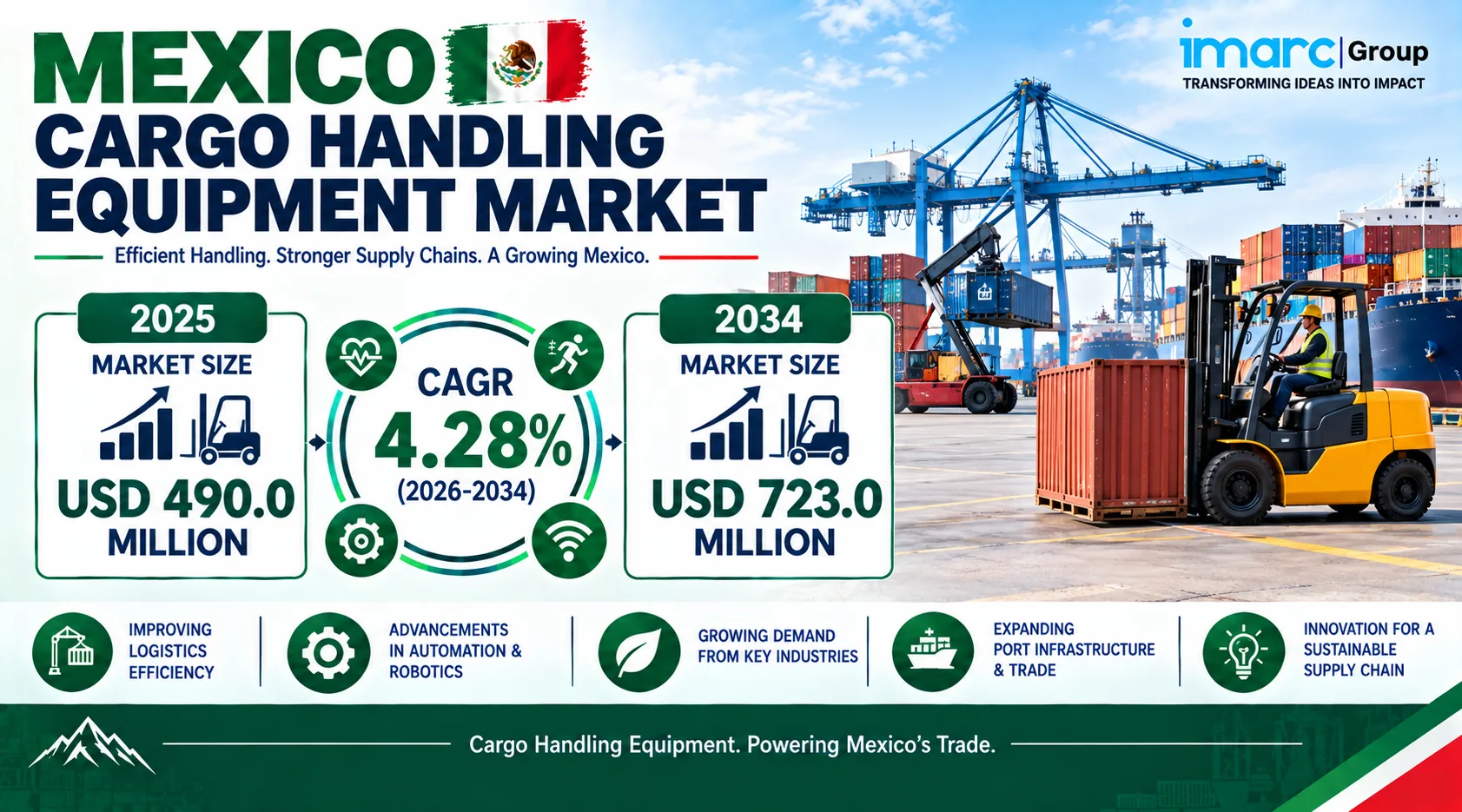
IMARC Group has recently released a new research study titled “Mexico Cargo Handling Equipment Market Report by Equipment Type, Propulsion Type, Application, and Region, 2026-2034,” offers a detailed analysis of the market drivers, segmentation, growth opportunities, trends and competitive landscape to understand the current and future market scenarios.
Mexico Cargo Handling Equipment Market Size, Growth, and Forecast (2026-2034)
The mexico cargo handling equipment market size reached USD 490.0 Million in 2025 and is projected to reach USD 723.0 Million by 2034, growing at a CAGR of 4.28% during 2026-2034. Increased port automation, growing adoption of sustainable and electric-powered equipment, and rising nearshoring-driven trade volumes are the primary factors driving the mexico cargo handling equipment market.
Cargo handling equipment encompasses industrial trucks, tow tractors, conveying equipment, stackers, and port cranes used to load, unload, transport, and stack cargo across ports, terminals, and logistics facilities. These machines support container movement, bulk cargo handling, and intermodal transfer operations across air, road and rail, and marine applications.
Mexico's ports are undergoing a significant modernization drive as international trade volumes rise and nearshoring reshapes regional supply chains. Terminal operators along the Gulf of Mexico and Pacific coastlines are investing in automated guided vehicles, robotic cranes, and terminal operating systems to reduce labor-intensive operations and improve vessel turnaround times, reinforcing demand for advanced cargo handling equipment across the mexico cargo handling equipment market.
Explore Growth Opportunities in the Mexico Cargo Handling Equipment Market - Grab Your Sample Report for Evaluation: https://www.imarcgroup.com/mexico-cargo-handling-equipment-market/requestsample
Key Trends Driving the Mexico Cargo Handling Equipment Market
- Rising demand for port automation: Mexican ports are increasingly adopting automated guided vehicles, robotic cranes, and terminal operating systems to manage growing international trade volumes and address labor shortages. Ports along the Gulf of Mexico and Pacific coastlines are installing automated stacking cranes and AI-based traffic management systems, driving overall throughput efficiency and reinforcing mexico cargo handling equipment market growth.
- Shift toward green and sustainable equipment: Strict regulatory requirements and rising investor expectations are pushing operators toward electric-powered forklifts, straddle carriers, and terminal tractors. Ports such as Veracruz and Lázaro Cárdenas are deploying hybrid-powered cranes and integrating renewable energy sources, positioning the mexico cargo handling equipment market as an increasingly sustainable segment of the logistics chain.
- Nearshoring-led expansion of port and logistics infrastructure: The relocation of manufacturing closer to the United States is increasing cargo volumes moving through Mexican ports and inland terminals, prompting capacity expansions and new equipment orders. This nearshoring-driven trade growth is a key contributor to the expanding mexico cargo handling equipment market share across northern industrial corridors and coastal gateways.
Mexico Cargo Handling Equipment Market Report Segmentation:
The Mexico Cargo Handling Equipment Market report provides a detailed segmentation analysis to help businesses identify key growth segments and evolving industry dynamics. The market is categorized based on equipment type, propulsion type, and application, offering comprehensive insights across the mexico cargo handling equipment market.
Equipment Type Insights:
Industrial trucks, tow tractors, conveying equipment, stacker, port cranes, and others together form the core of the mexico cargo handling equipment market, with industrial trucks and port cranes providing the primary infrastructure for container and bulk cargo movement across terminals.
Propulsion Type Insights:
IC engine and electric propulsion types define the market, with electric equipment gaining share as ports pursue decarbonization goals and operators look to reduce fuel and long-term maintenance costs.
Application Insights:
Air, road and rail, and marine applications make up the market, with marine applications accounting for the largest share given Mexico's reliance on container ports for import and export trade.
Regional Insights:
- Northern Mexico: Northern Mexico sees strong demand for cargo handling equipment driven by cross-border trade, logistics hubs, and nearshoring-related industrial expansion requiring cargo and facility handling capacity.
- Central Mexico: Central Mexico, anchored by Mexico City, supports growing inland logistics and intermodal cargo handling activity linked to dense commercial and industrial demand.
- Southern Mexico: Southern Mexico is gradually expanding cargo handling infrastructure as government programs and private investment extend port and logistics capacity into emerging industrial centers.
- Others: Other regions continue to see steady growth in cargo handling equipment adoption as national trade and logistics modernization initiatives extend coverage beyond major port hubs.
Mexico Cargo Handling Equipment Market: Recent News and Developments
- May 2025: ICTSI’s Contecon Manzanillo terminal in Mexico added two STS cranes and four RTGs to boost its capacity to 2 Million TEU. This expansion, following a USD 300 Million investment in 2024, strengthens container handling efficiency and enhances Mexico’s position in global logistics.
- January 2026: APM Terminals Yucatán ordered two Konecranes Gottwald ESP.7 Mobile Harbor Cranes for its terminal at the Port of Progreso, with each unit equipped with an external power supply to support the terminal’s decarbonization strategy. The order, booked in the fourth quarter of 2025, will be delivered by the end of September 2026 as part of an ongoing modernization and capacity-building program.
Challenges Impacting the Mexico Cargo Handling Equipment Market
Latin America, including Mexico, tends to lag North America in adopting advanced cargo handling technologies, creating a gap between available automation innovations and actual deployment across many terminal operators.
High costs associated with deploying electric-powered and automated cargo handling equipment can be a barrier for smaller terminal operators and logistics providers seeking to upgrade from conventional, diesel-powered machinery.
Investment Opportunities in the Mexico Cargo Handling Equipment Market
The mexico cargo handling equipment market presents compelling investment opportunities supported by its projected growth from USD 490.0 Million in 2025 to USD 723.0 Million by 2034. Electric and hybrid-powered cranes, terminal tractors, and forklifts represent a high-value opportunity as ports pursue decarbonization and emissions compliance.
Automated terminal solutions, including automated guided vehicles, robotic cranes, and AI-based traffic management systems, represent a growing investment frontier as operators seek to improve throughput and address labor shortages. Companies that combine automation capabilities with strong regional service networks can build durable competitive positions in this expanding market.
Outlook of the Mexico Cargo Handling Equipment Market (2026-2034)
The outlook for the mexico cargo handling equipment market is positive, supported by rising trade volumes, nearshoring-driven industrial expansion, and continued investment in port automation and sustainable equipment. The market is projected to grow from USD 490.0 Million in 2025 to USD 723.0 Million by 2034 at a CAGR of 4.28%.
Continued adoption of electric and hybrid-powered equipment, expanding automation at major container terminals, and nearshoring-driven demand for cargo and facility handling capacity will be the defining trends shaping the mexico cargo handling equipment market through 2034.
Key Players in the Mexico Cargo Handling Equipment Market
The mexico cargo handling equipment market is served by a mix of global crane and material handling technology providers competing on the basis of automation capability, energy-efficient equipment, and regional service coverage.
- Kalmar (Cargotec): A global leader in port and terminal cargo handling solutions, Kalmar maintains a long-standing presence at major Mexican terminals, including Manzanillo and Altamira, supplying ship-to-shore cranes, rubber-tired gantry cranes, terminal tractors, and SmartPort automation technology.
- Konecranes: A global leader in material handling and mobile harbor crane solutions, Konecranes supplies Gottwald mobile harbor cranes to Mexican port operators, including a 2025-booked order of two ESP.7 cranes for APM Terminals Yucatán at the Port of Progreso to support terminal modernization and decarbonization.
Frequently Asked Questions (FAQs): Mexico Cargo Handling Equipment Market
1. What is the current Mexico cargo handling equipment market size?
The Mexico cargo handling equipment market size reached USD 490.0 Million in 2025 and is projected to reach USD 723.0 Million by 2034, growing at a CAGR of 4.28% during 2026-2034.
2. What is cargo handling equipment?
Cargo handling equipment refers to industrial trucks, tow tractors, conveying equipment, stackers, and port cranes used to load, unload, move, and stack cargo across ports, terminals, and logistics facilities serving air, road and rail, and marine applications.
3. What are the key drivers of the mexico cargo handling equipment market?
Key drivers include increased port automation, growing adoption of electric and sustainable equipment, and rising nearshoring-driven trade volumes moving through Mexican ports and inland terminals.
4. Which region leads the Mexico cargo handling equipment market?
Northern Mexico leads demand for cargo handling equipment, supported by cross-border trade, logistics hubs, and nearshoring-related industrial expansion, while Central Mexico also contributes significant inland logistics activity.
5. Who are the key players in the Mexico cargo handling equipment market?
Key players in the mexico cargo handling equipment market include Kalmar (Cargotec) and Konecranes, alongside other global crane and material handling technology providers serving Mexican port and terminal operators.
Author IMARC Group
IMARC Group is a global management consulting firm that helps the world's most ambitious changemakers to create a lasting impact. The company provide a comprehensive suite of market entry and expansion services. IMARC offerings include thorough market assessment, feasibility studies, company incorporation assistance, factory setup support, regulatory approvals and licensing navigation, branding, marketing and sales strategies, competitive landscape and benchmarking analyses, pricing and cost research, and procurement research.
Contact Us
IMARC Group,
134 N 4th St. Brooklyn, NY 11249, USA,
Email: [email protected],
United States: +1-201971-6302