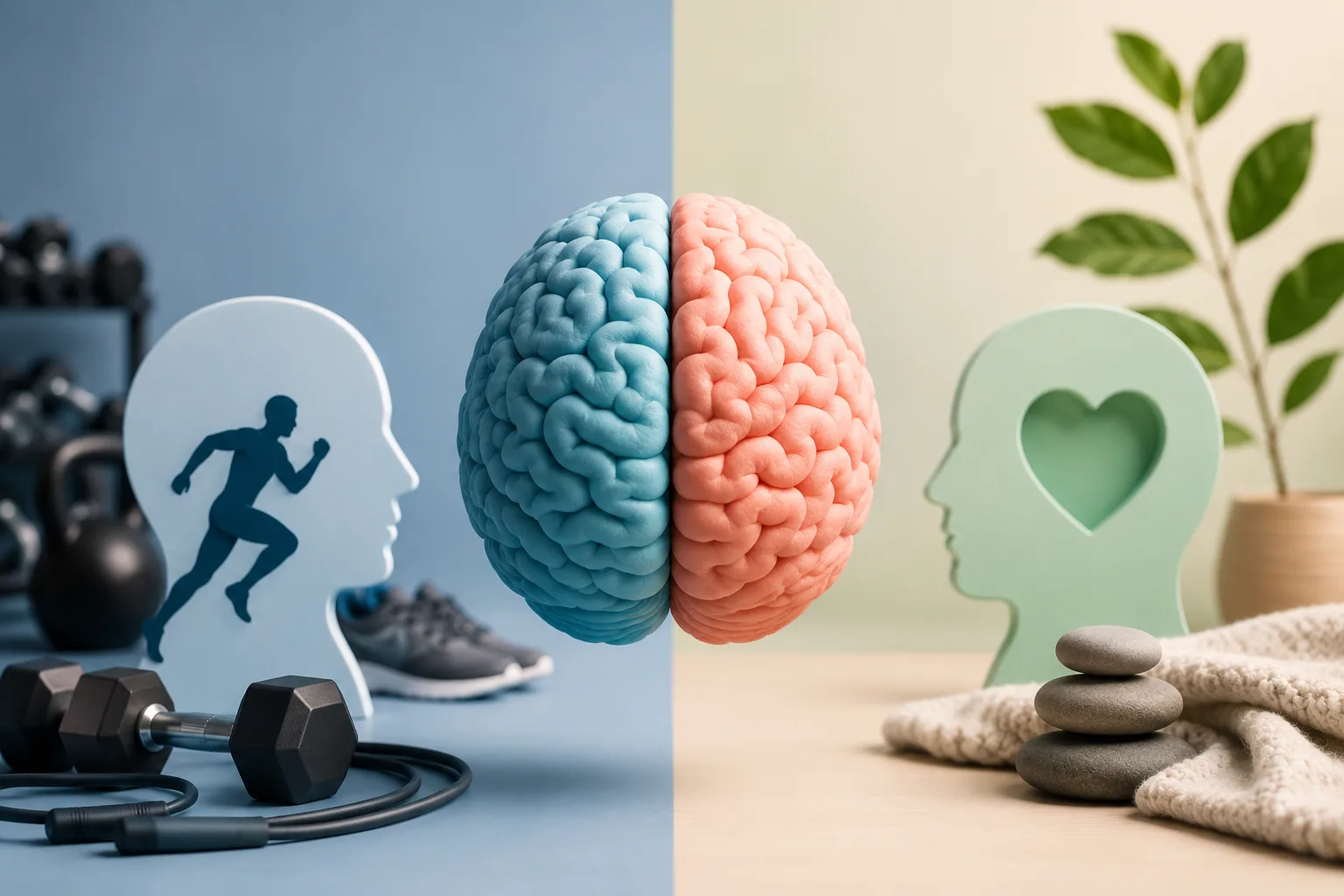
Mental health and mental fitness get thrown around like synonyms in wellness marketing, and that's a problem. They're not the same thing, and blurring the line does two kinds of damage: it makes people brush off a real clinical issue as something they can "train away," and it makes people over-medicalize ordinary stress that a bit of skill-building would fix. Here's the actual difference, and why it matters more than most articles on this topic let on.
What Mental Health Actually Means
Mental health is a state, not a skill. It's where you stand right now, including your mood, your capacity to handle stress, your ability to function day to day. The World Health Organization frames it as a state of well-being that lets a person manage life's demands, use their abilities, and contribute to their community and not simply the absence of a diagnosed disorder.
That state can fluctuate for reasons entirely outside your control, such as genetics, trauma, illness, grief, hormonal shifts, a bad diagnosis year. This is also the part of the equation clinicians treat.
According to the National Institute of Mental Health, more than one in five U.S. adults, an estimated 59.3 million people, live with a diagnosable mental illness in a given year. That's a health statistic. It belongs in the same category as blood pressure or blood sugar: something a professional assesses, diagnoses, and treats.
What is Meant by Mental Fitness?
Mental fitness is a skillset, and it's trainable. Where mental health asks "how are you doing," mental fitness asks "how capable are you of handling what's coming." It covers things like emotional regulation, focus under pressure, cognitive flexibility, and the ability to bounce back after a setback. These are the capacities you build through repetition, the same way you'd build physical strength.
Researchers are starting to treat it that way too. A 2024 study published via the National Library of Medicine measured mental fitness across seven domains in nearly 5,000 adults:
- Physical activity
- Sleep
- Nutrition
- Substance use
- Daily activities
- Social connection
- Psychological distress
It was treated as a composite of habits rather than a single mood reading. That's the key distinction: mental fitness is built from behavior, not diagnosed from symptoms.
Why Treating Them as Interchangeable Backfires
This is the part most competitor content skips, and it's the part that actually matters for real people.
You Can Have a Diagnosis and Still Be Mentally Fit
Someone managing generalized anxiety or depression isn't disqualified from building strong mental fitness. The skills including reframing a spiraling thought, regulating breath before a hard conversation, recovering faster after a bad day, can be trained right alongside clinical treatment. Fitness work doesn't replace therapy or medication; it runs parallel to it, and often makes the clinical treatment work better.
A Clean Bill of Mental Health Doesn't Guarantee Resilience
The reverse trips people up just as often. Someone with no diagnosis at all can still fall apart under a rough week because they've never actually practiced the skills and not because something is clinically wrong. That's a fitness gap, not a health problem. But because "mental health" is the term everyone reaches for, people default to treating a skills gap like a medical issue, which quietly overloads a therapy system already stretched thin.
A 2022 editorial in Frontiers in Public Health makes a related point worth sitting with: mental health disorder rates have climbed for two decades, and physical fitness levels correlate directly with mental health outcomes. Fitness, physical and mental, isn't a nice-to-have wrapped around treatment. It's part of the prevention layer treatment alone can't cover.
How to Actually Build Mental Fitness
- Structured reframing. When a thought spirals, name it, then rewrite it in one sentence. Do this daily, not just in a crisis.
- Journaling for patterns, not venting. Track triggers over weeks, not single bad days.
- Regular movement. The physical-activity link to mental fitness outcomes shows up consistently across the research above as this isn't optional.
- Scheduled social contact. Connection built into a calendar, not left to whenever you feel like it.
- Protected sleep windows. Tracked, not guessed at since sleep is one of the seven domains researchers now use to measure mental fitness itself.
When It's a Mental Health Issue, not a Fitness Gap
Mental fitness practices won't resolve a clinical condition, and pretending otherwise delays real treatment. Seek professional help if symptoms last more than two weeks, interfere with work or relationships, or involve thoughts of self-harm. If you're in crisis, call a friend or visit a mental health professional because that's a health emergency, not a fitness one.
Bottom Line
Mental health is the baseline you protect, often with professional support. Mental fitness is the daily training that keeps that baseline stable and pushes it further. Confuse the two, and you either skip care you actually need or hand a clinical problem to a meditation app. Keep them separate, and you know exactly which tool to reach for.