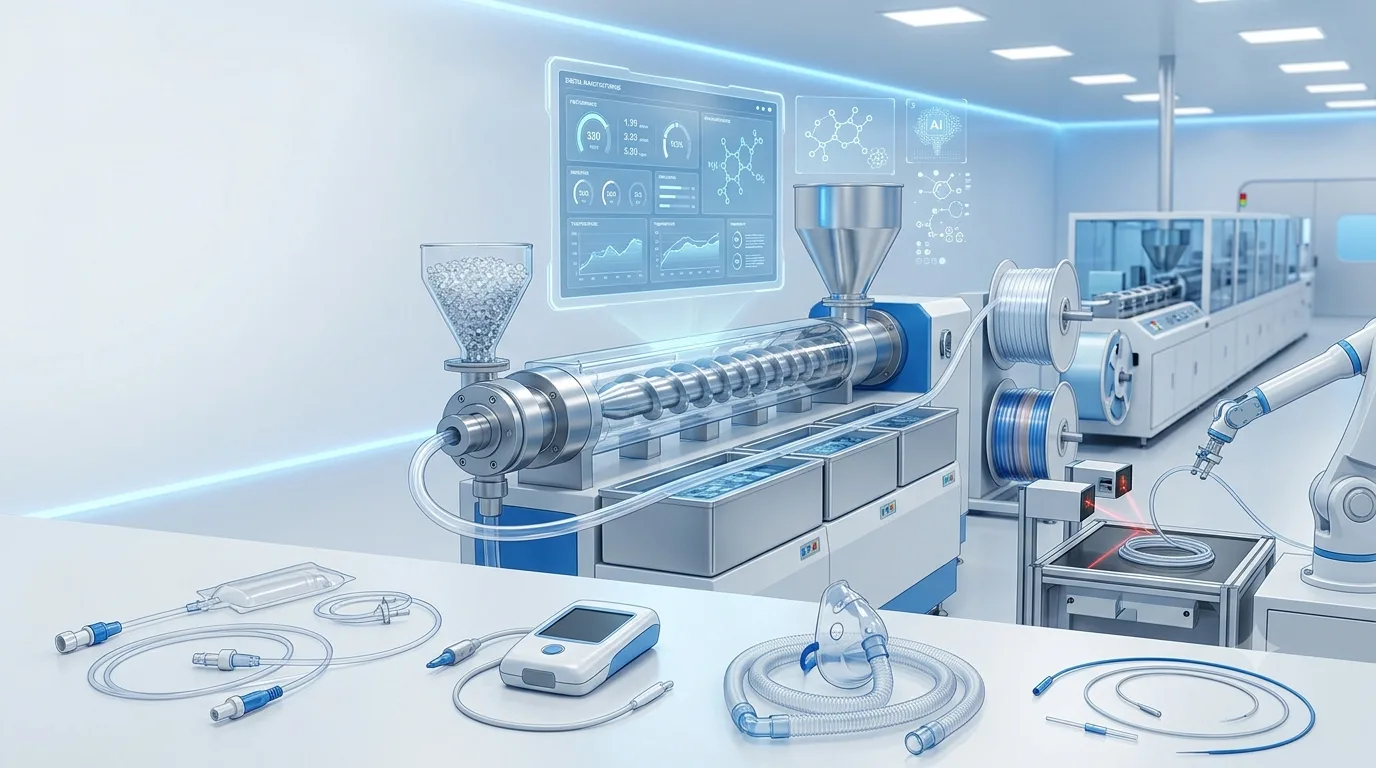
The Global Medical Plastics Extrusion Market is becoming an increasingly important part of the healthcare manufacturing ecosystem as demand rises for high-quality plastic components used in medical devices, diagnostic systems, drug delivery equipment, and surgical applications. Medical plastics extrusion enables manufacturers to produce highly precise tubing, catheters, profiles, films, and customized polymer components that meet stringent regulatory and performance standards. As healthcare systems continue to expand globally, the need for durable, lightweight, sterile, and biocompatible plastic products is driving sustained market growth.
The market is also benefiting from rapid advancements in polymer science, precision extrusion technologies, and automation across medical manufacturing facilities. Modern extrusion processes allow manufacturers to produce multilayer tubing, micro-extruded products, and highly customized components with exceptional consistency, making them suitable for advanced minimally invasive procedures and next-generation medical devices.
The Global Medical Plastics Extrusion Market is projected to reach USD 921.7 million in 2025 and grow at a CAGR of 5.2% through 2034, reaching an estimated USD 1,453.9 million. Rising healthcare investments, increasing production of disposable medical products, and continuous innovation in polymer processing technologies are expected to sustain long-term market expansion.
Download a Complimentary PDF Sample Report:
https://dimensionmarketresearch.com/request-sample/medical-plastics-extrusion-market/
Market Overview
Medical plastics extrusion is a specialized manufacturing process used to produce continuous plastic profiles with precise dimensions for healthcare applications. The technology is widely utilized to manufacture medical tubing, catheter shafts, IV lines, drainage systems, surgical instrument components, laboratory consumables, diagnostic device parts, and implantable product components.
Unlike conventional industrial extrusion, medical extrusion requires strict compliance with regulatory standards, exceptional dimensional accuracy, contamination-free manufacturing environments, and the use of medical-grade polymers. Manufacturers increasingly rely on advanced extrusion technologies to produce thinner walls, tighter tolerances, multilayer structures, and complex geometries demanded by modern medical devices.
Healthcare providers are also adopting more minimally invasive procedures, increasing the demand for sophisticated catheter systems and precision tubing. At the same time, the rapid expansion of home healthcare, wearable medical devices, and portable diagnostic equipment continues creating new opportunities for medical plastics extrusion manufacturers worldwide.
Key Findings
- The market is projected to reach USD 921.7 million in 2025.
- The industry is expected to reach USD 1,453.9 million by 2034.
- The market is forecast to grow at a CAGR of 5.2%.
- Asia-Pacific is expected to account for 43.2% of global revenue in 2025, making it the leading regional market.
- Medical tubing remains one of the largest application segments due to widespread use in minimally invasive procedures and fluid management systems.
- Advanced polymer materials such as TPU, PEBA, fluoropolymers, polypropylene, polyethylene, PVC, and silicone continue to gain wider adoption across medical device manufacturing.
Market Dynamics
Growth Drivers
Rising Demand for Medical Devices
The global healthcare industry continues to witness increasing demand for medical devices due to aging populations, rising chronic disease prevalence, and greater access to healthcare services. Every new catheter, infusion system, diagnostic instrument, or respiratory device requires precision-engineered plastic components, significantly boosting demand for medical plastics extrusion.
Medical tubing used in cardiovascular interventions, dialysis systems, intravenous therapies, and minimally invasive surgeries represents one of the fastest-growing application categories.
Expansion of Minimally Invasive Procedures
Hospitals worldwide increasingly prefer minimally invasive surgical procedures because they reduce hospital stays, minimize complications, and improve patient recovery. These procedures require highly specialized catheters, guidewires, introducers, balloon systems, and flexible tubing manufactured using advanced extrusion technologies.
The continuous evolution of robotic surgery and image-guided interventions further strengthens demand for precision-extruded medical plastics.
Increasing Adoption of Single-Use Medical Products
Healthcare providers continue expanding the use of disposable medical products to reduce infection risks and improve patient safety. Single-use tubing, IV sets, blood bags, respiratory circuits, and diagnostic consumables rely heavily on extruded plastic materials.
This growing preference for disposable devices is expected to remain one of the strongest long-term drivers of market growth.
Market Challenges
Strict Regulatory Requirements
Medical extrusion manufacturers must comply with stringent regulatory standards governing material quality, traceability, sterilization compatibility, biocompatibility, and manufacturing consistency.
Meeting these requirements increases production costs while extending product development timelines.
Volatility in Raw Material Prices
Medical-grade polymers require exceptionally high purity and quality standards. Fluctuations in resin prices, supply chain disruptions, and increasing transportation costs can directly impact manufacturing expenses and profit margins.
Manufacturers are therefore investing in long-term supplier partnerships and process optimization to improve operational efficiency.
Market Opportunities
Growth in Home Healthcare
The increasing popularity of home healthcare devices, portable infusion systems, wearable drug delivery devices, respiratory care equipment, and home dialysis solutions creates significant opportunities for extrusion manufacturers.
These products require lightweight, flexible, and durable polymer components manufactured using precision extrusion technologies.
Innovation in Advanced Polymer Materials
Continuous development of high-performance medical polymers allows manufacturers to produce stronger, thinner, more flexible, and chemically resistant medical components.
Advanced thermoplastic elastomers, fluoropolymers, bio-based plastics, and antimicrobial materials are expected to create new growth opportunities throughout the forecast period.
Medical Plastics Extrusion Market Trends
Growing Adoption of Micro Extrusion
Medical device miniaturization continues driving demand for micro-extrusion technologies capable of producing extremely small-diameter tubing with highly accurate tolerances.
Micro-extruded components are increasingly used in neurovascular interventions, cardiovascular procedures, ophthalmology, and pediatric devices.
Multi-Layer Extrusion Technologies
Manufacturers are increasingly producing multilayer tubing that combines multiple polymer materials into a single product. These structures provide enhanced flexibility, strength, chemical resistance, lubricity, and durability.
This technology is becoming increasingly important for complex catheter systems and drug delivery applications.
Automation Across Manufacturing Facilities
Automation and digital process monitoring continue improving extrusion precision, reducing production waste, and enhancing product consistency.
Manufacturers are investing in intelligent extrusion systems equipped with real-time quality monitoring, automated inspection, and predictive maintenance capabilities.
Sustainable Manufacturing
Healthcare manufacturers increasingly seek environmentally responsible production methods. Companies are focusing on energy-efficient extrusion equipment, recycling production waste where feasible, and developing recyclable medical polymers without compromising product performance.
Market Segmentation Overview
By Product
- Medical Tubing
- Catheters
- Profiles
- Films
- Sheets
- Rods
- Specialty Extruded Components
Medical tubing remains the largest product category due to its extensive use in fluid management, respiratory care, cardiovascular procedures, and minimally invasive surgeries.
By Material
- Polyvinyl Chloride (PVC)
- Polyethylene (PE)
- Polypropylene (PP)
- Thermoplastic Polyurethane (TPU)
- Silicone
- Fluoropolymers
- Polyether Block Amide (PEBA)
- Other Engineering Polymers
Medical-grade TPU and PEBA continue gaining popularity due to their flexibility, durability, and superior mechanical performance.
By Application
- Catheters
- Drug Delivery Systems
- Intravenous Systems
- Respiratory Equipment
- Diagnostic Devices
- Surgical Instruments
- Laboratory Equipment
- Implantable Devices
Catheter manufacturing represents one of the largest application segments owing to increasing cardiovascular, urology, and neurovascular procedures.
By End User
- Medical Device Manufacturers
- Hospitals
- Diagnostic Laboratories
- Pharmaceutical Companies
- Contract Manufacturing Organizations
Medical device manufacturers account for the largest share due to continuous product innovation and expanding production capacities.
Purchase the report for comprehensive details:
https://dimensionmarketresearch.com/checkout/medical-plastics-extrusion-market/
Regional Analysis
Asia-Pacific Leads the Global Market
Asia-Pacific is projected to account for 43.2% of global revenue in 2025, making it the dominant regional market.
The region benefits from extensive manufacturing capabilities, competitive production costs, expanding healthcare infrastructure, and strong government support for medical device manufacturing.
China remains one of the world's largest manufacturing centers for medical devices under its Made in China 2025 initiative. India continues attracting investments through its Make in India program while expanding medical device parks and polymer processing capabilities. Japan and South Korea also maintain advanced manufacturing ecosystems focused on precision healthcare technologies and innovation.
North America
North America continues to represent a major market owing to advanced healthcare infrastructure, high healthcare expenditure, and widespread adoption of technologically advanced medical devices.
The region remains a leader in medical innovation, minimally invasive procedures, and high-value medical device manufacturing.
Europe
Europe continues to experience stable growth supported by mature healthcare systems, increasing demand for precision medical devices, and strong regulatory emphasis on product quality and patient safety.
The region also remains a significant center for medical technology innovation and advanced polymer engineering.
Latin America
Healthcare modernization, increasing investments in hospitals, and growing access to medical treatments continue driving demand for medical plastics extrusion products across Latin America.
Middle East & Africa
Healthcare infrastructure development, rising medical investments, and increasing adoption of advanced medical technologies are gradually expanding opportunities for extrusion manufacturers across the Middle East and Africa.
Competitive Landscape
The Global Medical Plastics Extrusion Market remains moderately competitive, with manufacturers focusing on technological innovation, product customization, quality assurance, and strategic partnerships.
Key competitive strategies include:
- Investment in precision extrusion technologies
- Expansion of cleanroom manufacturing facilities
- Development of advanced medical-grade polymer solutions
- Product customization for OEM medical device manufacturers
- Geographic expansion into emerging healthcare markets
- Automation of manufacturing operations
- Capacity expansion to meet increasing global demand
- Strategic collaborations with healthcare and medical device companies
Manufacturers are also strengthening research and development capabilities to produce increasingly complex extruded components suitable for next-generation medical devices.
Future Market Outlook
The future of the Global Medical Plastics Extrusion Market appears highly promising as healthcare systems continue investing in innovative medical technologies, minimally invasive procedures, and advanced patient care solutions.
Several factors are expected to shape future growth:
- Rising global demand for minimally invasive medical devices
- Expansion of wearable healthcare technologies
- Growing home healthcare equipment market
- Increased production of disposable medical products
- Development of advanced biocompatible polymers
- Greater adoption of automated extrusion technologies
- Higher investments in medical device manufacturing across emerging economies
- Continued innovation in micro-extrusion and multilayer extrusion technologies
As healthcare continues evolving toward precision medicine, personalized treatment, and portable medical technologies, extrusion manufacturers will play an increasingly important role in supporting next-generation medical device production.
Frequently Asked Questions (FAQs)
1. What is the projected size of the Global Medical Plastics Extrusion Market?
The market is projected to reach USD 921.7 million in 2025 and is expected to grow to USD 1,453.9 million by 2034 at a CAGR of 5.2%.
2. Which region dominates the Medical Plastics Extrusion Market?
Asia-Pacific is expected to lead the market with 43.2% of global revenue in 2025, driven by strong manufacturing capabilities and expanding healthcare infrastructure.
3. What are the major applications of medical plastics extrusion?
Major applications include medical tubing, catheters, intravenous systems, respiratory equipment, diagnostic devices, surgical instruments, implantable devices, and laboratory equipment.
4. What factors are driving market growth?
Key drivers include rising demand for medical devices, increasing minimally invasive procedures, expansion of disposable medical products, healthcare infrastructure development, and continuous advancements in polymer extrusion technologies.
5. What opportunities are expected to influence future market growth?
Future opportunities include home healthcare expansion, wearable medical devices, advanced biocompatible polymers, automation in extrusion manufacturing, micro-extrusion technologies, and increasing investments in global medical device production.
Summary of Key Insights
The Global Medical Plastics Extrusion Market is positioned for steady long-term growth, supported by expanding healthcare infrastructure, rising demand for minimally invasive procedures, increasing production of disposable medical devices, and continuous advancements in precision extrusion technologies. With the market expected to grow from USD 921.7 million in 2025 to USD 1,453.9 million by 2034 at a 5.2% CAGR, manufacturers are investing heavily in automation, advanced polymers, cleanroom production, and customized extrusion solutions. Asia-Pacific is expected to remain the largest regional market due to its strong manufacturing ecosystem, while ongoing innovation in medical device technologies will continue creating attractive opportunities across developed and emerging healthcare markets alike.