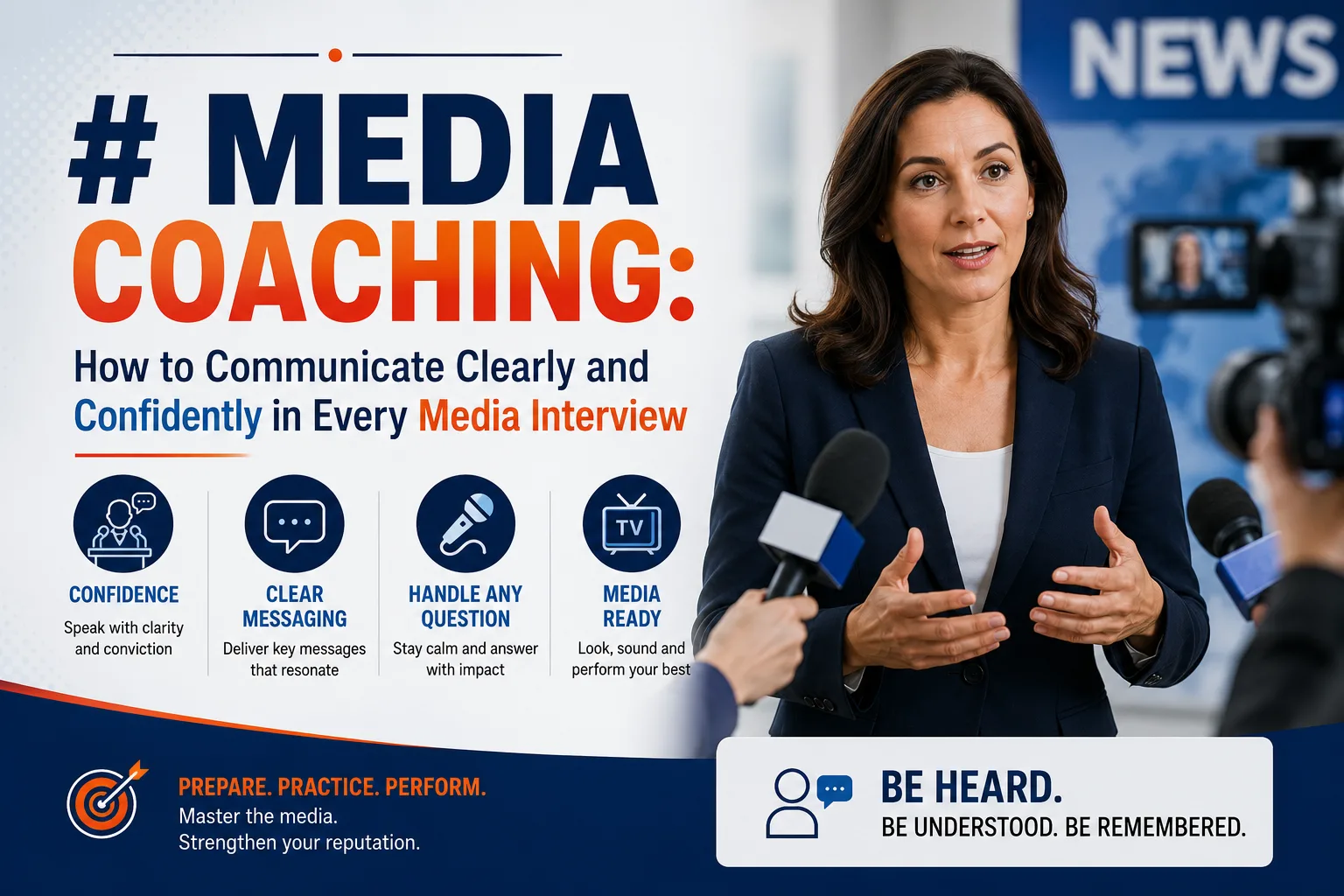
The camera is rolling. The journalist leans forward with their first question. And in that moment—regardless of how senior you are, how well you know your industry, or how many times you've been in this position before—something shifts.
For some leaders, that shift is a subtle heightening of awareness, a focus that sharpens their thinking and brings their best communication instincts forward. For others, it's something closer to a freeze. Words that felt perfectly clear in preparation suddenly feel slippery. Talking points blur. The message that seemed so crisp an hour ago now competes with a dozen other thoughts, all arriving at once.
The difference between those two experiences isn't talent. It isn't seniority. It's preparation—the specific, structured kind that builds both the skills and the composure to perform well when the stakes are highest and the margin for error is smallest.
Why Media Interviews Are Unlike Any Other Communication Context
Leaders who are exceptional communicators in boardrooms, on stages, and in client meetings are sometimes surprised by how differently a media interview feels. The format is unfamiliar. The dynamic is asymmetrical—the journalist controls the questions, the pace, and ultimately the narrative that gets published or broadcast. And unlike a presentation or a town hall, you can't fully anticipate where the conversation will go.
There's also the matter of permanence. A misspoken phrase in a meeting can be clarified in the moment. A misspoken phrase in a media interview can become a headline. That reality changes the psychological experience of the conversation in ways that unprepared communicators often underestimate—until they're already in it.
Media coaching addresses this gap directly. Not by teaching leaders to be guarded or evasive, but by helping them develop the clarity, the structure, and the composure to communicate their message authentically and effectively—regardless of how the conversation unfolds around them.
The Core Skills That Media Performance Demands
Effective media communication draws on a specific set of capabilities that overlap with—but are distinct from—general presentation or leadership communication skills. Understanding what those capabilities are helps explain why leaders who are strong communicators in other contexts still benefit enormously from dedicated development in this area.
Message discipline is perhaps the most fundamental. In a media interview, every question is an opportunity to communicate your key message—but only if you know what that message is and have internalized it deeply enough to return to it naturally, even when the conversation pulls in a different direction. Leaders who haven't done this work often find themselves responding to whatever the interviewer asks, which means their message gets determined by the questions rather than by their own strategic intent.
Bridging is the technique that makes message discipline possible in practice. It's the ability to acknowledge a question, then smoothly transition to the point you most need to make—without appearing evasive or dismissive. Done well, it's nearly invisible. Done poorly, it reads as deflection. The difference is practice, and media training that includes repeated bridging exercises in realistic interview simulations is what makes it feel natural rather than mechanical.
Managing silence and pace is another capability that separates strong media performers from nervous ones. The instinct under pressure is to fill silence—to keep talking past the point where the answer is complete, adding qualifications and context that dilute rather than strengthen the message. Learning to deliver a complete, concise answer and then stop is a skill that takes real practice. But it's one of the most powerful things a leader can develop, because brevity in a media context is almost always more compelling than elaboration.
Non-verbal communication carries particular weight in broadcast contexts. How a leader sits, where they look, the quality of their stillness or their restlessness—all of it is visible, all of it is interpreted, and all of it contributes to the audience's assessment of that leader's credibility and confidence. Media coaching that includes video review and targeted feedback on physical presence consistently produces rapid, visible improvement in this area.
Crisis Communication Is Its Own Discipline
Not every media interview happens under favorable conditions. Some of the most consequential ones happen in the middle of organizational challenges, industry controversies, or moments of public scrutiny—when the pressure is highest and the consequences of a misstep are most significant.
Communicating effectively in those moments requires a different kind of preparation. It requires leaders who have thought carefully about their values, their organization's position, and the narrative they want to shape—before the camera is rolling. It requires the composure to respond to difficult questions without becoming defensive, dismissive, or visibly rattled. And it requires the message discipline to stay grounded in what matters most, even when an interviewer is pushing toward a different story.
At Moxie Institute, media training programs include scenario-based practice that replicates these high-pressure conditions. We create realistic interview simulations—including adversarial questioning, unexpected pivots, and sensitive topic navigation—because we know that the composure leaders need in real situations can only be built by practicing in conditions that genuinely test it.
The Investment That Changes How You're Perceived
Every media appearance is an opportunity—to shape narrative, build credibility, demonstrate leadership, and communicate directly with audiences that matter. Leaders who show up to those opportunities prepared don't just avoid mistakes. They create moments that strengthen their reputation and extend their influence.
That's what great media coaching makes possible. Not a performance. Not a script. A version of yourself that's clearer, more grounded, and more compelling than the version that walks in unprepared.
Moxie Institute works with leaders who understand the stakes and are serious about rising to meet them. Reach out today to explore how we can help you communicate with confidence in every media moment that matters.