Ask a developer what makes a project successful, and you will hear the usual list: land, approvals, financing, timelines. Ask a facility manager the same question ten years later, and the answer is shorter. It is about how much the building costs to keep running.
That gap between the builder’s view and the owner’s view is where some of the biggest hidden costs in construction live. And it is one reason FRP rebar manufacturers in India are seeing more interest from developers, consultants and public project owners who want fewer surprises after handover.
The Number Nobody Puts on the Quote
When two materials are compared, the quote usually decides. The cheaper one wins, the tender closes, and everyone moves on. But the quote only shows the price of day one.
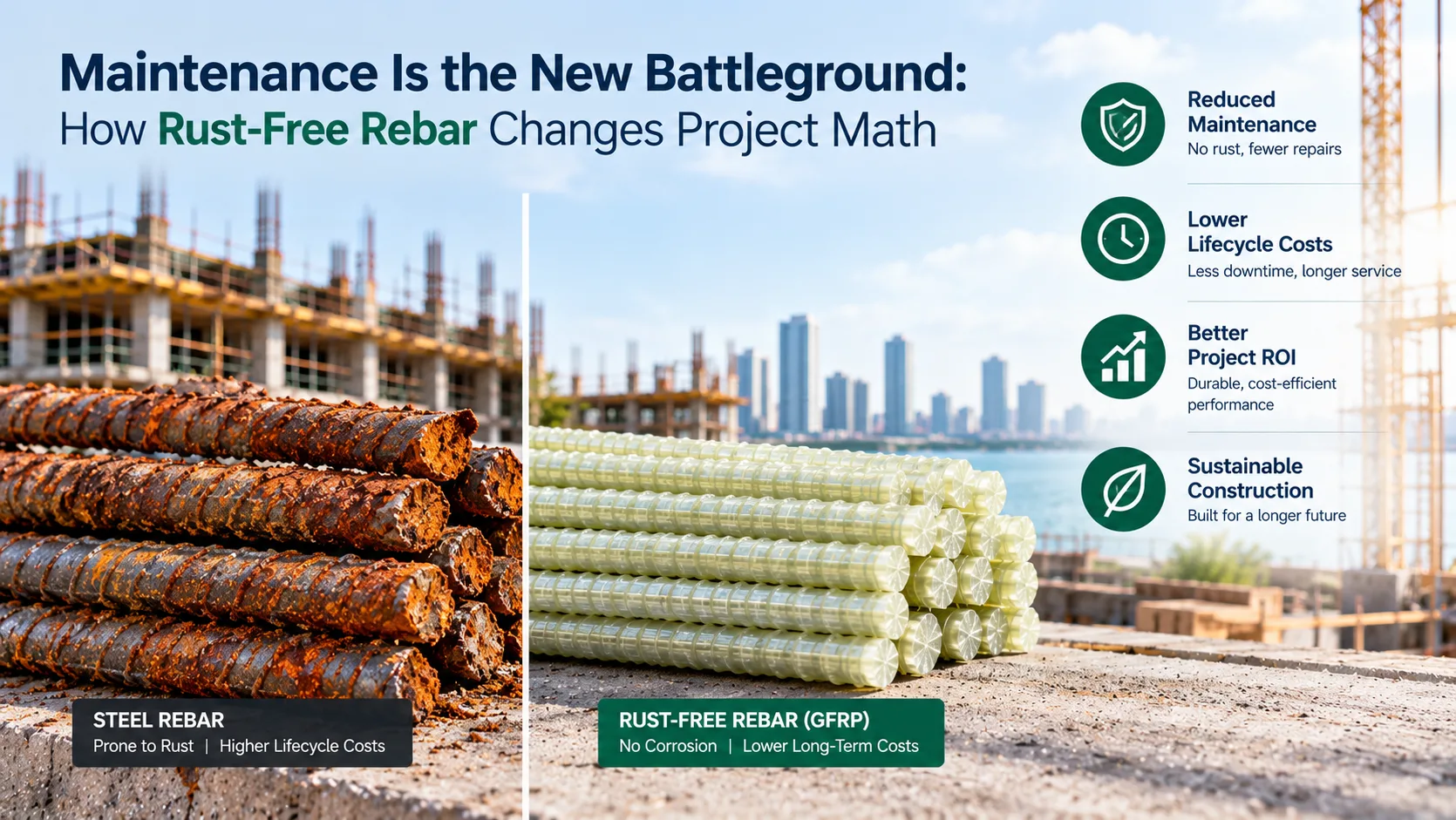
A building lives for fifty years or more. During that time it needs painting, patching, repairs and sometimes serious structural work. Much of that spending traces back to one cause: steel rusting inside concrete.
Here is how it happens. Concrete protects steel at first. Over the years, moisture, salts and chemicals slowly work their way through tiny pores. Once they reach the steel, rust forms. Rust takes up more space than steel, so it swells, cracks the concrete from within, and lets in even more moisture. The damage speeds up quietly, and by the time it shows on the surface, repair is already expensive.
Why Owners Are Paying Closer Attention
A few shifts are pushing this topic up the agenda.
First, more projects are being built in tough places. Coastal corridors, ports, metro tunnels, industrial zones and water treatment plants all deal with salt, dampness or chemicals every day.
Second, shutting down a structure for repair is costly. A closed lane on a bridge, a stopped production line, or an empty hotel floor all lose money while the work goes on.
Third, owners and lenders are asking longer-term questions. They want to know what a building will cost to run, not just to build.
What GFRP Rebar Actually Is
GFRP means Glass Fiber Reinforced Polymer. Thin glass fibers are bundled and held together in a hard resin, then formed into a ribbed bar that grips concrete. It is placed in a structure much like steel bars, but it has no iron in it. Without iron, there is nothing to rust.
It is also light, often around a quarter of the weight of steel for the same size, and it does not conduct electricity or attract magnets. Exact strength and weight figures vary by bar size and grade, so always confirm them on the manufacturer’s data sheet before putting them into a design or a budget.
Where the Business Case Is Strongest
GFRP is not a fit for every project, and a good business case does not pretend otherwise. It is strongest where the environment is harsh or repairs are hard.
Coastal hotels, ports and waterfront buildings face salt constantly. Bridges and flyovers face moisture, traffic and sometimes salts. Tunnels and underground structures are damp and difficult to inspect. Chemical and industrial plants deal with aggressive substances. Hospitals and electrical facilities need non-magnetic and non-conductive materials.
In these cases, the question is no longer whether rust-free reinforcement is interesting. It is whether the extra upfront cost can be balanced by fewer repairs and less downtime later.
Doing the Math Properly
Per kilogram, GFRP can cost more than steel. But kilograms are not the right unit. Because GFRP is light, one kilogram covers more length. Transport and handling may also be easier.
A better comparison looks at the whole life of the structure. Add up the first cost, expected repairs, downtime, and the cost of money over the years. In a harsh environment, the gap can narrow, and in some cases it may reverse. In a dry, mild location, steel may still come out ahead.
There is no single answer. That is why the right approach is to ask for a proper estimate based on your own drawings and compare the numbers over twenty-five or fifty years. Any consultant who promises a fixed saving without looking at your project is guessing.
The Risks Smart Buyers Check
A strong business case also lists the risks. With GFRP, there are a few.
The material does not yield before breaking the way steel does. It holds firm and then fails suddenly if overloaded, so designs use larger safety margins. It is also less stiff than steel, so beams and slabs need closer checks for cracking and sagging.
Bars cannot be bent on site. All hooks, stirrups and curves are made at the factory. A late design change can therefore delay a project, which means schedules need to be locked earlier than usual.
Finally, awareness among designers and contractors is still growing in India. Projects go better when the team has someone who has worked with composite reinforcement before. A structural engineer should approve the design, following guidance such as ACI 440 or the Indian codes that apply to the project.
Supply Chain and Regional Presence
For a developer, supply is as important as price. A late truck can stall a pour, and a wrong bend can hold up a whole floor. This is why many project teams prefer suppliers with a presence near their sites.
Take Punjab as an example. It has growing urban projects, a dense highway network and a strong industrial base. If you are planning work there, you can connect with a GFRP manufacturer in Punjab to understand delivery times, technical support and how bar bending schedules are handled.
What Lenders and Consultants May Ask
As the market matures, a few questions are likely to become routine.
What is the expected service life of the structure, and what is the maintenance plan? What are the exposure conditions: salt, moisture, chemicals? Why was this reinforcement chosen, and who approved the design? Are there test reports and data sheets to back up the claims?
Teams that can answer these clearly tend to move faster through approvals and avoid awkward conversations later.
A Simple Framework for Decision-Makers
If you are weighing GFRP for a project, here is a quick way to think about it.
Start with exposure. Is the structure going to face salt, constant water, chemicals or sensitive equipment? Then look at repair difficulty. Would a shutdown be expensive or disruptive? Next, check the design. Can your engineer make GFRP work within the project’s needs? After that, compare costs over the full life of the structure. And finally, confirm the supply: data sheets, test reports, lead times and local support.
If most answers point the same way, the decision becomes much easier.
Final Thoughts
Construction has always been a business of today’s cost. But owners live with tomorrow’s bills. The projects that age well are usually the ones where someone asked early, what will this cost us in year twenty?
Rust-free reinforcement will not suit every project, and it should not be sold as a cure for everything. But where salt, water and chemicals are part of daily life, it offers a practical way to protect a long-term investment.
Choose with data, not hype, and let the numbers over the full life decide. To discuss your own project, reach out to the MaxFibar team.