Many enterprises still rely on legacy applications to manage critical operations, customer information, financial processes, and business workflows. While these systems may have served organizations for years, outdated architecture, increasing maintenance costs, limited integration capabilities, and scalability challenges can restrict digital growth.
For modern enterprises, legacy system modernization is no longer simply a technology upgrade. It is a strategic investment in operational efficiency, business continuity, and long-term competitiveness.
Through professional Cloud Application Migration Services, organizations can transition suitable workloads to modern cloud environments while improving application architecture, data management, and infrastructure flexibility.
For CIOs, CTOs, and enterprise IT leaders across the USA, UK, South Africa, UAE, Australia, and Canada, selecting the right modernization approach is essential to achieving sustainable results.
1. Identify Legacy Infrastructure Challenges Before Migration
A successful modernization project begins with understanding the existing technology environment.
Many enterprises operate applications developed using older programming frameworks, outdated databases, and tightly connected software components. These systems can become difficult to maintain and integrate with modern business platforms.
Consider a manufacturing company using a legacy inventory application that cannot communicate effectively with its modern ERP and supplier management systems.
Replacing the entire application immediately may introduce unnecessary operational risks. A technical assessment can identify which components need upgrading, integration, or replacement.
Important assessment areas include application dependencies, database structures, infrastructure performance, security vulnerabilities, and business-critical workflows.
2. Select the Right Cloud Migration Strategy
Cloud migration requires more than transferring applications from physical servers to cloud infrastructure.
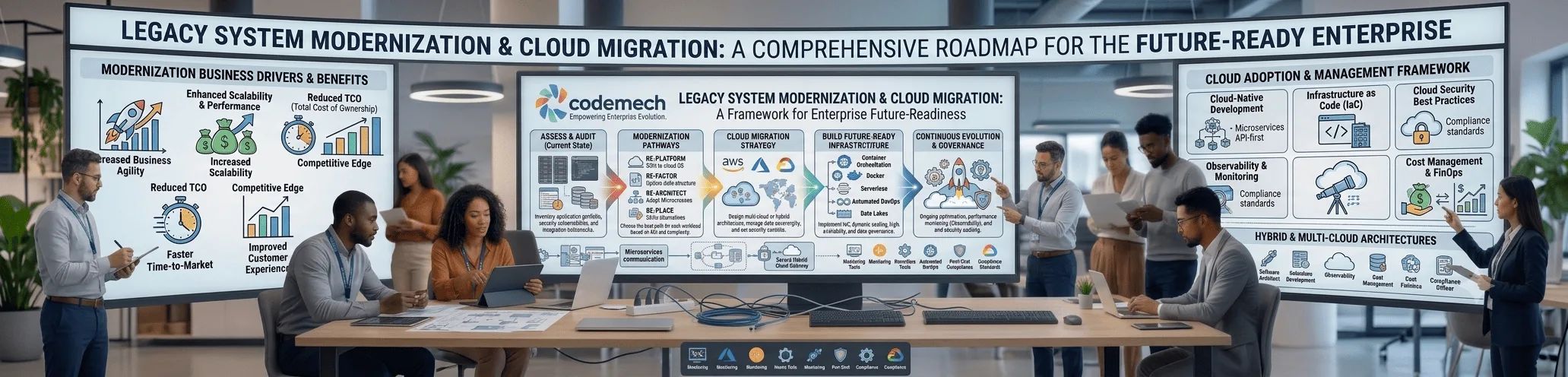
Enterprises must determine whether applications should be rehosted, replatformed, refactored, replaced, or retained.
For example, a business operating an older Java application may initially move it to cloud infrastructure with minimal changes. Later, selected components can be modernized to improve performance and integration capabilities.
Organizations evaluating Azure Migration Services should consider workload compatibility, identity management, networking, storage, application dependencies, and disaster recovery requirements.
AWS and Microsoft Azure both provide infrastructure and services for enterprise workloads. The appropriate platform depends on technical requirements, existing investments, security needs, and operational objectives.
A phased migration approach can help reduce downtime and maintain business continuity.
3. Modernize Application Architecture for Future Growth
Moving an outdated application to the cloud does not automatically make it scalable or efficient.
Some legacy applications contain tightly coupled components that make updates difficult and increase maintenance complexity.
Professional Application Modernization Services can address these limitations through framework upgrades, API development, database optimization, modular architecture, and selective application re-engineering.
For example, an enterprise application built using an older Java framework may benefit from gradual modernization using Spring Boot and REST APIs.
Businesses should also consider Enterprise Architecture Services to establish clear standards for application integration, infrastructure management, data governance, and security.
The objective is to create an architecture that supports future expansion without introducing unnecessary technical complexity.
4. Protect Data Integrity During Enterprise Migration
Data migration is one of the most sensitive stages of enterprise modernization.
Moving information between legacy databases and modern cloud environments requires careful planning to preserve accuracy, relationships, and availability.
Reliable Data Migration Solutions typically involve:
- Database and data quality assessment.
- Source-to-target data mapping.
- Data transformation and cleansing.
- Migration testing and validation.
- Data synchronization.
- Backup and recovery planning.
For example, a financial organization migrating customer records must preserve transaction histories, account relationships, and access permissions.
A structured validation process helps identify missing records, inconsistent values, and migration errors before production systems are switched over.
5. Strengthen Security, Compliance, and Operational Reliability
Enterprise modernization introduces new infrastructure, integrations, and access management requirements.
Security should be considered throughout the development and migration lifecycle.
Organizations should evaluate encryption, identity and access management, role-based permissions, secure APIs, vulnerability assessments, infrastructure monitoring, and disaster recovery.
International businesses must also account for applicable privacy and regulatory requirements, such as UK GDPR and South Africa's POPIA, alongside relevant regulations in the USA, Australia, and Canada.
A well-planned modernization strategy should balance innovation with business continuity, data protection, and operational reliability.
6. Choose an Experienced Modernization Partner
Large-scale modernization projects often involve multiple applications, databases, cloud environments, and internal departments.
Choosing a capable technology partner helps coordinate these technical activities.
Before selecting a provider, evaluate its practical experience with cloud migration, AWS, Azure, application modernization, enterprise architecture, database management, API integration, and quality assurance.
Also assess its approach to technical documentation, project governance, communication, and post-migration support.
A reliable partner should provide a clear modernization roadmap based on existing infrastructure and business priorities rather than recommending unnecessary technology replacements.
Conclusion
Legacy system modernization and cloud migration help enterprises improve infrastructure flexibility, application performance, security, and long-term scalability.
By combining structured migration planning, modern application architecture, reliable data migration, and appropriate cloud technologies, organizations can build technology environments that support changing business requirements.
Codemech Solutions offers software development and digital engineering capabilities for businesses exploring custom applications, enterprise software, cloud solutions, and application modernization.
Organizations planning cloud transformation or legacy system upgrades can visit Codemech Solutions to explore its development capabilities and potential technology partnership opportunities.