ISO Certification in Gurgaon: What Businesses Should Know Before Getting Certified
Gurgaon, now widely known as Gurugram, has become an important business and corporate hub, with organizations operating across technology, manufacturing, consulting, healthcare, logistics, construction, food processing, and professional services. As businesses expand, maintaining consistent processes and demonstrating a commitment to quality, safety, information security, or environmental management can become increasingly important. This is one reason why ISO certification in Gurgaon is being considered by businesses across different sectors.
ISO certification is associated with a specific management-system standard. It is important to understand that ISO itself develops and publishes standards; certification is carried out by independent certification bodies rather than by ISO. For example, ISO 9001 provides requirements for a quality management system and is designed to help organizations establish, maintain, and continually improve their quality-management processes. (ISO)
Understanding ISO Certification
ISO standards provide structured frameworks that organizations can use to manage particular areas of their operations. The appropriate standard depends on the organization's activities, objectives, risks, and requirements.
Some commonly used management-system standards include ISO 9001 for quality management, ISO 14001 for environmental management, ISO 45001 for occupational health and safety, and ISO/IEC 27001 for information security. ISO/IEC 27001, for instance, provides requirements for establishing, implementing, maintaining, and continually improving an information security management system. (ISO)
Rather than treating certification as simply a document, businesses can approach it as an opportunity to review how their processes actually operate. A well-implemented management system can help clarify responsibilities, identify risks, monitor performance, and create a framework for continual improvement.
Why ISO Certification Matters for Gurgaon Businesses
The business environment in Gurgaon includes companies ranging from early-stage startups to large organizations with complex operations. As organizations grow, informal processes may become difficult to manage consistently. Documented procedures and clearly assigned responsibilities can help businesses create greater operational clarity.
For some businesses, certification may also be relevant when dealing with customers, suppliers, tenders, contracts, or supply-chain requirements. However, whether certification is necessary depends on the specific business relationship and applicable requirements.
ISO 9001, for example, is designed for organizations of different sizes and sectors and focuses on areas such as leadership, planning, support, operations, performance evaluation, and improvement. (ISO)
Common ISO Standards Businesses Consider
ISO 9001 – Quality Management
ISO 9001 focuses on quality management systems. It can help organizations establish processes for consistent delivery, customer satisfaction, performance evaluation, and continual improvement.
The standard can be relevant to manufacturing companies, service providers, IT businesses, consultants, educational organizations, healthcare organizations, and many other sectors.
ISO 14001 – Environmental Management
ISO 14001 focuses on environmental management systems. Businesses can use it to create a structured approach toward managing environmental aspects associated with their activities.
For organizations involved in manufacturing, construction, industrial operations, or other environmentally significant activities, an environmental management system can become an important part of their operational framework.
ISO 45001 – Occupational Health and Safety
ISO 45001 focuses on occupational health and safety management. It provides a framework for organizations to manage workplace hazards and risks systematically.
Businesses can use this approach to establish processes around workplace safety, employee awareness, risk management, incident handling, and continual improvement.
ISO/IEC 27001 – Information Security
As businesses increasingly depend on digital systems and data, information security has become an important management concern. ISO/IEC 27001 provides requirements for an information security management system and addresses the systematic management of information-security risks. (ISO)
It can be particularly relevant for technology companies, software businesses, professional service providers, financial organizations, and companies handling confidential information.
What Is the ISO Certification Process?
The certification process can differ depending on the standard, organization, scope, and certification body. However, businesses generally begin by identifying the appropriate standard and defining what parts of their organization will be covered.
The next stage involves reviewing existing processes and identifying areas that need to be developed or improved. Documentation may then be prepared according to the applicable requirements.
Implementation is an important part of the process. Policies and procedures should not exist only on paper; they should be incorporated into actual business operations. Employees should understand their responsibilities and relevant processes should generate appropriate records and evidence.
Organizations may also conduct internal audits and management reviews to evaluate how effectively the management system is working. Following this preparation, an independent certification body can assess the system against the applicable standard.
Choosing the Right ISO Standard
One common mistake businesses make is assuming that one ISO certification is suitable for every organization. The right standard depends on what the business actually does.
A company primarily concerned with product and service quality may consider ISO 9001. An organization managing significant environmental aspects may consider ISO 14001. A business focusing on workplace safety may consider ISO 45001, while an organization managing substantial information-security risks may consider ISO/IEC 27001.
Businesses should therefore assess their objectives and operational requirements before deciding which certification to pursue.
The Role of Professional Assistance
Preparing for certification can be challenging for businesses that have never worked with a management-system standard before. Professional assistance can help organizations understand the applicable requirements, organize documentation, identify gaps, and prepare for the assessment process.
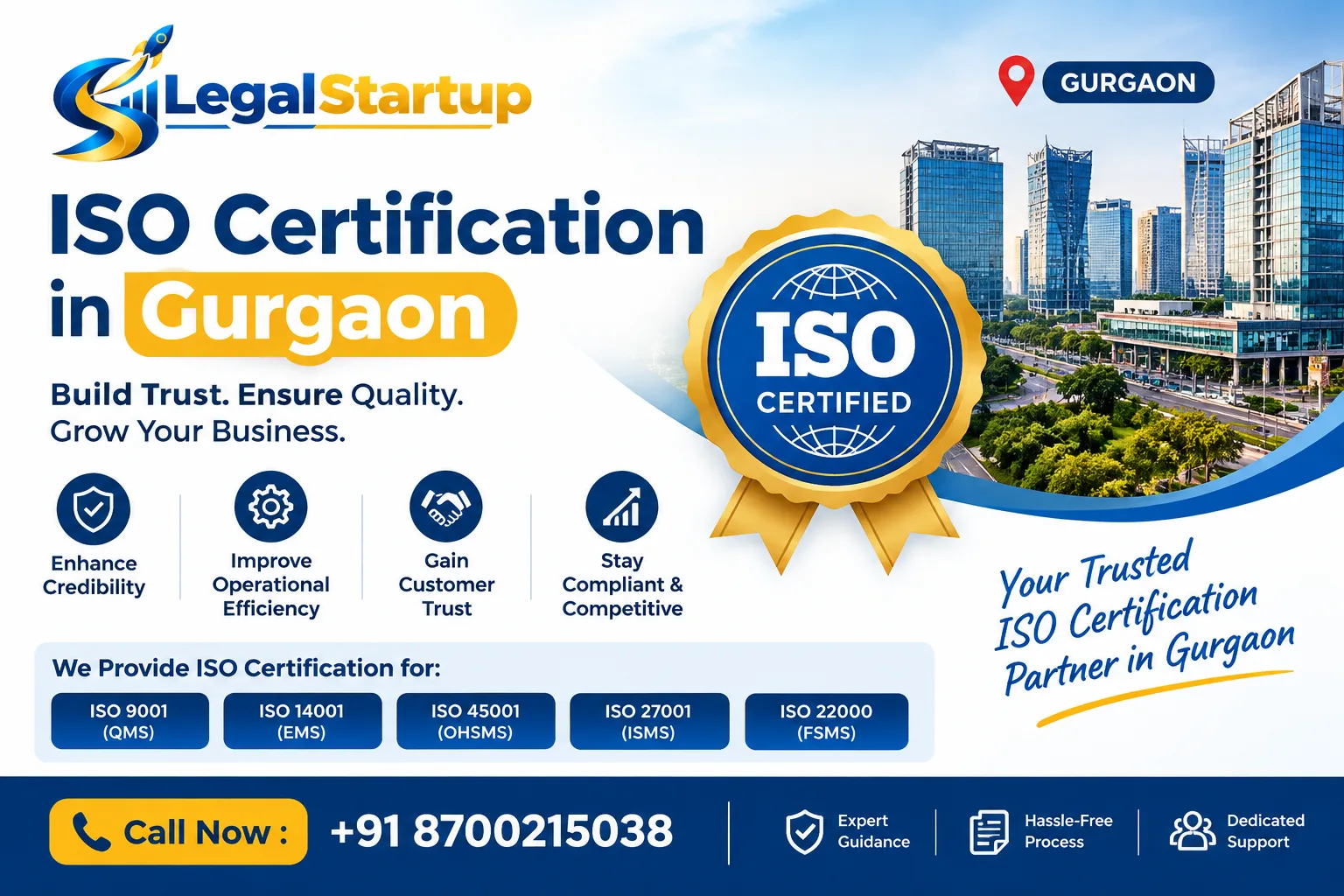
For businesses specifically looking for assistance with ISO Certification in Gurgaon, LegalStartup provides support related to standard selection, documentation, preparation, and certification-related activities.
The purpose of such assistance should be to help the organization understand and implement the relevant management system rather than simply treating certification as a paperwork exercise.
ISO Certification and Continuous Improvement
Certification should not necessarily be viewed as the end of the process. Management systems are intended to be maintained and continually improved.
For example, ISO 9001 emphasizes monitoring, performance evaluation, corrective action, and continual improvement. The newly published ISO 9001:2026 edition also places greater emphasis on leadership, quality culture, and the management of risks and opportunities. (ISO)
This means businesses can use their management system as an ongoing framework for reviewing processes and identifying opportunities for improvement.
Final Thoughts
ISO certification can provide businesses with a structured approach to managing quality, environmental responsibilities, workplace safety, or information security. For organizations in Gurgaon, the first step is understanding which standard is relevant to their business and what the certification process involves.
Businesses should evaluate their actual requirements, establish an appropriate management system, implement it within their operations, and work with a suitable certification body when they decide to pursue certification.
With the right preparation, ISO certification can become more than a compliance exercise—it can form part of a broader approach to organized processes, risk management, customer confidence, and continual business improvement.