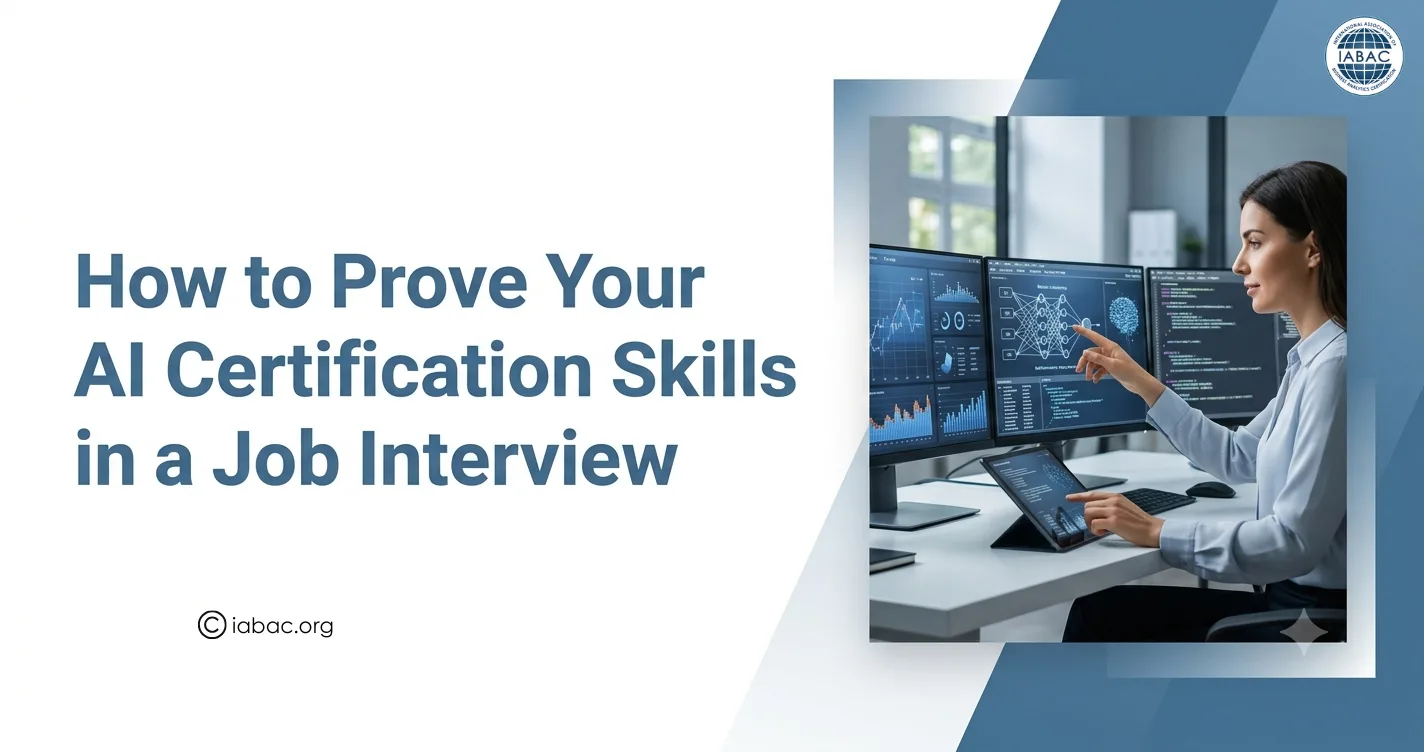
Earning an AI certification is a valuable career milestone, but having a certificate alone does not prove that you can apply what you learned. During a job interview, employers want evidence that you understand AI concepts, can solve practical problems, and can connect technical knowledge with business needs.
So, how do you turn an AI certification into a strong interview advantage?
The key is to show, not simply tell. Instead of saying, “I am AI certified,” demonstrate how your certification helped you understand a problem, choose an appropriate solution, analyze data, or contribute to an AI project.
This guide explains how to effectively prove your AI certification skills during an interview.
Why Your AI Certification Alone Is Not Enough
An AI certification demonstrates that you have completed structured learning and gained knowledge in relevant areas. However, recruiters often need to determine whether you can apply that knowledge in real-world situations.
For example, saying:
“I completed an AI certification and learned machine learning.”
is less convincing than:
“During my certification, I worked on a classification project where I prepared the dataset, selected relevant features, trained a model, evaluated its performance, and interpreted the results.”
The second answer provides evidence of practical understanding.
Your goal is to connect your certification → skills → practical application → business outcome.
1. Know Exactly What Your Certification Taught You
Before your interview, review the curriculum of your AI certification.
Identify the specific concepts, tools, and methodologies you learned. Depending on the certification, these may include:
- Artificial intelligence fundamentals
- Machine learning
- Deep learning
- Generative AI
- Natural language processing
- Data analysis
- Python
- SQL
- Model evaluation
- AI ethics and responsible AI
- AI implementation
- Business analytics
- AI strategy
Do not try to mention every topic during the interview.
Instead, identify three to five skills that are most relevant to the job description.
For example, if you are applying for a data analyst position, emphasize data analysis, Python, SQL, machine learning fundamentals, and visualization rather than discussing every AI theory you studied.
2. Turn Certification Knowledge into Project Stories

One of the strongest ways to demonstrate your skills is through projects.
If your certification included practical assignments, case studies, capstone projects, or assessments, prepare a short explanation for each relevant project.
A useful structure is:
Problem → Approach → Tools → Result → Learning
For example:
Problem: A business wanted to predict customer churn.
Approach: You analysed historical customer data and identified factors associated with churn.
Tools: Python, SQL, and a machine learning algorithm.
Result: You evaluated the model using appropriate performance metrics.
Learning: You discovered that data quality and feature selection significantly influenced model performance.
This gives the interviewer something concrete to evaluate.
3. Use the STAR Method for Behavioural Questions
The STAR method can help you explain your certification projects clearly.
S – Situation: What was the problem?
T – Task: What were you responsible for?
A – Action: What did you actually do?
R – Result: What happened as a result?
Suppose the interviewer asks:
“Tell me about a time you used AI to solve a problem.”
Instead of giving a theoretical explanation, you could structure your answer like this:
Situation: “I worked on a project involving customer data where the objective was to identify customers at risk of leaving.”
Task: “My responsibility was to prepare the dataset and develop a predictive model.”
Action: “I cleaned the data, selected relevant variables, trained a classification model, and evaluated its performance.”
Result: “The project helped demonstrate how predictive analytics could support proactive customer retention.”
This approach makes your certification experience sound practical and relevant.
4. Be Prepared to Explain Your Tools
Recruiters may ask about the tools listed on your resume.
If your certification introduced you to Python, SQL, Power BI, Tableau, TensorFlow, Scikit-learn, or generative AI tools, be prepared to explain how you used them.
Do not simply memorize tool names.
For example, if you mention Python, you should be able to explain:
- What you used Python for
- Which libraries you worked with
- How you handled data
- How you evaluated your model
- What challenges you encountered
The same principle applies to AI platforms and analytics tools.
A shorter list of tools that you can confidently explain is much stronger than a long list of technologies you barely used.
5. Demonstrate That You Understand AI Limitations
Strong AI candidates do not present AI as a solution to every problem.
Interviewers may want to know whether you understand issues such as:
- Data quality
- Bias
- Model accuracy
- Hallucinations in generative AI
- Privacy
- Security
- Explainability
- Model drift
- Implementation costs
- Human oversight
For example, if asked whether a company should immediately deploy a generative AI chatbot, you could explain that you would first assess the use case, data requirements, security risks, expected business value, and appropriate evaluation metrics.
This demonstrates mature AI thinking rather than simply theoretical knowledge.
6. Connect AI Skills With Business Problems
Companies generally do not hire AI professionals simply because they know AI terminology.
They hire people who can use technology to create value.
Therefore, try to connect your technical skills to business outcomes.
Instead of saying:
“I know machine learning.”
say:
“I understand how machine learning can be used to identify patterns in historical data and support forecasting, classification, or decision-making.”
Similarly, instead of saying:
“I learned generative AI.”
you could say:
“I understand how generative AI can support tasks such as content generation, knowledge retrieval, customer support, and workflow automation, while also considering accuracy and governance.”
This shift from technology-first thinking to problem-solving thinking can make your answers much stronger.
7. Build a Small AI Portfolio Before the Interview
If your certification did not include extensive projects, create a few yourself.
You do not need ten complicated projects.
Two or three well-documented projects can be enough to demonstrate practical ability.
For example:
Project 1: Predictive Analytics
Use a public dataset to build a basic prediction model and explain your methodology.
Project 2: Business Dashboard
Analyse a dataset and create a dashboard that communicates meaningful business insights.
Project 3: Generative AI Application
Build a simple AI-powered workflow, chatbot, document analysis solution, or knowledge-retrieval prototype.
Document your projects with:
- Problem statement
- Dataset or input
- Methodology
- Tools used
- Key decisions
- Results
- Limitations
- Future improvements
Your portfolio gives interviewers something tangible to discuss.
8. Prepare for Technical Questions
Expect interviewers to test whether you genuinely understand the concepts behind your certification.
Depending on the position, questions might include:
- “What is the difference between supervised and unsupervised learning?”
- “How would you evaluate a classification model?”
- “What causes overfitting?”
- “How would you handle missing data?”
- “What is the difference between precision and recall?”
- “What are the risks of generative AI?”
- “How would you decide whether an AI use case is worth implementing?”
Do not prepare only definitions.
Practice explaining concepts using simple business examples.
Being able to explain a technical concept clearly often demonstrates deeper understanding than reciting a textbook definition.
9. Explain What You Learned from Your IABAC Certification
If you have completed an IABAC certification, use the certification as a starting point for demonstrating your capabilities rather than treating it as the entire proof of your expertise.
Explain what the certification helped you develop and, more importantly, how you applied those skills.
For example:
“My IABAC certification gave me a structured understanding of AI and analytics concepts. I used that knowledge in practical projects where I worked through data, selected appropriate approaches, evaluated results, and considered how the solution could support business decisions.”
You can then follow this statement with a specific project example.
This creates a natural connection between your credential and demonstrated ability.
For professionals who are still developing their AI careers, an IABAC certification can also provide a structured foundation for building relevant knowledge and practical capabilities.
10. Prepare a Strong Answer to “Why Should We Hire You?”
This is your opportunity to bring everything together.
A strong answer should combine:
Certification + practical skills + projects + business understanding + willingness to learn
For example:
“My AI certification has given me a structured foundation in AI and analytics, but I have focused on applying that knowledge through practical projects. I understand the fundamentals, can work with relevant tools, and more importantly, I understand that successful AI solutions need to solve a real business problem. I am also continuing to develop my technical and analytical skills as AI evolves.”
Keep your answer specific to the position.
11. Bring Evidence, Not Just Claims
Before your interview, prepare an evidence folder or digital portfolio containing:
- Your AI certification
- Project summaries
- GitHub repositories, if available
- Dashboards
- Case studies
- Model evaluation results
- Presentation decks
- Relevant coursework
- Technical documentation
You may not need to show everything.
The purpose is to have evidence available if the interviewer asks:
“Can you show me an example?”
That question becomes an opportunity rather than a challenge.
Common Mistakes to Avoid
Listing Skills, You Cannot Explain
Do not add AI tools to your resume simply because they appeared in a course.
Giving Only Theoretical Answers
Connect concepts to practical examples whenever possible.
Overstating Your Experience
Be honest about whether you have academic, certification-based, internship, freelance, or professional experience.
Ignoring Business Impact
Explain why the AI solution matters, not just how it works.
Treating Certification as the Finish Line
AI changes quickly. Employers value candidates who continue learning and experimenting.
Final Takeaway
An AI certification can help validate your learning, but your ability to demonstrate what you can do is what makes the certification valuable during an interview.
The strongest candidates do not simply say, “I am certified in AI.” They can explain what they learned, demonstrate relevant tools, discuss projects, solve practical scenarios, recognize AI limitations, and connect technical solutions to business objectives.
If you are pursuing an AI career, choose a certification that gives you more than a credential. Look for structured learning that helps you build practical knowledge and develop skills you can confidently discuss with employers.
An IABAC certification can be a useful part of that journey by giving professionals and aspiring AI practitioners a structured foundation in AI, analytics, and related business applications. The real advantage comes when you combine the certification with projects, a strong portfolio, continuous learning, and the ability to communicate your skills effectively.
Remember: your certification opens the door. Your ability to demonstrate your skills help you walk through it.