Customers today interact with businesses across websites, mobile applications, marketplaces, customer portals, social platforms, and other digital touchpoints. As these channels continue to grow, managing content, customer data, commerce, personalization, and analytics across disconnected systems can create inconsistent experiences and operational complexity.
A digital experience platform (DXP) can help businesses bring these capabilities together and create more connected digital customer journeys. However, choosing the right platform is not simply about comparing features or selecting the vendor with the longest list of capabilities.
The best digital experience platform is one that fits your business goals, technology ecosystem, customer needs, scalability requirements, and long-term digital strategy.
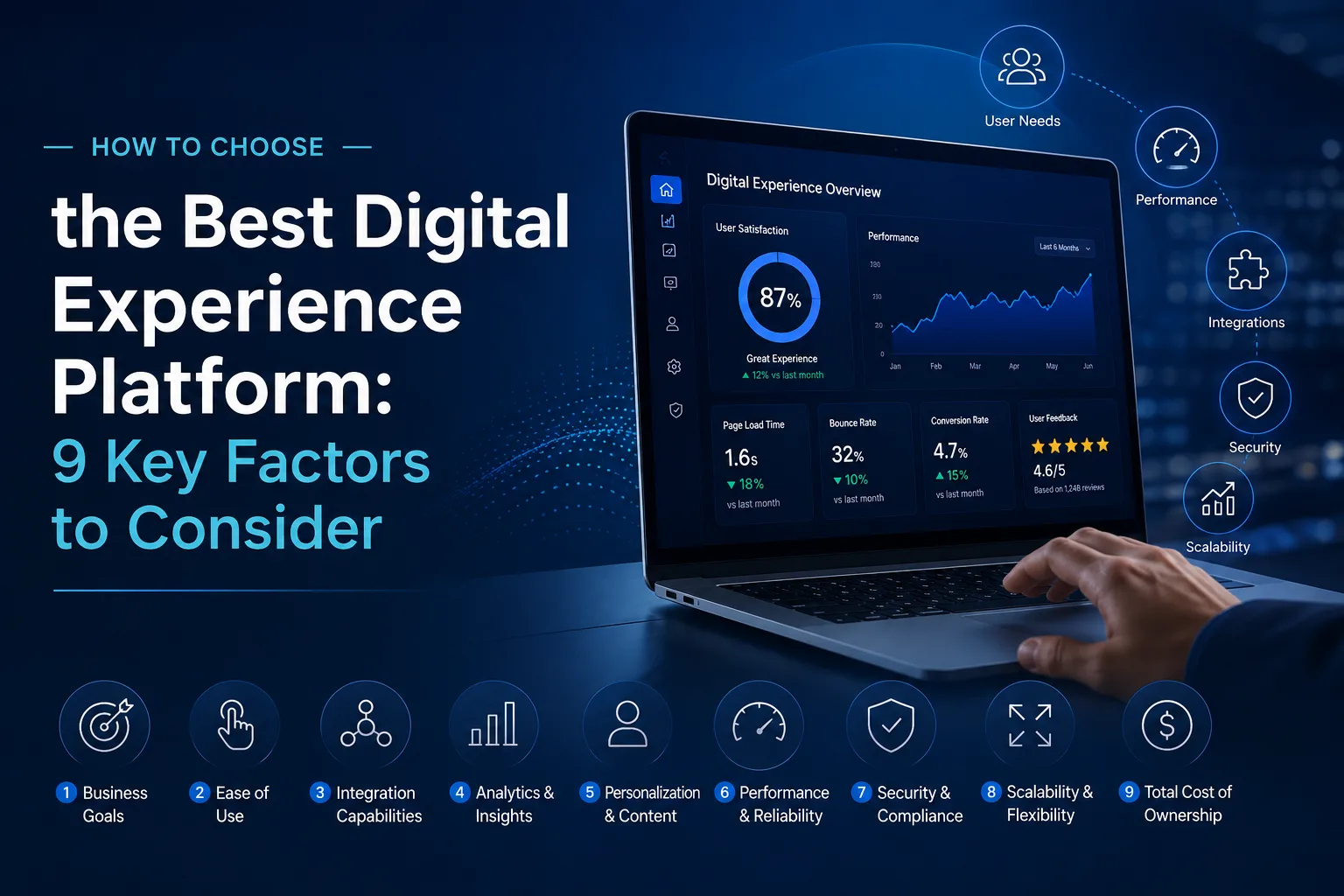
This guide explains the nine key factors businesses should evaluate when choosing a DXP and how to determine which solution is the right fit.
What Is a Digital Experience Platform?
A digital experience platform is a technology ecosystem that helps businesses manage, connect, and optimize digital customer experiences across multiple channels.
A modern DXP can connect capabilities such as:
- Content management
- E-commerce
- Customer data
- Marketing automation
- Analytics
- Personalization
- Product information
- Search and discovery
- Customer portals
- Digital asset management
Rather than managing each digital channel independently, a DXP creates a connected foundation for delivering consistent and personalized experiences.
For example, Neortus describes a DXP as a central hub connecting content management, e-commerce, marketing automation, customer data, analytics, and personalization tools.
However, not every DXP is designed the same way. The right choice depends on your organization's specific requirements.
Why Choosing the Right DXP Matters
Selecting a DXP is a long-term technology decision. Changing platforms later can involve significant costs related to implementation, integrations, data migration, content migration, training, and ongoing maintenance.
The right platform can help organizations:
- Create consistent experiences across digital channels
- Personalize content and customer journeys
- Connect existing business systems
- Improve operational efficiency
- Scale into new markets and channels
- Support faster content and campaign launches
- Improve customer engagement and conversion
- Reduce technology complexity
- Build a more flexible digital foundation
The wrong platform, on the other hand, can create another technology silo rather than solving existing problems.
That is why businesses should evaluate a DXP based on business outcomes—not just its feature checklist.
9 Key Factors for Choosing the Best Digital Experience Platform
1. Define Your Business and Customer Experience Goals
Before comparing DXP vendors, establish what you want the platform to achieve.
Start by identifying your current challenges and future objectives.
For example, are you trying to:
- Deliver a consistent omnichannel experience?
- Improve website and mobile experiences?
- Personalize customer journeys?
- Connect commerce and content?
- Improve conversion rates?
- Simplify technology management?
- Expand into new markets?
- Support multiple brands or regions?
- Improve digital engagement?
- Reduce dependencies between marketing and development teams?
Your goals should determine the capabilities you prioritize.
A platform that is ideal for a global B2B organization may not be the right solution for a smaller business with a simpler digital ecosystem.
Key takeaway: Define business outcomes first and evaluate DXP capabilities against those outcomes.
2. Evaluate Integration Capabilities
A DXP rarely operates independently.
Your platform may need to communicate with:
- CRM systems
- E-commerce platforms
- CMS solutions
- ERP systems
- PIM or PXM platforms
- Marketing automation tools
- Analytics platforms
- Customer data platforms
- Search solutions
- Personalization engines
- Digital asset management systems
Strong integration capabilities are therefore essential.
When evaluating a platform, consider whether it provides robust APIs, connectors, webhooks, integration frameworks, and other mechanisms for securely exchanging data between systems.
Also consider how easily the DXP can integrate with your existing technology stack.
Neortus' DXP approach specifically includes architecture and integration planning across CMS, commerce, CRM, analytics, and personalization systems, with a focus on data consistency, performance, and secure interactions.
Key takeaway: The best digital experience platform should fit into your technology ecosystem rather than forcing your business to rebuild everything around it.
3. Look for Scalability and Composable Architecture
Your digital experience requirements will change as your business grows.
You may add:
- New products
- New brands
- New markets
- New languages
- New customer segments
- New digital channels
- New technologies
- New personalization capabilities
Your DXP should be able to accommodate that growth without requiring a complete platform replacement.
Composable architecture can be particularly valuable because it allows businesses to use modular components and replace or upgrade individual capabilities as requirements evolve.
A scalable DXP should provide flexibility around:
- APIs
- Headless architecture
- Modular services
- Cloud infrastructure
- Multi-site management
- Multi-language experiences
- Multi-market operations
- Third-party integrations
Neortus emphasizes modular, headless, and composable components as part of its DXP approach to support agility and long-term scalability.
Key takeaway: Choose an architecture that can evolve with your business instead of locking you into a rigid technology stack.
4. Assess Personalization Capabilities
Modern customers expect relevant digital experiences.
A DXP should help organizations deliver content, offers, recommendations, and messaging based on factors such as:
- Customer behavior
- Preferences
- Location
- Previous interactions
- Purchase history
- Customer segment
- Context
- Device or channel
Personalization can help businesses make digital experiences more relevant and improve engagement and conversion.
When comparing platforms, look beyond the word "personalization." Determine what the platform can actually personalize, how customer data is used, and how easily marketers can create and manage personalized experiences.
Key takeaway: Evaluate personalization based on your actual customer journeys, not just the existence of a personalization feature.
5. Consider Content and Commerce Management
For many businesses, digital experience and commerce are closely connected.
A customer may discover a product through content, research it through a website, compare products, interact with personalized recommendations, and eventually complete a purchase.
Your DXP should therefore work effectively with your content and commerce ecosystem.
Evaluate how easily the platform supports:
- Content creation
- Content publishing
- Product information
- Product discovery
- E-commerce experiences
- Campaign management
- Promotions
- Customer journeys
- Omnichannel delivery
The goal is to create a connected experience rather than separate content and commerce journeys.
Neortus' DXP offering specifically connects content, commerce, customer data, personalization, and analytics into a broader digital experience ecosystem.
Key takeaway: Look for a DXP that connects content and commerce instead of treating them as isolated systems.
6. Evaluate Digital Experience Monitoring and Analytics
Creating a digital experience is only the beginning. Businesses also need to understand how those experiences perform.
This is where analytics and monitoring become important.
A digital experience monitoring platform can help organizations identify issues affecting digital journeys, depending on the capabilities of the technology being evaluated.
When assessing monitoring and analytics capabilities, consider whether you can measure:
- Page performance
- User behavior
- Conversion journeys
- Engagement
- Customer drop-offs
- Technical issues
- Experience quality
- Campaign performance
- Personalization results
- Channel performance
The objective is to connect experience data with business outcomes.
A platform should make it easier for teams to understand what is happening and identify opportunities for improvement.
Neortus also emphasizes continuous optimization after implementation, including performance monitoring, customer feedback analysis, A/B testing, and personalization refinement.
Key takeaway: Choose a platform that supports continuous measurement and improvement—not just initial implementation.
7. Compare Usability and Marketing Capabilities
A DXP should not become a bottleneck for marketing and content teams.
Consider how easily non-technical users can:
- Create content
- Update pages
- Launch campaigns
- Manage experiences
- Create personalization rules
- Review analytics
- Test variations
- Publish across channels
A technically powerful platform can still become a poor investment if every small change requires developer involvement.
During vendor evaluation, request demonstrations using real business scenarios rather than generic product presentations.
For example, ask the vendor to demonstrate how your marketing team would create a campaign, personalize a page, publish content, and measure its performance.
Key takeaway: Evaluate the platform from the perspective of the people who will use it every day.
8. Calculate Total Cost of Ownership
The platform's licensing price is only one part of the investment.
Your total cost may include:
- Platform licensing
- Implementation
- Custom development
- Integrations
- Data migration
- Content migration
- Infrastructure
- Training
- Support
- Maintenance
- Additional modules
- Third-party tools
A platform with a lower initial price may become more expensive over time if it requires extensive customization or complex integrations.
When comparing solutions, calculate the expected total cost over several years rather than comparing only the initial license or implementation cost.
Also consider the cost of not solving the problem. Fragmented systems, manual processes, poor customer experiences, and slow campaign launches can create significant operational and revenue costs.
Key takeaway: Compare the long-term business value and total cost—not just the platform's starting price.
9. Assess Vendor Expertise, Implementation, and Long-Term Support
Choosing a platform is only one part of a successful DXP strategy.
Implementation quality can significantly affect the final outcome.
Before selecting a vendor or implementation partner, evaluate:
- Relevant industry experience
- DXP implementation experience
- Integration expertise
- Architecture capabilities
- Migration experience
- UX and experience design capabilities
- Change management
- Training and adoption support
- Post-launch optimization
- Ongoing maintenance
Ask potential partners how they approach discovery, architecture, proof of concept, implementation, migration, and optimization.
A structured approach can reduce implementation risks and help ensure the platform delivers measurable business value.
Neortus' DXP process includes discovery and requirements gathering, vendor-fit evaluation, architecture and integration planning, proof-of-concept phases, implementation and change management, followed by continuous optimization.
Key takeaway: Choose a partner that can support the entire DXP lifecycle, not just the initial deployment.
DXP Evaluation Checklist
Before making your final decision, ask these questions:
Evaluation AreaQuestions to AskBusiness goalsDoes the platform solve our most important experience challenges?IntegrationCan it connect with our existing technology stack?ScalabilityCan it support future markets, channels, and products?ArchitectureDoes it provide the flexibility we need?PersonalizationCan we deliver relevant experiences to different customer segments?ContentCan marketing teams manage content efficiently?CommerceCan it work effectively with our commerce ecosystem?MonitoringCan we measure and improve digital experiences?UsabilityCan non-technical teams use the platform efficiently?CostWhat is the total cost of ownership?ImplementationDoes the partner have the expertise to implement and optimize it?Best Digital Experience Platform: What Should You Prioritize?
There is no single DXP that is automatically the best digital experience platform for every business.
The right solution depends on your:
- Business model
- Customer journeys
- Technology ecosystem
- Digital maturity
- Integration requirements
- Personalization strategy
- Scalability needs
- Budget
- Internal capabilities
- Long-term growth plans
For one organization, a comprehensive suite may be the best option. Another may benefit more from a composable approach that combines best-of-breed technologies.
The key is to choose the platform architecture that supports your specific business strategy.
When Should You Consider Implementing a DXP?
A DXP may be worth evaluating if your organization is experiencing several of these challenges:
- Customer experiences are inconsistent across channels
- Content and commerce systems are disconnected
- Teams rely heavily on developers for content changes
- Personalization is difficult to implement
- Customer data is fragmented
- Digital channels are difficult to scale
- Multiple platforms require manual processes
- Marketing campaigns take too long to launch
- You cannot effectively measure digital experiences
- Your existing architecture is limiting innovation
If several of these challenges apply, a DXP assessment can help determine whether a platform change or broader digital experience strategy is appropriate.
How to Choose the Right DXP Implementation Approach
Selecting the platform is only the beginning. A successful implementation should start with understanding your current ecosystem and defining the desired future state.
A practical approach can include:
1. Discover
Assess your existing systems, customer journeys, data sources, content processes, and business objectives.
2. Define Requirements
Identify the capabilities your DXP must provide and separate essential requirements from nice-to-have features.
3. Evaluate Vendors
Compare platforms based on functionality, scalability, integrations, usability, architecture, support, and total cost.
4. Validate With a Proof of Concept
Test important workflows with real use cases before committing to a large-scale rollout.
5. Implement and Migrate
Configure the platform, connect systems, migrate required data and content, and establish governance.
6. Optimize
Continue measuring performance, analyzing customer behavior, testing experiences, and improving personalization after launch.
This lifecycle-based approach reduces the risk of selecting a platform based only on a sales demonstration.
Final Thoughts
Choosing a digital experience platform is a strategic decision that can influence how your business manages content, commerce, customer data, personalization, analytics, and digital channels for years to come.
The best choice is not necessarily the platform with the most features. It is the platform that aligns with your business objectives, integrates with your existing ecosystem, supports scalable architecture, enables personalized experiences, provides meaningful analytics and monitoring, and can evolve as your requirements change.
Start by defining your goals, evaluate the nine factors outlined above, validate your shortlisted platforms through real use cases, and consider the expertise required for implementation and continuous optimization.
For businesses looking to build a connected, scalable, and personalized digital ecosystem, the right DXP can provide the foundation for improving customer experiences while supporting long-term digital growth.
Frequently Asked Questions
What is a digital experience platform?
A digital experience platform (DXP) is a technology ecosystem that connects capabilities such as content management, commerce, customer data, analytics, personalization, and marketing tools to help businesses deliver connected digital experiences across multiple channels.
How do I choose the best digital experience platform?
Start by defining your business goals and customer experience requirements. Then evaluate integration capabilities, scalability, architecture, personalization, content and commerce capabilities, analytics and monitoring, usability, total cost of ownership, and implementation expertise.
What is a digital experience monitoring platform?
A digital experience monitoring platform focuses on measuring and identifying issues that can affect digital user experiences. Depending on the solution, monitoring can include performance, user behavior, conversion journeys, technical issues, and other experience-related metrics.
Is a DXP the same as a CMS?
No. A CMS primarily focuses on creating and managing content, while a DXP can connect content with commerce, customer data, personalization, analytics, marketing, and other digital experience capabilities.
Is a composable DXP better than a traditional platform?
It depends on your requirements. A composable approach can provide greater flexibility because organizations can combine and replace modular components. However, it may also require stronger architecture and integration capabilities.
How long does DXP implementation take?
The timeline depends on the platform, number of integrations, migration requirements, customization, organizational readiness, and project scope. A proof of concept or phased implementation can help validate requirements before a full rollout.
What should I look for in a DXP implementation partner?
Look for experience in platform architecture, integrations, migration, user experience, personalization, implementation, change management, and post-launch optimization. The partner should understand both the technology and your business objectives.