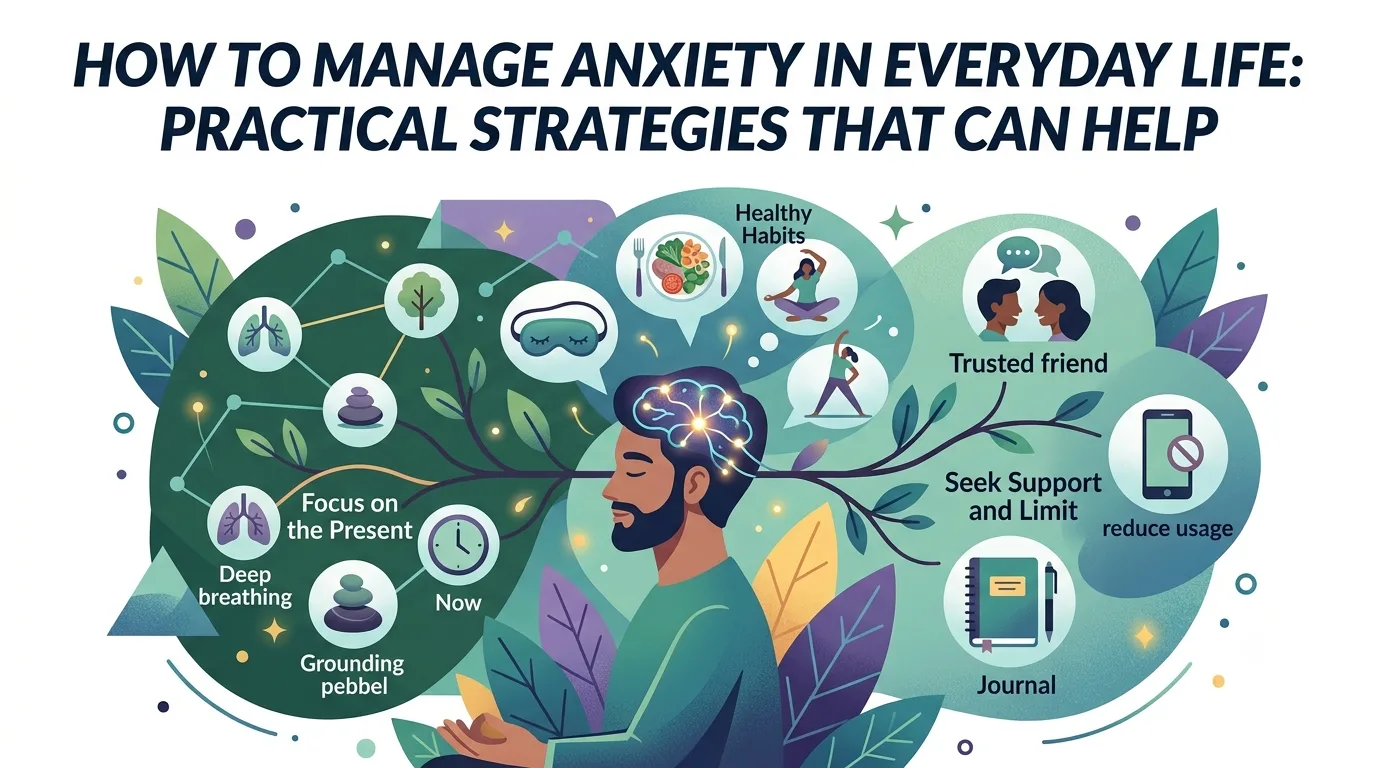
Anxiety is a normal human emotion. Almost everyone experiences it at some point—before an important presentation, during a difficult conversation, while waiting for uncertain news, or when facing a major change in life. A certain amount of anxiety can even be useful because it helps us recognize potential challenges and prepare for them.
The problem begins when anxiety becomes persistent, overwhelming, or difficult to control. Instead of appearing only in response to a specific situation, it may become a constant background feeling that affects concentration, sleep, relationships, work, and everyday activities.
Learning how anxiety works and developing healthier ways of responding to it can make a meaningful difference. While professional support may be appropriate for persistent or severe anxiety, there are also practical strategies that can help people manage everyday anxious feelings.
What Exactly Is Anxiety?
Anxiety involves feelings of worry, fear, nervousness, or uneasiness about something that may happen. It can affect both the mind and body.
Someone experiencing anxiety may notice racing thoughts, difficulty concentrating, restlessness, muscle tension, irritability, changes in sleep, or physical sensations such as a faster heartbeat.
According to the National Institute of Mental Health, anxiety disorders involve more than occasional worry or fear. They can involve symptoms that interfere with everyday activities such as work, school, relationships, and social interactions.
This distinction is important. Feeling nervous before an interview is not necessarily a sign of an anxiety disorder. However, constantly worrying about multiple areas of life and finding it difficult to control those worries may indicate that additional support could be helpful.
Why Does Anxiety Feel So Difficult to Control?
One reason anxiety can feel overwhelming is that the brain is designed to detect potential threats.
When we perceive danger, the body can enter a state of heightened alertness. This response can be useful when an immediate physical threat exists. But modern life often presents psychological or uncertain threats rather than immediate physical danger.
For example, you might worry about losing your job, disappointing someone, making a mistake, getting sick, or being judged by others. Even though these situations may not represent immediate physical danger, your body can still respond strongly.
Anxiety can also create a cycle:
Worry → physical symptoms → noticing the symptoms → more worry → stronger physical symptoms.
Breaking this cycle often requires learning to respond differently to anxious thoughts and sensations rather than trying to eliminate every uncomfortable feeling immediately.
Start by Identifying Your Triggers
One of the simplest ways to understand anxiety is to identify when it tends to appear.
For several days, pay attention to situations that consistently make you feel anxious.
You might notice that anxiety appears:
- Before checking emails
- During social situations
- When speaking in meetings
- Late at night
- After spending too much time on social media
- During financial discussions
- Before making important decisions
- When thinking about the future
- During conflicts with someone close to you
Keeping a short journal can help reveal patterns.
You do not need to write pages every day. A few sentences may be enough:
What happened?
What did I think?
What did I feel physically?
What did I do afterward?
Over time, these observations can help distinguish between the situation itself and the thoughts or interpretations that may be intensifying your anxiety.
Learn to Question Anxious Thoughts
Anxiety often involves predicting negative outcomes.
For example:
“I will definitely fail.”
“Everyone will think I'm incompetent.”
“Something terrible is going to happen.”
“I won't be able to handle it.”
The mind can treat these predictions as facts even though they are actually possibilities.
When you notice this happening, try asking yourself:
What evidence supports this thought?
What evidence contradicts it?
Am I assuming the worst possible outcome?
What would I tell a friend who had this thought?
Is there another possible explanation?
The purpose is not to force yourself to think positively. Instead, it is to develop a more balanced interpretation of the situation.
For instance, instead of thinking, “I will definitely fail the presentation,” you might replace it with, “I feel nervous because the presentation matters to me. I have prepared, and even if I make a mistake, I can recover.”
That statement does not deny the possibility of difficulty. It simply makes the thought more realistic.
Pay Attention to Your Breathing
Anxiety can affect breathing patterns. Some people begin breathing more rapidly or shallowly when they feel stressed, which can contribute to uncomfortable physical sensations.
Slow, deliberate breathing can be one practical way to create a moment of calm.
Rather than trying to take extremely deep breaths, focus on breathing comfortably and slowly. Give yourself a few minutes without multitasking.
The goal is not to “force” anxiety away. It is to give your body an opportunity to settle.
Breathing exercises are particularly useful when combined with other strategies rather than treated as a complete solution for persistent anxiety.
Reduce Constant Mental Stimulation
Modern technology makes it possible to consume information almost continuously.
Notifications, emails, social media updates, news alerts, short videos, and messages can keep the brain engaged from morning until bedtime.
For some people, constant digital stimulation can make it more difficult to mentally switch off.
Creating small periods without notifications may therefore be helpful.
You could try:
- Keeping your phone away during meals
- Turning off unnecessary notifications
- Avoiding work messages immediately before bed
- Taking short screen-free breaks
- Limiting repeated checking of social media
- Setting a specific time to respond to emails
You do not necessarily need a complete digital detox. Even small boundaries can create more mental space.
Take Care of Your Physical Health
Mental and physical health are closely connected.
Regular physical activity, adequate sleep, balanced nutrition, and healthy routines can support overall well-being.
The Centers for Disease Control and Prevention notes that physical activity can provide immediate benefits for brain health, including reduced short-term feelings of anxiety, while regular activity can also support long-term health.
Sleep is particularly important.
When you are consistently sleep-deprived, everyday challenges can feel harder to manage. You may become more irritable, emotionally reactive, or less able to concentrate.
Creating a consistent bedtime routine, reducing stimulating activities before bed, and maintaining a comfortable sleeping environment can support better sleep habits.
Of course, persistent sleep difficulties may have multiple causes and should not automatically be attributed to anxiety.
Avoid Trying to Control Everything
Anxiety often becomes stronger when we try to achieve complete certainty.
Unfortunately, many aspects of life are uncertain.
You cannot completely control what other people think, whether every plan works perfectly, what happens in the future, or whether unexpected problems will arise.
Trying to eliminate every possible risk can therefore become exhausting.
A more useful question may be:
“What is within my control right now?”
Perhaps you cannot control the outcome of a job interview, but you can prepare for it.
You cannot control another person's reaction, but you can communicate respectfully.
You cannot know exactly what will happen next year, but you can take a reasonable step today.
Focusing on controllable actions can reduce the endless mental effort of trying to predict everything.
Do Not Underestimate the Value of Connection
Anxiety can make people withdraw from others.
Someone may avoid social situations because they are afraid of being judged. Another person may isolate themselves because they feel too mentally exhausted to explain what they are experiencing.
But social connection can be an important source of emotional support.
Talking to someone you trust does not necessarily require a long discussion about mental health. Sometimes having dinner together, going for a walk, or simply spending time with someone can provide a welcome break from anxious thinking.
If you do want to talk about anxiety, be specific about what you need.
You might say:
“I don't need advice right now. I just need someone to listen.”
Or:
“I'm feeling overwhelmed and could use some company.”
Clear communication can make it easier for others to support you.
When Professional Support May Be Helpful
Self-help strategies can be useful, but they are not appropriate substitutes for professional mental health care in every situation.
Consider speaking with a qualified mental health professional if anxiety is persistent, increasingly difficult to manage, or significantly affecting your daily life.
For example, professional support may be worth considering if you are regularly avoiding important activities because of anxiety, experiencing persistent panic, struggling to sleep because of worry, or finding that anxiety is interfering with relationships, education, or work.
Therapy can provide a structured environment where you can explore patterns of thinking, emotional responses, behaviors, and underlying concerns.
For people looking for professional psychological support for anxiety and emotional well-being, The Thought Co. offers psychologist-led therapy and describes support for concerns such as anxiety, burnout, relationships, grief, and self-esteem.
The right approach can vary from person to person. A mental health professional can help determine what kind of support may be appropriate based on an individual's circumstances.
Therapy Is Not Only for Crisis Situations
Another misconception is that therapy is something people should consider only when they are experiencing a major crisis.
In reality, people seek therapy for many different reasons.
Someone may want help understanding recurring relationship patterns. Another person may be struggling with self-confidence. Someone else may be navigating a career change, grief, burnout, or a major transition.
Therapy can also provide a dedicated space for self-reflection.
Everyday life can be busy enough that people rarely have an opportunity to slow down and examine what they are thinking and feeling. A structured therapeutic environment can make that process easier.
Create a Personal Anxiety Toolkit
Instead of relying on one technique, consider developing a collection of strategies that you can use depending on the situation.
Your personal toolkit might include:
For immediate stress:
Slow breathing, grounding exercises, stepping outside, or taking a short break.
For recurring worry:
Writing thoughts down, questioning assumptions, and identifying what is within your control.
For physical tension:
Walking, stretching, exercise, or other forms of movement.
For loneliness:
Calling someone you trust or spending time with supportive people.
For persistent difficulties:
Speaking with a qualified mental health professional.
Having several options can make you feel less helpless when anxiety appears.
Be Patient With Yourself
Managing anxiety is not about becoming calm every second of every day.
There will be stressful days. You may still overthink something, feel nervous before an important event, or experience moments when your usual coping strategies do not work.
That does not mean you have failed.
Progress may look different from what you expect. Perhaps you notice anxious thoughts sooner. Perhaps you recover from stressful situations faster. Perhaps you stop avoiding situations that previously frightened you. Perhaps you become more comfortable asking for help.
These changes can matter.
The goal is not perfection. It is developing a healthier relationship with uncertainty, difficult emotions, and your own thoughts.
Final Thoughts
Anxiety can make ordinary situations feel much bigger than they actually are. But understanding your triggers, questioning unhelpful thought patterns, maintaining healthy routines, staying connected with others, and focusing on what you can control can help you respond to anxious feelings more effectively.
Most importantly, you do not have to manage everything alone.
If anxiety becomes persistent or begins interfering with your daily life, seeking professional support can be a practical and responsible step. Mental health professionals can help you understand what you are experiencing and explore strategies that are appropriate for your circumstances.
Taking care of your mental health does not mean eliminating every worry. It means learning how to recognize difficult emotions, respond to them with greater awareness, and seek support when you need it.
Sometimes, managing anxiety starts with something very simple: acknowledging that what you are experiencing deserves attention.