When UK documents need to be used in Libya, they may require official certification and legalisation before the receiving authority will accept them. Whether you are relocating for employment, continuing your education, managing family matters, or conducting international business, preparing your paperwork correctly is an important part of the process.
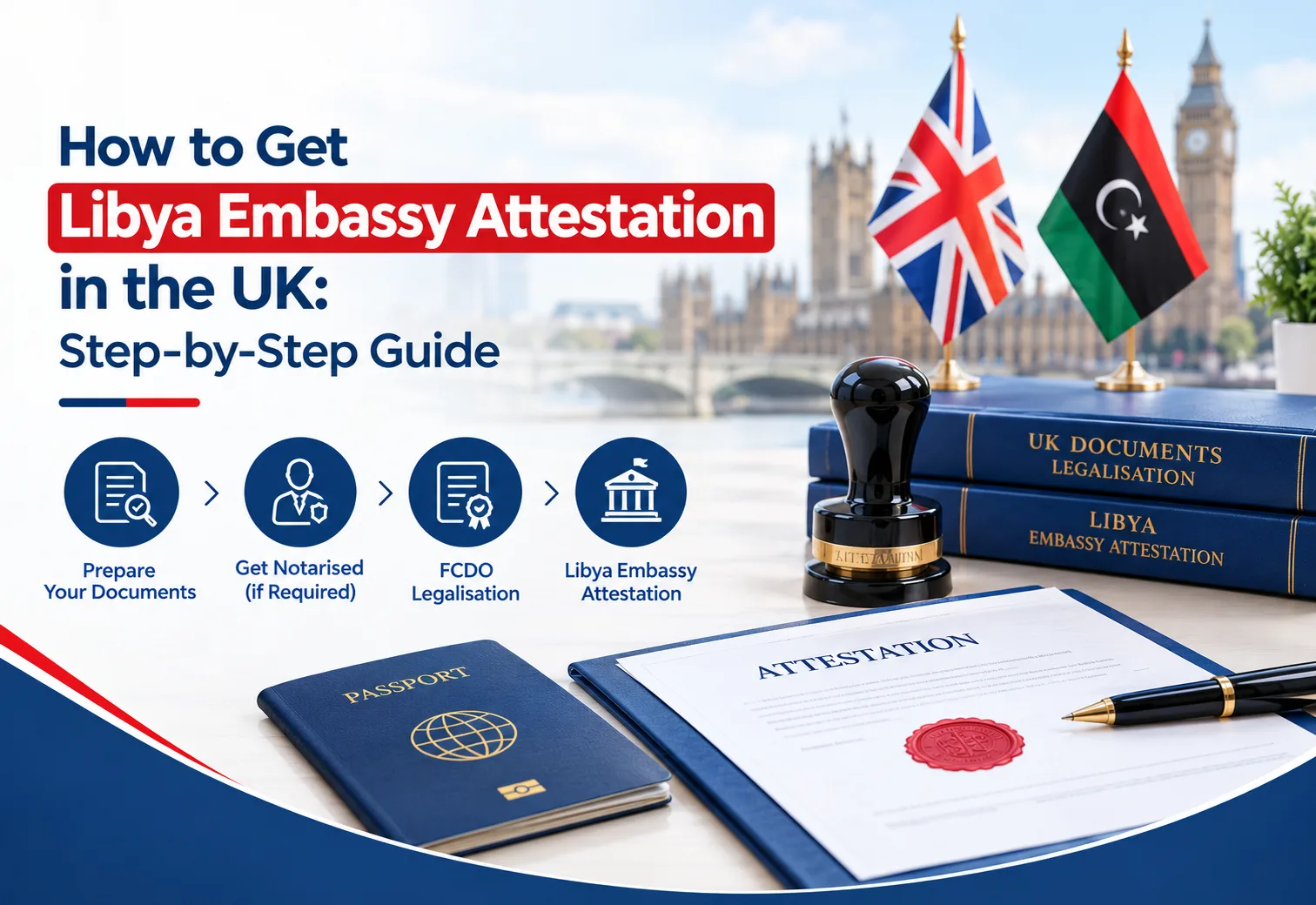
Libya embassy attestation is a document legalisation procedure that helps authenticate eligible UK documents for official use in Libya. Depending on the document type, the process may involve certification by a solicitor or notary, legalisation by the UK Foreign, Commonwealth & Development Office (FCDO), and further attestation by the relevant Libyan consular authority.
Understanding the requirements before submitting your documents can help you avoid unnecessary delays, additional costs, and rejected applications. This guide explains the main stages, documents that may require legalisation, common mistakes to avoid, and practical ways to prepare your paperwork.
What Is Libya Embassy Attestation?
Embassy attestation is a procedure through which a diplomatic or consular authority authenticates documents that have completed the required preliminary legalisation steps. It helps the receiving authority establish that the document has passed through the applicable authentication process.
For UK documents intended for use in Libya, the route generally involves FCDO legalisation followed by submission to the relevant Libyan consular authority. Some documents require additional preparation before reaching the FCDO stage, while commercial paperwork may need certification by the appropriate chambers of commerce.
The precise requirements depend on the document, its format, and the organisation receiving it in Libya. An educational institution, employer, government department, or commercial partner may have specific instructions that you must follow.
It is therefore advisable to confirm the complete legalisation route before arranging an appointment or sending original documents for processing.
Which Documents May Require Attestation for Libya?
The documents you need to legalise depend on why you are submitting them and the requirements of the Libyan authority concerned.
Common categories include the following.
1. Personal and Civil Documents
Personal documents may be required for family applications, residence matters, marriage procedures, and other administrative purposes.
Examples include:
- Birth certificates
- Marriage certificates
- Death certificates
- Name change documents
- Certain medical certificates
- Police certificates, where accepted and required
The appropriate route depends on the issuing authority and document format. Some official certificates may be eligible for direct FCDO legalisation, while other documents may need certification first.
2. Educational Documents
People applying for jobs, professional registration, or further education in Libya may need to present evidence of their academic qualifications.
These documents can include:
- Degree certificates
- Diplomas
- Academic transcripts
- University letters
- Professional qualification certificates
Before starting the process, check whether the receiving institution requires an original certificate, a certified copy, or a document verified by the issuing educational institution.
3. Business and Commercial Documents
Companies trading with Libya may need to legalise paperwork for contracts, business registrations, customs procedures, or commercial transactions.
Examples include:
- Certificates of incorporation
- Company resolutions
- Commercial agreements
- Certificates of origin
- Commercial invoices
- Powers of attorney issued for business purposes
Commercial documents can follow a different route from personal paperwork. Certain documents may require certification by the relevant chamber of commerce before being submitted to the Libyan consular authority.
For invoices and certificates of origin, charges may depend on the transaction value and the applicable requirements. Businesses should confirm the relevant fees and documentation rules before proceeding.
4. Legal Documents
Legal documents may require additional authentication, particularly when they contain signatures or declarations that must be recognised overseas.
Examples include affidavits, statutory declarations, powers of attorney, and certain court documents.
Some signed documents must be notarised before they can be submitted for FCDO legalisation. Always confirm whether notarisation is required and whether the receiving authority has specified particular wording or document formats.
Step-by-Step Process for Libya Embassy Attestation
Following the correct sequence is essential when preparing UK documents for use in Libya. The following steps provide a general overview of the process.
Step 1: Confirm the Requirements With the Receiving Authority
Start by contacting the organisation in Libya that has requested your documents. This could be an employer, university, government department, bank, or business partner.
Ask which documents are required, whether originals or certified copies are acceptable, and whether any particular certification or translation is necessary.
You should also confirm whether the document needs an apostille, consular attestation, or both. Do not assume that every document follows an identical route.
Having these details in writing can help you plan the process more accurately.
Step 2: Check the Document Format and Authenticity
Once you understand the requirements, check that your documents are complete and suitable for submission.
Make sure that names, dates, signatures, and other identifying information are consistent. If a document contains an error, contact the issuing organisation to find out how it can be corrected.
You should also determine whether the receiving authority requires the original document or permits a properly certified copy.
Avoid submitting incomplete paperwork or relying on photographs of documents when the authority requires an original or an officially certified version.
Step 3: Arrange Solicitor or Notary Certification if Required
Some documents need additional certification before they can be submitted to the FCDO.
For example, a power of attorney or affidavit may need to be notarised, while certain copies or supporting documents may require certification by a solicitor or another appropriately authorised professional.
The correct approach depends on the document and the legalisation requirements. Not every document needs solicitor certification or notarisation, and these steps should not be added unnecessarily.
A professional legalisation provider can help establish whether preliminary certification is required before the next stage.
Step 4: Obtain the FCDO Apostille
The FCDO provides a legalisation service for eligible UK documents. An apostille authenticates the signature, stamp, or seal of an eligible official so that the document can proceed through the required international legalisation process.
Where required for Libya, this is an important stage before the document is submitted to the relevant Libyan consular authority.
The FCDO will assess the document according to its legalisation requirements. If the document is unsuitable or requires additional preparation, you may need to resolve the issue before proceeding.
Check the latest FCDO guidance for acceptable document formats, application procedures, fees, and processing times.
Step 5: Complete Libya Embassy Attestation
After the required UK legalisation stage has been completed, the document can be submitted to the relevant Libyan consular authority for further attestation, subject to its current requirements.
This stage may involve submitting the original document, a completed application form, identification details, and any supporting paperwork requested by the authority.
The Libyan Consulate General in Manchester publishes document certification requirements that include an application form, a passport copy, and certification by the FCDO or another relevant UK authority. Its guidance also states that documents must be legalised by the issuing authority.
Requirements can vary by document category, so confirm the applicable procedure before submitting your paperwork.
For corporate documents, additional certification by the appropriate chamber of commerce may be necessary. It is particularly important for businesses to establish the correct sequence before sending invoices, certificates of origin, or other commercial paperwork.
Step 6: Check Translation Requirements
Some Libyan authorities require documents to be translated into Arabic. The translation requirements may differ depending on the document type and the organisation receiving it.
Ask whether the translation must be completed by a particular provider and whether the translation itself needs certification or legalisation.
For commercial documents, Arabic translations may also be required for the relevant chamber or consular submission process.
Do not assume that an English-language document will be accepted simply because it has completed the authentication stages. Confirm the language requirements before submitting the final paperwork.
Step 7: Review and Collect Your Legalised Documents
Once the required stages have been completed, check the returned documents carefully.
Confirm that the correct document has been processed and that the expected stamps, certificates, or attachments are present. Keep copies of the paperwork and any application receipts for your records.
If you are arranging the process through a service provider, confirm how the original documents will be returned and whether tracked delivery is available.
Before sending the documents to Libya, check whether the receiving authority requires any additional steps after the UK legalisation process has been completed.
How Long Does the Process Take?
The time required depends on the document type, whether preliminary certification is needed, the FCDO processing option selected, and the workload of the relevant consular authority.
Straightforward documents may follow a simpler route than commercial paperwork requiring additional chamber of commerce certification.
Translation requirements, incomplete applications, and errors in supporting documents can also affect the overall timeline.
If your paperwork is needed for a job start date, university application, business transaction, or other deadline, allow sufficient time for every stage. Ask for current estimates from the relevant authorities or service provider rather than relying on a general turnaround time.
Remember that the completion date for one stage does not guarantee that the entire process will be finished by the same date.
Common Mistakes to Avoid
A few preventable errors can complicate the legalisation process.
Starting without checking the requirements: Confirm the receiving authority's instructions before paying for certification or legalisation.
Choosing the wrong certification route: Some documents need notarisation or solicitor certification, while others may qualify for direct FCDO legalisation.
Submitting unsuitable copies: Check whether original documents are required and avoid using photographs or scans where they are not accepted.
Overlooking Arabic translation requirements: Ask whether a translation is necessary and whether any specific certification applies.
Ignoring commercial document requirements: Company paperwork, invoices, and certificates of origin may need additional chamber of commerce certification.
Leaving insufficient time: Consider the processing time for each stage, including translation, document collection, and return delivery.
Failing to check the returned documents: Review your paperwork before forwarding it to the receiving authority.
Taking these precautions can make the process more predictable and reduce the risk of avoidable delays.
Why Use a Professional Document Legalisation Service?
Managing multiple legalisation stages independently can be challenging, particularly when different authorities have separate requirements.
A professional provider can review your paperwork, explain the likely procedure, identify missing information, and help coordinate the required certification and legalisation stages.
When choosing a provider, look for clear pricing, secure document handling, realistic turnaround estimates, and a willingness to confirm the correct route before processing begins.
Ask which stages are included in the quoted price and whether translation, courier delivery, or additional certification will incur separate charges.
A provider should explain the process clearly without promising that a foreign authority will accept a document regardless of its requirements. The final decision on acceptance remains with the relevant receiving authority.
Get Help With Your Libya Document Legalisation
Preparing UK documents for international use can involve several stages, from preliminary certification and FCDO legalisation to consular attestation and translation. Understanding the correct route before you begin can help you avoid unnecessary complications.
Legalisation4you provides support with UK document legalisation, including apostille services and embassy attestation. Whether you are preparing personal certificates, educational qualifications, legal paperwork, or commercial documents, the team can help you understand the process and identify the appropriate next steps.
Visit to explore the available services and get guidance on preparing your documents for use abroad.
Frequently Asked Questions (FAQs)
1. What is Libya embassy attestation?
It is a consular legalisation stage used to authenticate eligible documents for official use in Libya after the required preliminary steps have been completed. For UK documents, this generally involves FCDO legalisation before submission to the relevant Libyan consular authority.
2. Do UK documents need an apostille before submission to the Libyan Consulate?
UK documents generally need the appropriate FCDO legalisation before consular attestation. The precise requirements depend on the document type, so confirm the current route with the relevant authority before submitting your paperwork.
3. Which documents can be legalised for use in Libya?
Potentially eligible documents include birth and marriage certificates, educational qualifications, legal documents, company records, commercial invoices, and certificates of origin. Eligibility and preparation requirements vary according to the document and its intended use.
4. Is Arabic translation required?
An Arabic translation may be required, depending on the document and the receiving authority. Some commercial submissions also have specific translation requirements. Confirm whether the translation must be certified or completed in a particular format.
5. Do commercial documents follow the same procedure as personal documents?
Not always. Commercial documents may require certification by a chamber of commerce in addition to the relevant UK and consular legalisation stages. Requirements and fees can also differ for invoices and certificates of origin.
6. How much does the process cost?
The total cost depends on the document type, preliminary certification, FCDO fees, consular charges, any chamber of commerce certification, translation, and delivery. Request an itemised quotation that identifies which stages are included.
7. Can I submit documents without visiting the consulate myself?
A document legalisation provider may be able to coordinate submissions on your behalf, subject to the relevant authority's rules. Confirm the available arrangements and whether any original documents or personal attendance are required.
8. How can I avoid delays?
Check the receiving authority's requirements, prepare the correct original documents, arrange any necessary preliminary certification, confirm translation requirements, and allow sufficient time for every stage. Reviewing the paperwork before submission can also help prevent avoidable problems.