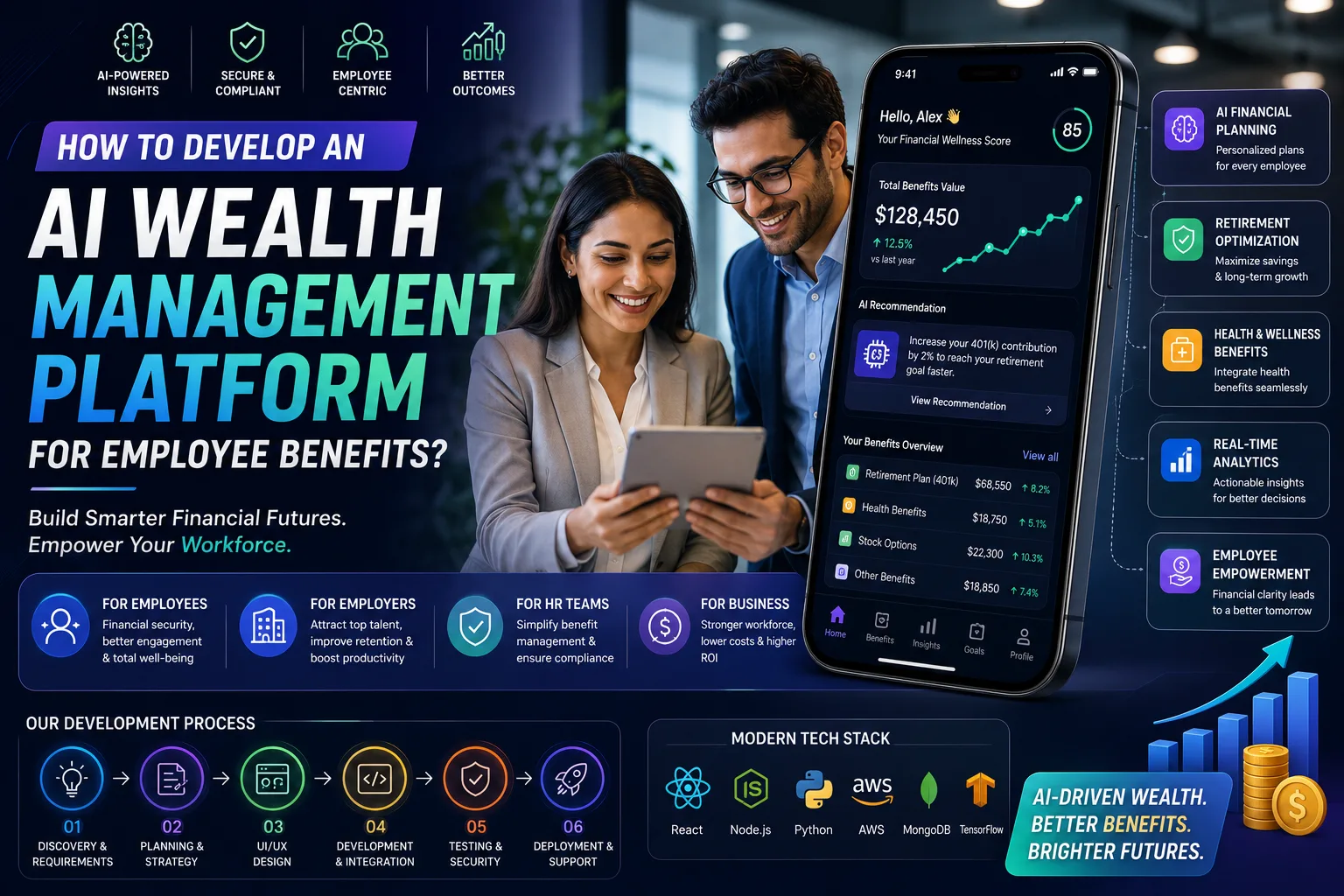
Employee benefits are evolving beyond traditional healthcare coverage and retirement plans. Modern organizations are increasingly investing in financial wellness programs that help employees build long-term financial security while improving workplace satisfaction. AI-powered wealth management platforms are at the forefront of this transformation, enabling employers to provide personalized financial planning, investment insights, retirement guidance, and savings recommendations through intelligent digital solutions.
Developing an AI wealth management platform for employee benefits requires combining advanced technologies with a user-centric approach. The platform should simplify financial decision-making while providing employees with secure, personalized, and data-driven recommendations. From AI-powered financial planning to secure data management and regulatory compliance, every component contributes to creating a valuable employee benefit that supports financial well-being.
Define the Platform's Objectives
The first step in development is identifying the goals of the platform. Some organizations may want to improve retirement planning, while others may focus on increasing employee savings, investment education, or overall financial wellness.
Understanding the needs of both employers and employees helps determine which features should be prioritized. A clear product strategy also ensures the platform aligns with organizational objectives and delivers measurable value.
Build Personalized Financial Profiles
Personalization is one of the greatest advantages of artificial intelligence in wealth management.
The platform should allow employees to create financial profiles that include income, savings habits, investment preferences, retirement goals, financial obligations, and risk tolerance. AI algorithms can analyze this information to generate customized financial plans that evolve as users' circumstances change.
Tailored recommendations make financial planning more relevant and actionable for each employee.
Integrate AI-Powered Financial Planning
Artificial intelligence can simplify complex financial decisions by analyzing large amounts of financial data in real time.
The platform can recommend savings strategies, retirement contribution adjustments, investment allocations, emergency fund targets, and debt management plans based on individual financial goals. AI continuously evaluates changing financial conditions and user behavior to provide updated recommendations that support long-term wealth creation.
These intelligent insights empower employees to make more informed financial decisions.
Offer Retirement Planning Tools
Retirement planning is one of the most valuable employee benefits offered by modern organizations.
The platform should include retirement calculators, future income projections, contribution tracking, and scenario analysis to help employees understand whether they are on track to meet their retirement goals. AI can suggest personalized contribution increases or investment adjustments based on projected retirement outcomes.
Interactive retirement planning tools encourage employees to take a more proactive approach to long-term financial security.
Provide Investment Education
Many employees have limited knowledge of investing, making financial education an essential component of the platform.
AI can recommend educational resources based on each employee's experience level, financial goals, and interests. Articles, videos, interactive tutorials, webinars, and personalized learning paths help users improve their financial literacy while building confidence in their investment decisions.
Continuous education increases engagement and supports better long-term financial outcomes.
Integrate Employer Benefit Programs
The platform should seamlessly connect with existing employee benefit programs.
Integration with retirement plans, stock purchase programs, pension schemes, health savings accounts, insurance benefits, and payroll systems provides employees with a complete view of their financial benefits in one centralized dashboard. This unified experience simplifies financial management while increasing awareness of available employer-sponsored programs.
A connected platform delivers greater value than isolated financial tools.
Implement AI-Powered Goal Tracking
Financial goals vary from person to person, including buying a home, paying off debt, saving for education, or preparing for retirement.
Artificial intelligence can monitor progress toward these goals, provide milestone updates, and recommend adjustments whenever financial circumstances change. Automated reminders and personalized action plans help employees stay focused on achieving their objectives.
Goal-based planning encourages long-term financial discipline.
Prioritize Security and Privacy
Wealth management platforms handle highly sensitive financial information, making security a top priority.
Developers should implement encryption, secure authentication, multi-factor authentication, role-based access controls, fraud detection systems, and continuous monitoring to protect user data. Compliance with privacy regulations and transparent data management practices further strengthens user confidence.
Strong cybersecurity measures are essential for maintaining trust.
Use Predictive Analytics
Predictive analytics enables AI to identify future financial trends based on historical data and user behavior.
The platform can forecast retirement readiness, identify potential savings gaps, estimate future investment growth, and alert employees to financial risks before they become significant problems. These proactive insights help users make informed decisions earlier rather than reacting to financial challenges later.
Predictive intelligence adds long-term value to employee financial planning.
Build a Scalable Cloud Infrastructure
As organizations grow, the platform must be capable of supporting thousands of employees while maintaining fast performance.
Cloud-native architecture, scalable databases, automated backups, and load balancing ensure the platform remains reliable during periods of high usage. Modular system design also simplifies future feature development and integration with additional HR and financial systems.
Scalability supports sustainable platform growth.
Ensure Regulatory Compliance
Financial platforms must comply with various regulations governing data privacy, financial services, and employee information.
Development teams should collaborate with legal and compliance experts to ensure the platform aligns with applicable financial regulations, employment laws, and data protection requirements in each target market. Compliance should be incorporated into both technical development and operational procedures from the beginning.
Maintaining regulatory compliance protects both employers and employees.
Measure Employee Financial Wellness
Analytics dashboards provide employers with valuable insights into employee engagement and overall financial wellness while protecting individual privacy.
Organizations can monitor participation rates, retirement readiness trends, educational program engagement, and overall platform usage to evaluate the effectiveness of their financial wellness initiatives. These insights help employers continuously improve employee benefit programs and maximize their return on investment.
Data-driven decision-making supports long-term program success.
Conclusion
Developing an AI wealth management platform for employee benefits requires a thoughtful combination of artificial intelligence, financial expertise, secure technology, and user-focused design. By delivering personalized financial planning, retirement guidance, investment education, predictive analytics, and seamless integration with existing benefit programs, organizations can empower employees to make smarter financial decisions and build greater financial security.
As workplace financial wellness continues to gain importance, AI-powered wealth management platforms will play an increasingly significant role in helping employers attract, retain, and support talent while creating more personalized and impactful employee benefit experiences.