Some art forms arrive in a room and quietly change everything. They do not shout for attention — they earn it. Pichwai paintings are exactly this kind of art. Rich in narrative, extraordinary in detail, and rooted in over four centuries of devotional tradition, Pichwai paintings bring a quality of depth and cultural beauty to a living room that very few other art forms can match. If you have been looking for a way to make your living room feel genuinely distinctive — not just well-decorated but truly meaningful — Pichwai art deserves your serious consideration.
Understanding What You Are Bringing Into Your Home
Before styling a Pichwai painting in your living room, it helps to understand what the art carries with it. Pichwai paintings originated in Nathdwara, Rajasthan, where they were created as devotional backdrops for the idol of Shrinathji — a beloved form of Lord Krishna. These were not casual decorations; they were sacred commissions, painted by hereditary artists with extraordinary skill and spiritual intention, changed with the seasons and festivals in alignment with the temple's liturgical calendar.
This history means that a Pichwai painting in your living room is not simply a beautiful object — it is a carrier of cultural memory, devotional energy, and artistic heritage. Understanding this changes how you approach styling it. You are not dressing a wall; you are making space for something meaningful.
Choosing the Right Pichwai for Your Living Room
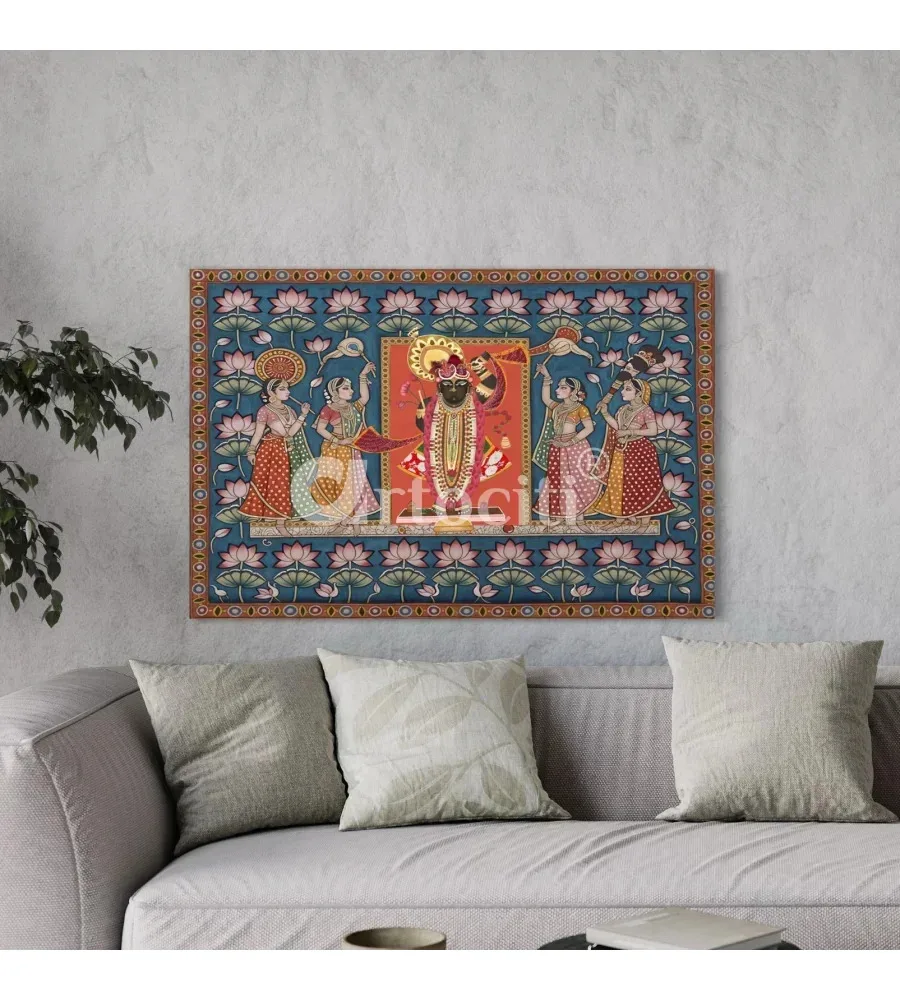
Pichwai paintings come in a range of themes, and your choice should be guided by both the aesthetic of your room and the quality of the artwork itself. Lotus Pichwais — featuring the sacred lotus in intricate, repeating patterns around Shrinathji — are among the most visually striking and work beautifully in living rooms with rich, layered palettes. Cow Pichwais, depicting Krishna surrounded by his beloved cattle, bring warmth and narrative abundance to the space. Raas Lila Pichwais — showing the divine dance of Krishna with the gopis — carry a celebratory, rhythmic energy that suits larger, more social living spaces.
For contemporary living rooms with cleaner, more restrained aesthetics, look for Pichwai compositions with generous negative space, a more limited palette, or a modern rendering of traditional motifs. The subject matter remains classical, but the visual presentation can be adapted to suit a wide range of interior styles without losing the integrity of the tradition.
Placement: Giving the Painting the Space It Deserves
In the living room, a Pichwai painting commands a prominent wall — not a corner, not a secondary surface, but the wall that naturally draws the eye when you enter the room or settle into the main seating. Above the sofa is the most natural and effective placement. Choose a canvas size that covers roughly two-thirds of the sofa's width — this creates proportion and visual balance without the painting feeling either too timid or overwhelming.
Hang it at eye level, with the centre of the canvas sitting approximately 145 to 150 centimetres from the floor. Leave a comfortable gap of 15 to 20 centimetres between the top of the sofa and the bottom of the frame. This maintains the visual relationship between art and furniture without cramping either element. Resist the temptation to surround a Pichwai painting with other wall art or decorative objects — its intricacy and narrative richness mean it works best with breathing room.
Lighting transforms a Pichwai canvas from beautiful to breathtaking. The fine detail, the layered color, and the intricate border work all reveal themselves fully only under directed warm light. A picture light or a focused warm spotlight positioned to illuminate the canvas will show the painting at its absolute best and make it the undisputed centre of the room.
Styling the Room Around the Painting
Once the Pichwai canvas is placed, build the rest of the room's styling around it rather than trying to fit the painting into an already-complete interior. Pull two or three colors from the canvas — the deep indigo, the saffron gold, the ivory white — and echo them in your soft furnishings. Cushions, throws, and curtains that carry these tones create cohesion without being matchy-matchy. Keep the furniture itself relatively neutral so the painting remains the dominant element.
Natural materials complement Pichwai art exceptionally well. Dark wood furniture, brass decorative accents, handwoven cotton or silk textiles, and terracotta or stone accessories all reinforce the organic, craft-rooted character of the painting without competing with its visual complexity. Avoid synthetic or highly reflective materials in the immediate vicinity of the canvas — they create a visual dissonance that subtly undermines the warmth and authenticity of the Pichwai aesthetic.
For living rooms where you want to build a broader wall of Artociti canvas wall décor around a Pichwai centrepiece, choose complementary pieces carefully — devotional subjects, nature-inspired themes, or cultural motifs that share a warm palette and a handcrafted sensibility. A curated arrangement of two or three pieces with the Pichwai as the anchor creates a gallery wall with genuine cultural depth and visual coherence.
Where to Find Authentic Quality
The quality of a Pichwai reproduction matters enormously. The fine detail, the layered palette, and the intricate border work of a genuine Pichwai composition only translate well onto a canvas that is printed with precision and care. Archival inks, a properly stretched frame, and faithful color reproduction are non-negotiable for a painting of this visual complexity.
To explore a curated range of Pichwai paintings across themes, sizes, and formats — each crafted with the quality and attention to detail that this extraordinary art tradition deserves — shop the collection and find the piece that is right for your living room, your home, and your sense of what beauty on a wall should truly mean.
A Pichwai painting in your living room does not just make the space more beautiful. It makes it more meaningful — and in the end, that is the only decoration worth having.