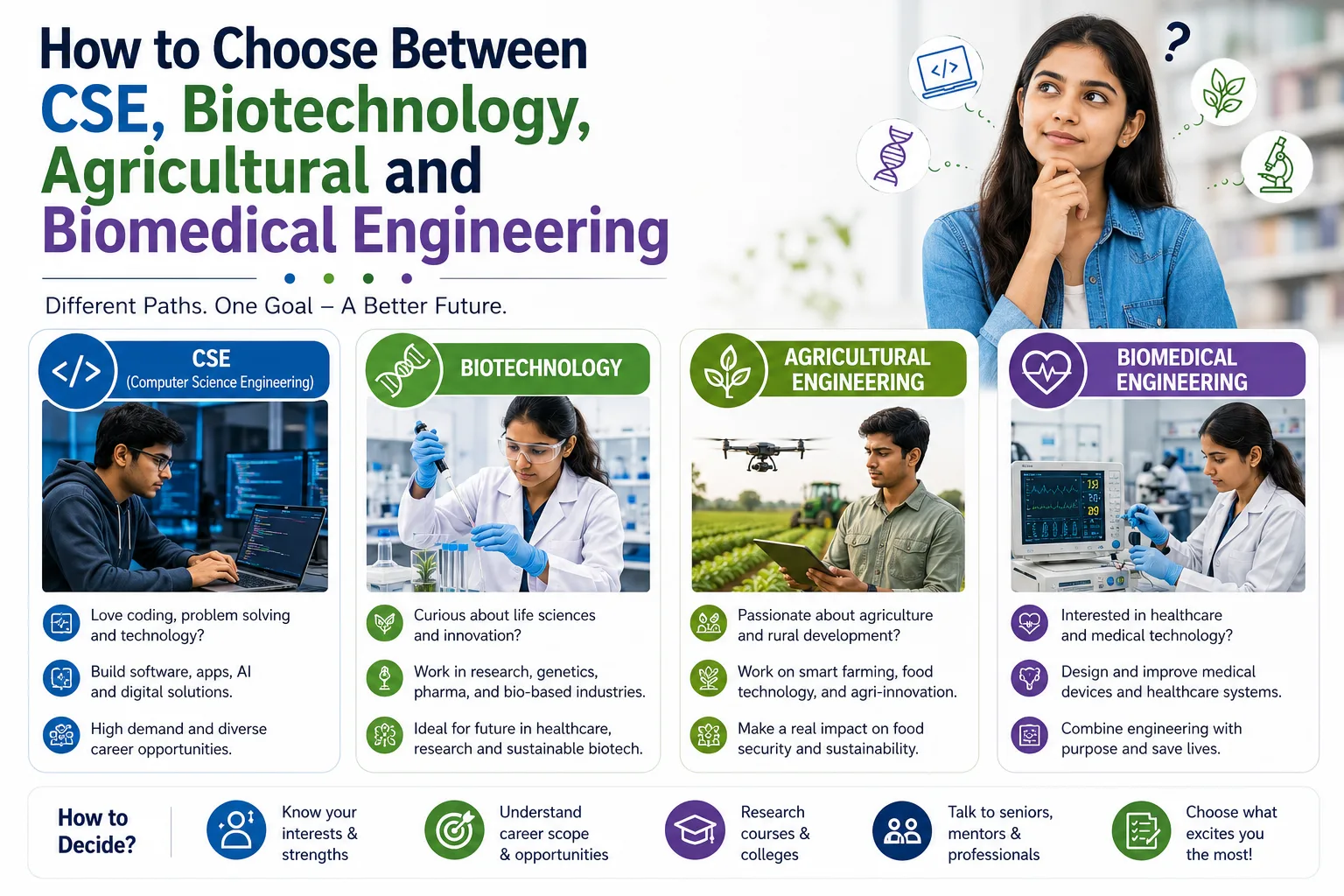
Selecting a B.Tech specialization is an important decision, but students often find it difficult to understand which branch aligns with their interests and future plans. Computer Science Engineering, Biotechnology, Agricultural Engineering, and Biomedical Engineering each offer a different combination of subjects, skills, and career applications.
Instead of choosing a branch only because it is popular, students should understand what they will study and the types of problems they may eventually work on.
Computer Science Engineering
Computer Science Engineering is centered around computing, programming, software, and digital technologies.
Students typically encounter subjects such as programming, data structures, algorithms, databases, operating systems, networking, and software development. Advanced learning may include artificial intelligence, machine learning, cloud computing, cybersecurity, and data analytics.
This branch may suit students who enjoy mathematics, logical reasoning, problem-solving, and technology.
Those researching B.Tech Computer Science Engineering Colleges in UP should compare curriculum quality, coding opportunities, laboratories, projects, internships, and exposure to current technologies.
Biotechnology
Biotechnology connects biological sciences with technology and laboratory applications.
Students may study genetics, molecular biology, microbiology, biochemistry, cell biology, bioinformatics, and bioprocess technology.
This field can appeal to students who enjoy biology and scientific experimentation. Laboratory work is an important component, and students interested in research may also consider pursuing postgraduate education.
Career areas can include pharmaceuticals, research, clinical applications, food technology, quality control, and bioinformatics.
Agricultural Engineering
Agricultural Engineering combines engineering concepts with agricultural systems.
Students may learn about agricultural machinery, irrigation, soil and water management, farm automation, food processing, renewable energy, and precision agriculture.
The field is becoming increasingly connected with digital technologies. Sensors, drones, automated equipment, satellite data, and smart irrigation systems are changing modern farming.
Students interested in agriculture but also comfortable with engineering and technology may find this branch particularly interesting.
Biomedical Engineering
Biomedical Engineering sits at the intersection of engineering, biology, and healthcare.
Students can explore medical instrumentation, biomedical signals, biomaterials, biomechanics, medical imaging, wearable technologies, and healthcare devices.
The field may suit students who enjoy engineering but want to apply their knowledge to medical and healthcare challenges.
The growing use of AI, robotics, sensors, and digital health technologies is also expanding the areas students can explore.
Compare the Learning Style
Each specialization involves a different academic experience.
BranchMajor Learning FocusComputer ScienceProgramming, computing and softwareBiotechnologyBiology, laboratory science and researchAgricultural EngineeringEngineering, farming systems and automationBiomedical EngineeringEngineering, biology and healthcareThinking about preferred subjects and learning environments can make the selection process easier.
Consider Future Career Interests
Students should also research potential professional roles before selecting a branch.
A student interested in developing software may naturally lean toward CSE. Someone fascinated by biological research may prefer biotechnology.
Agricultural Engineering can be relevant to students interested in smart farming and agricultural technology, while Biomedical Engineering can appeal to those interested in medical devices and healthcare innovation.
It is also important to remember that a degree does not permanently restrict a person's career. Additional education, certifications, projects, and experience can allow graduates to move into related or interdisciplinary areas.
Look Beyond the Course Name
Once a student identifies a preferred branch, choosing the right institution becomes the next step.
Students comparing best engineering colleges in Delhi Ncr or universities elsewhere should investigate the specific department rather than relying only on the institution's overall reputation.
Important factors include:
- Curriculum
- Faculty expertise
- Laboratories
- Practical learning
- Research opportunities
- Internships
- Industry interaction
- Student projects
- Career support
The quality and availability of these resources can vary considerably between institutions.
Think About Skills, Not Just Jobs
A good specialization should help students develop skills that remain useful as industries change.
Programming students can develop logical reasoning and software development skills. Biotechnology students can strengthen laboratory and analytical capabilities. Agricultural engineers can combine technical knowledge with agricultural problem-solving, while biomedical engineers can develop expertise across engineering and healthcare.
Communication, teamwork, critical thinking, and adaptability are valuable across all four disciplines.
Explore Before Making a Final Decision
Students do not need to make the decision based entirely on assumptions.
They can attend university open days, review course syllabi, speak with faculty members, communicate with current students, watch introductory lectures, and explore professional roles related to each branch.
This kind of research can reveal what a particular discipline is actually like beyond its name.
Final Thoughts
There is no universally perfect B.Tech specialization. CSE, Biotechnology, Agricultural Engineering, and Biomedical Engineering each serve different interests and industries.
The right choice depends on a student's strengths, preferred subjects, career aspirations, and willingness to develop the skills required by the selected field.
A well-researched decision can help students enter university with clearer expectations and a stronger sense of direction.