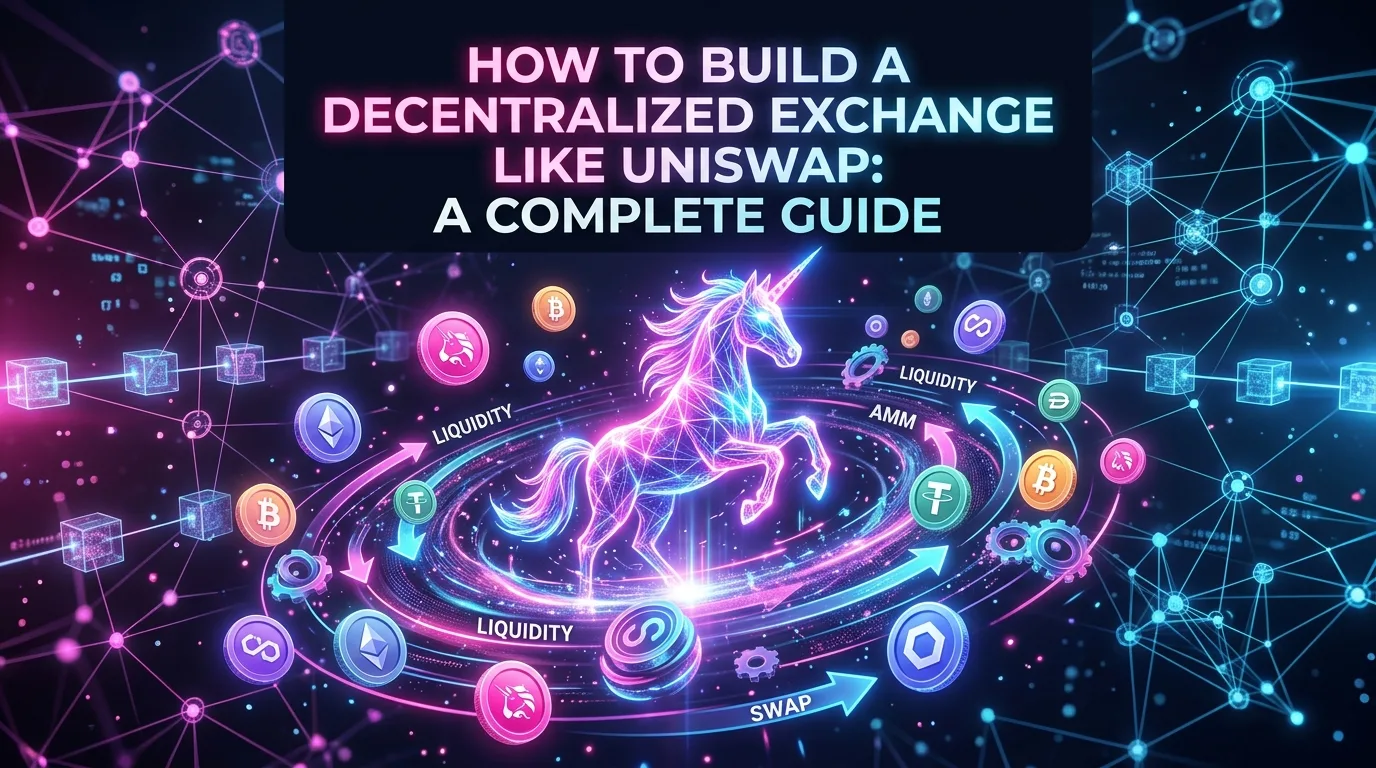
The rise of decentralized finance (DeFi) has fundamentally changed how people interact with financial services. Instead of relying on banks, brokers, or centralized trading platforms, users can now exchange digital assets directly from their wallets through decentralized exchanges (DEXs). Among these platforms, Uniswap has emerged as one of the most influential innovations in the blockchain ecosystem, pioneering the Automated Market Maker (AMM) model and processing billions of dollars in trading volume.
The success of Uniswap has inspired startups, enterprises, and crypto entrepreneurs to explore the possibility of launching their own decentralized exchanges. However, building a DEX is far more complex than creating a traditional cryptocurrency exchange. It requires a deep understanding of blockchain architecture, smart contracts, liquidity mechanisms, security standards, and regulatory considerations.
This guide explores the key components, technologies, and development processes involved in building a decentralized exchange like Uniswap.
Understanding the Uniswap Model
Launched in 2018, Uniswap introduced the Automated Market Maker (AMM) model, allowing users to trade cryptocurrencies directly through liquidity pools instead of traditional order books. These pools are funded by liquidity providers who earn a share of trading fees. Prices are determined using the formula x × y = k, enabling continuous and decentralized trading. The simplicity and efficiency of this model have made Uniswap one of the leading platforms in the DeFi ecosystem.
Why Build a Decentralized Exchange Like Uniswap?
The global DeFi market has expanded dramatically over the last few years. Total Value Locked (TVL) across DeFi protocols has reached tens of billions of dollars, demonstrating sustained investor confidence in decentralized financial systems.
Building a DEX presents numerous opportunities:
- Access to a rapidly growing DeFi ecosystem.
- Revenue generation through transaction and swap fees.
- Creation of governance ecosystems using native tokens.
- Enhanced transparency and user trust.
- Elimination of intermediaries and custodial risks.
Businesses entering this market can create platforms catering to niche communities, regional markets, institutional users, or specialized digital assets.
Core Features of a Uniswap-Like Decentralized Exchange
Developing a competitive DEX requires integrating several essential features that ensure usability, security, and scalability.
Automated Market Maker (AMM)
The AMM engine serves as the backbone of the exchange. Instead of matching buyers and sellers, the protocol uses liquidity pools to facilitate token swaps automatically.
Modern AMMs often include advanced capabilities such as:
- Dynamic pricing algorithms
- Concentrated liquidity models
- Multi-token pools
- Reduced slippage mechanisms
The efficiency of the AMM directly influences user experience and liquidity utilization.
Liquidity Pools
Liquidity pools are crucial for ensuring uninterrupted trading activity. A well-designed liquidity mechanism should include:
- Liquidity provider incentives
- Yield farming opportunities
- Fee distribution systems
- Automated rewards calculation
Attracting liquidity remains one of the biggest challenges for new decentralized exchanges, making incentive programs essential during the platform's early stages.
Wallet Integration
Unlike centralized exchanges, DEXs do not hold user funds. Instead, users connect their wallets directly to the platform.
Popular wallet integrations include:
- MetaMask
- Trust Wallet
- Coinbase Wallet
- WalletConnect
- Ledger hardware wallets
The platform should provide seamless wallet connectivity while maintaining a user-friendly interface.
Token Swapping
The token swap engine enables users to exchange one cryptocurrency for another directly from their wallets. Efficient routing algorithms can identify the most cost-effective trading paths, improving execution prices and reducing transaction costs.
Governance Mechanisms
Many successful DEXs use governance tokens that allow community members to vote on:
- Protocol upgrades
- Fee structures
- Treasury allocation
- New feature implementation
Decentralized governance strengthens community engagement and aligns platform development with user interests.
Technology Stack for Building a Uniswap-Like DEX
Creating a decentralized exchange requires a sophisticated technology stack that integrates blockchain infrastructure with modern web development technologies.
Blockchain Network
The first major decision involves selecting the blockchain on which the exchange will operate.
Popular options include:
- Ethereum
- Binance Smart Chain
- Polygon
- Solana
- Avalanche
- Arbitrum
Ethereum remains the most established DeFi ecosystem, but Layer-2 networks and alternative chains often offer significantly lower transaction costs and faster processing times.
Smart Contracts
Smart contracts automate the entire exchange process, including:
- Token swaps
- Liquidity management
- Fee distribution
- Governance execution
- Staking functions
These contracts are typically written using Solidity for Ethereum-compatible blockchains.
Front-End Development
The user interface determines how easily traders can interact with the platform. Common technologies include:
- React.js
- Next.js
- TypeScript
- Web3.js
- Ethers.js
A modern interface should provide intuitive navigation, real-time market data, and seamless wallet integration.
Backend Infrastructure
Although decentralized exchanges minimize reliance on centralized servers, certain backend components remain necessary, including:
- Analytics engines
- Data indexing services
- Notification systems
- Transaction monitoring tools
- Administrative dashboards
Many projects utilize The Graph for blockchain data indexing and retrieval.
Step-by-Step Process to Build a Decentralized Exchange Like Uniswap
Step 1: Conduct Market Research
Before development begins, businesses should identify:
- Target audience
- Preferred blockchain ecosystem
- Competitor strengths and weaknesses
- Monetization strategies
- Regulatory requirements
A clear business model significantly improves the chances of long-term success.
Step 2: Define Platform Architecture
The next phase involves creating a detailed technical blueprint covering:
- Smart contract architecture
- Security protocols
- Token economics
- Governance framework
- Scalability plans
Proper planning reduces development costs and minimizes future technical debt.
Step 3: Develop Smart Contracts
Smart contract development is one of the most critical phases. The contracts governing liquidity pools and token swaps must be optimized for:
- Security
- Gas efficiency
- Scalability
- Upgradeability
Any vulnerability can result in catastrophic financial losses.
Step 4: Build the User Interface
An effective DEX interface should prioritize:
- Simplicity
- Fast transaction execution
- Responsive design
- Portfolio tracking
- Cross-device compatibility
Many successful DeFi platforms owe their growth partly to superior user experience rather than technological innovation alone.
Step 5: Integrate Wallets and Liquidity Pools
The exchange should support multiple wallet providers and provide incentives to attract early liquidity providers.
Without adequate liquidity, even technically advanced exchanges struggle to gain adoption.
Step 6: Conduct Security Audits
Security is arguably the most important aspect of DEX development.
Leading blockchain projects often undergo multiple independent audits before launch. Common vulnerabilities include:
- Reentrancy attacks
- Oracle manipulation
- Flash loan exploits
- Integer overflow errors
- Access control failures
Given the frequency of DeFi hacks, investing heavily in security audits is essential.
Step 7: Launch and Scale
After testing and auditing, the platform can be deployed on the chosen blockchain network.
Post-launch priorities include:
- Community building
- Marketing campaigns
- Liquidity mining programs
- Governance expansion
- Cross-chain integrations
Successful exchanges continuously evolve based on user feedback and market conditions.
Essential Security Considerations
Security breaches have resulted in billions of dollars in losses across the DeFi industry. Therefore, every aspect of development should follow rigorous security standards.
Best practices include:
- Multi-signature treasury management
- Formal smart contract verification
- Continuous monitoring systems
- Bug bounty programs
- Penetration testing
- Decentralized governance safeguards
The credibility of a decentralized exchange often depends on its security record.
Revenue Models for a Decentralized Exchange
A DEX can generate income through several channels:
Trading Fees
Every token swap can incur a small fee, which may be distributed between liquidity providers and the protocol treasury.
Listing Fees
Some exchanges charge projects for listing new trading pairs or accessing premium features.
Premium Analytics Services
Advanced market analytics and institutional trading tools can create additional revenue streams.
Staking and Yield Products
Offering staking services and yield-generating products can significantly enhance platform profitability.
Many successful platforms combine several monetization methods to diversify income sources.
Why Businesses Are Investing in Decentralized Exchange Development
The future of finance is increasingly moving toward decentralization. Institutional investors, fintech startups, and blockchain enterprises are actively exploring DeFi opportunities due to:
- Reduced operational costs
- Global accessibility
- Transparent financial infrastructure
- New revenue opportunities
- Rapid market growth
As blockchain adoption accelerates, decentralized exchanges are expected to play an increasingly central role in digital asset trading and financial services.
Conclusion
Building a decentralized exchange like Uniswap requires much more than deploying smart contracts. Success depends on combining secure blockchain architecture, efficient liquidity mechanisms, user-friendly interfaces, and sustainable token economics into a robust ecosystem. As the DeFi industry continues to mature, businesses are increasingly turning toward customized Decentralized Exchange Software solutions to capitalize on this growing market. From smart contract development and liquidity pool integration to governance systems and cross-chain capabilities, professional Decentralized Exchange Software provides the technological foundation necessary to launch and scale modern trading platforms. Companies seeking to enter the DeFi sector can accelerate development and reduce technical risks by leveraging enterprise-grade Decentralized Exchange Software, and Blockchain App Factory provides Decentralized Exchange Software solutions designed to help businesses build secure, scalable, and feature-rich decentralized exchanges.