Industrial heating rarely receives attention when a production line is operating smoothly. Yet behind plastic processing, packaging, hot-runner systems, sealing equipment, molds, dies, and other manufacturing processes is a carefully engineered thermal system. Even a small variation in temperature can affect process stability, product quality, cycle time, and equipment performance.
This is why choosing the right coil heaters manufacturer is more than a routine component-purchasing decision. Industrial users need heating elements designed around operating temperature, available space, wattage, voltage, heat-transfer conditions, and the actual process.
Nexthermal provides custom heating elements, controllers, and heating solutions for industrial applications from Bangalore, India. Its approach focuses on matching heating technology to the practical thermal requirements of machinery and manufacturing processes.
What Is a Coil Heater?
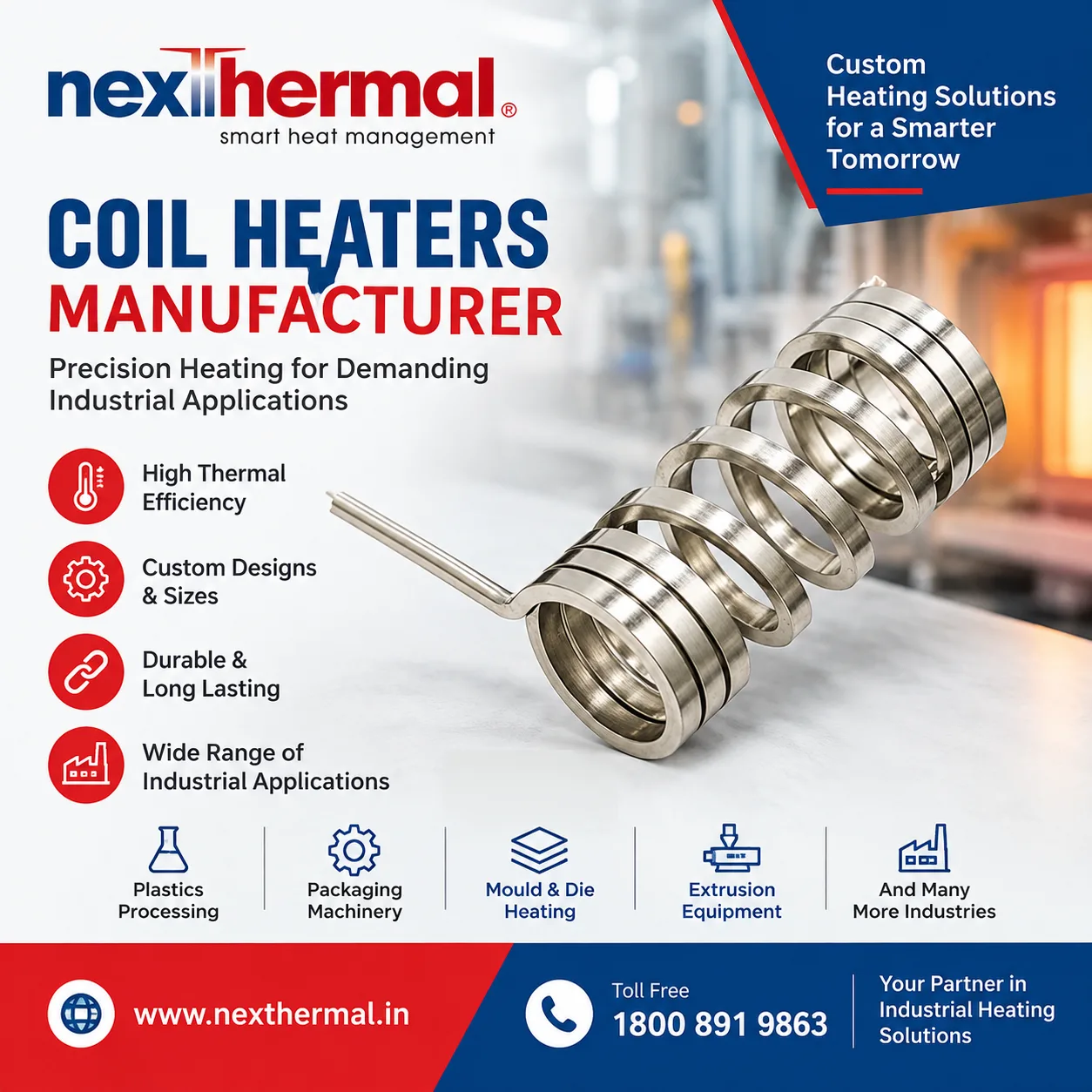
A coil heater is a compact electrical resistance heater designed to generate concentrated heat within a relatively small installation area. Electrical current passes through a resistance element, producing heat that is transferred to the surrounding component or process.
While the basic principle sounds simple, reliable industrial heating requires careful engineering.
A heater must be selected according to factors such as:
- Operating temperature
- Required wattage
- Supply voltage
- Heater dimensions
- Watt density
- Coil configuration
- Sheath construction
- Temperature sensing
- Mounting arrangement
- Heat-transfer requirements
This is one reason an experienced coil heater manufacturer can add significant value. Instead of selecting a heater based only on physical dimensions, engineers can evaluate how it will perform within the complete thermal system.
Why Coil Heaters Are Important in Industrial Equipment
Modern industrial machinery often requires high heating performance in limited space.
A large conventional heater may not fit around a small nozzle, die, mold, or processing component. Coil heaters provide an effective solution because they can be formed into compact geometries while delivering concentrated heating.
Their characteristics make them suitable for applications requiring rapid thermal response and controlled heat distribution.
Typical applications include plastic injection molding, extrusion equipment, hot-runner systems, blow molding, packaging machinery, sealing equipment, laboratory equipment, and other process-heating systems.
The objective is not simply to generate maximum heat. Good thermal design delivers the right amount of heat, in the right location, at the right time.
That distinction is important when specifying industrial heating elements.
Understanding the Role of a Coil Heater Element Manufacturer
A coil heater element manufacturer must consider electrical, mechanical, and thermal requirements together.
For example, increasing wattage may shorten heat-up time, but excessive watt density can create undesirable thermal conditions if the application is not designed to dissipate the generated heat effectively.
Likewise, a heater may have the correct electrical rating but still perform poorly if there is inadequate contact between the heater and the surface being heated.
A well-defined heater specification should therefore consider:
Voltage and wattage: These determine the electrical operating requirements and available heating power.
Watt density: This indicates how heating power is distributed over the heater's effective surface area.
Operating temperature: Heater materials and construction must be suitable for the intended temperature range.
Geometry: The heater needs to fit the available installation space while maintaining effective thermal contact.
Temperature sensing: Depending on the application, thermocouples or other sensors may be needed for process monitoring and control.
Evaluating these parameters before manufacturing can help reduce trial-and-error during machine installation.
Where Pencil Heaters Fit into Industrial Heating
Compact machinery sometimes requires a narrow heating element that can be installed within restricted spaces. This is where manufacturers may evaluate pencil-style heaters and other small-diameter heating technologies.
When searching for a Pencil Heater manufacturer, engineers should look beyond diameter and length.
The selection process should also consider the material being heated, operating temperature, voltage, required wattage, heat transfer, mounting conditions, and expected duty cycle.
A heater designed for intermittent operation, for example, may face different thermal stresses from one expected to operate continuously.
This application-based approach helps ensure that the heating element is specified for real operating conditions rather than selected as a generic replacement component.
Coil Nozzle Heaters for Plastic Processing
Plastic processing is one of the most important areas for compact industrial heating.
Injection molding and extrusion processes require carefully managed temperatures as polymer materials move through the machine. The nozzle area is particularly important because poor temperature management can interfere with material flow and process consistency.
A Coil Nozzle Heater manufacturer can design compact heaters that fit around nozzle geometries and provide concentrated heat where it is required.
For nozzle-heating applications, engineers should consider the nozzle diameter, heater length, wattage, voltage, operating temperature, installation method, lead orientation, and sensor requirements.
Mechanical fit also matters.
Effective contact between the heater and the component being heated can influence heat transfer. A heater with an appropriate electrical specification can still underperform when installation or surface contact is poor.
This illustrates why thermal performance needs to be considered as a complete system.
Heating Coil Elements and Temperature Control
A Heating Coil Element manufacturer provides the heat source, but maintaining a stable process temperature usually requires more than the heating element itself.
An industrial thermal-control loop commonly involves three important functions:
Heating: The heating element converts electrical energy into thermal energy.
Sensing: A temperature sensor measures actual process conditions.
Controlling: A temperature controller responds to sensor information and regulates power supplied to the heater.
When these functions are properly coordinated, the machine can respond more effectively to temperature changes.
For manufacturers, this integrated approach is often more useful than evaluating the heater, sensor, and controller as completely separate components.
Custom Heating Elements Versus Standard Heaters
Standard heating elements are appropriate for many applications, but industrial machinery frequently presents unique challenges.
Space restrictions, unusual geometries, demanding temperature conditions, special lead configurations, or specific wattage requirements can make a standard component unsuitable.
Custom heater development allows parameters such as dimensions, resistance, wattage, voltage, coil profile, termination, and temperature-sensing arrangements to be considered around the machine.
This can be particularly valuable for OEMs designing new equipment.
Rather than modifying an entire machine around an available heater, engineers can work toward a heating element that complements the mechanical and thermal design.
What to Consider When Choosing Industrial Heating Solutions in India
Organizations searching for Industrial Heating Solutions India should evaluate more than a supplier's product catalogue.
Industrial heating is fundamentally an engineering requirement.
Before selecting a heating partner, consider whether the manufacturer can understand the application, review technical requirements, support customization, and integrate heating with sensing and control.
Important evaluation points include manufacturing capability, engineering knowledge, material selection, customization options, quality processes, testing capabilities, technical communication, and after-sales support.
It is also useful to provide the supplier with detailed application information from the beginning.
Instead of asking only for a “coil heater,” specify what needs to be heated, target temperature, voltage, wattage, dimensions, available mounting space, duty cycle, environmental conditions, and temperature-control requirements.
Better input generally enables a more technically relevant heater specification.
Why Thermal Engineering Experience Matters
Industrial heating problems are not always caused by the heater itself.
Unexpected temperature variations can result from inadequate insulation, poor sensor placement, heat loss, insufficient contact, incorrect controller settings, or a mismatch between heater capacity and the thermal load.
This is where thermal engineering experience becomes valuable.
Nexthermal works across custom heating elements, controllers, temperature sensing, and thermal engineering solutions. This broader perspective enables industrial heating requirements to be examined as part of a complete process rather than as an isolated electrical component.
For OEMs and manufacturing plants, that approach can be particularly valuable when developing new machinery, modifying existing equipment, or investigating recurring heating problems.
Building More Reliable Industrial Thermal Systems
Manufacturing equipment continues to become more compact, automated, and process-sensitive. Thermal systems must evolve alongside those changes.
Coil heaters, pencil heaters, nozzle heaters, sensors, and temperature controllers all have specific roles, but reliable heating ultimately depends on how effectively these components work together.
The best starting point is therefore not simply asking, “Which heater should we buy?”
A more useful question is:
What thermal performance does the process actually require?
Once operating temperature, heat load, physical dimensions, electrical requirements, heat-transfer conditions, and control strategy are understood, the appropriate heater technology becomes much easier to define.
For manufacturers and OEMs looking for a coil heaters manufacturer, Pencil Heater manufacturer, Coil Nozzle Heater manufacturer, Heating Coil Element manufacturer, or customized Industrial Heating Solutions India, Nexthermal provides application-focused heating solutions from Bangalore.
Phone: 1800 891 9863
Book a Consultation: https://www.nexthermal.in/contact/
Visit website: https://www.nexthermal.in/
Visit Product Page: https://www.nexthermal.in/coil-heaters/
Connect With Us
More Products:
Electric Heating Elements manufacturer | cartridge heating element | coil heaters manufacturer | temperature sensors manufacturer | tubular heaters manufacturer | temperature controller manufacturers | Engineering services provider in india | Ceramic Infrared Heater manufacturer |Temperature Control Panel manufacturer | Heating Coil Element manufacturer | Tubular Heater manufacturer | Temperature Sensors manufacturer | Temperature Controller manufacturer