Here is something worth thinking about as a parent or educator in the UAE today. When your child sits down to solve a maths problem in school, they are usually given a method to follow, a formula to apply, and an expected answer to arrive at. The process is linear, predictable, and closed. There is one right answer and one approved path to reach it. This works reasonably well for passing exams. But it does very little to prepare a child for the thinking that the real world actually demands — where problems rarely have a single right answer, where the method is often unknown at the start, and where success depends on asking better questions rather than remembering better answers. This is exactly where STEM education for students changes everything. And in a nation such as the UAE, where innovation and technology are at the core of its ambitions, critical thinking skills are more than just academic competencies. They are life skills that each student needs to develop.
Why Critical Thinking Has Become the Most Important Skill in Education
Let us be clear about what critical thinking actually means — because it gets mentioned so often in education conversations that it has started to lose meaning.
Critical thinking is not just about being smart or getting good grades. It is the ability to look at a problem, question the assumptions around it, analyse the available information, consider multiple possible approaches, evaluate which one makes the most sense, and then act on that reasoning with confidence. It is thinking about your own thinking — knowing when you are on the right track and when you need to change direction.
This kind of thinking used to be considered a talent that some students naturally had and others did not. Decades of research have since shown that it is a skill — and like every skill, it can be developed, practised, and strengthened through the right kind of learning experiences.
The question then becomes: what type of learning fosters this ability? The answer, increasingly evident in research and practical results, seems to lie in STEM learning.
What STEM Actually Does Inside a Student’s Brain
There is a fundamental difference between how traditional education and STEM education approach learning — and it goes deeper than curriculum content.
Traditional classroom learning, at its core, is about knowledge transfer. The teacher knows something. The student needs to know it. Information travels from one to the other; the student demonstrates recall, and learning is considered to have occurred. This model has its place. There is a body of foundational knowledge that every student needs to acquire.
But critical thinking is not built through knowledge transfer. It is built through experience — specifically, encountering a problem you do not immediately know how to solve, being supported in working through it systematically, failing at some approaches, learning from those failures, and eventually arriving at a solution you built yourself.
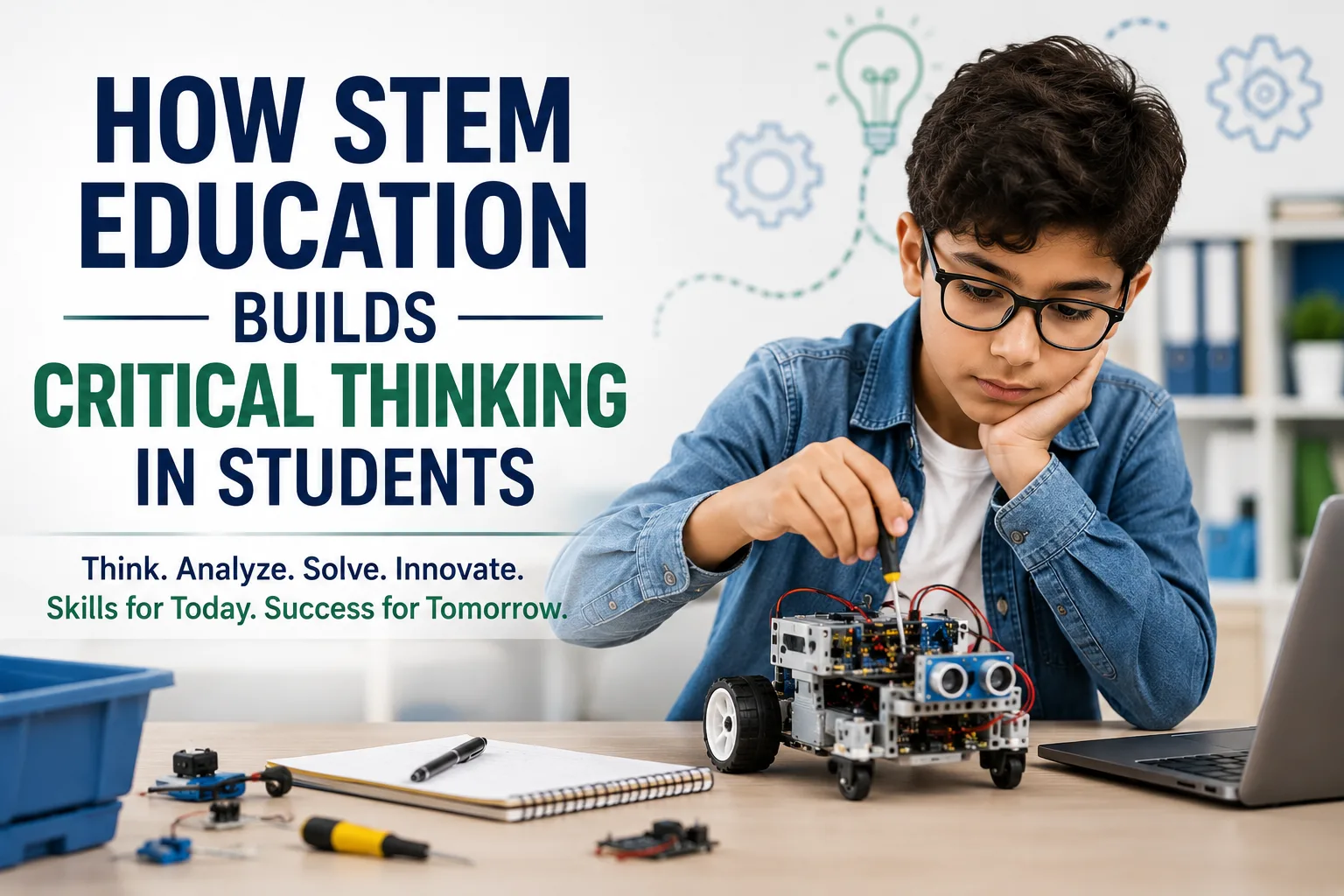
STEM learning for kids creates this experience repeatedly and deliberately. When a child is given a real engineering challenge, build a bridge that holds a certain weight, write code that makes a robot navigate an obstacle, they are not being asked to remember something. They are being asked to think. To plan. To test. To adjust. To think again.
This iterative cycle design, build, test, revise is the engine that drives the development of critical thinking. And it is the cycle that sits at the heart of genuinely effective STEM education in schools.
The Five Ways STEM Builds Critical Thinking, Specifically
Let us get specific about the mechanisms — because understanding how STEM builds this skill helps parents and educators make better decisions about the learning environments they choose.
1. Questioning Over Answering
The first and most fundamental shift that STEM-based learning makes is moving students from answer-seeking to question-asking. In a typical school test, the question is given, and the student provides an answer. In a STEM project, the student often begins by identifying the question itself — what is the problem we are trying to solve, why does it matter, what do we actually need to find out?
The ability to start with genuine inquiry rather than being directed to ask certain questions is one of the strongest intellectual habits a person can acquire in childhood. This is what leads to invention and discovery, as well as setting the problem-solver apart from those who consume information.
2. Failing Forward
One of the most important — and most overlooked — benefits of STEM activities for students is the relationship with failure that they develop.
In a traditional academic environment, a wrong answer results in a mark deduction. It signals inadequacy, triggers anxiety, and teaches children to avoid risks they are not certain about. In a STEM environment, the wrong answer is data. It tells you something useful about the approach you tried. It narrows the solution space and points you toward what to try next.
The children who undergo extensive STEM education learn to face failures in life in a way that is completely different from those who have had a conventional experience with academic tests. They do not think that making mistakes implies that they are stupid. On the contrary, it implies quite the opposite.
This shift in relationship with failure is one of the most important things STEM education contributes to a child’s long-term development — and it shows up not just in science and engineering but in every area of life.
3. Connecting Across Disciplines
One of the defining features of why STEM education matters is that it refuses to treat knowledge as existing in separate, unrelated boxes.
A robotics project requires mathematics to calculate angles, distances, and forces. It requires science to understand how motors, sensors, and electricity behave. It requires engineering to design a structure that actually works. It requires technology to write code that communicates instructions to the hardware. And increasingly, it requires communication and creativity — to explain what was built, why decisions were made, and what could be improved.
When children experience knowledge this way — as an interconnected system rather than a collection of isolated subjects — they naturally develop the ability to draw connections across domains. This cross-disciplinary thinking is exactly what critical thinking looks like in practice, and it is almost impossible to develop through subject-by-subject rote learning.
4. Arguing With Evidence
Good critical thinking requires the ability to form a reasoned position and defend it with evidence — not emotion, not authority, not simply repeating what was read somewhere.
STEM and problem-solving exercises consistently place students in situations where they need to justify their approach. Why did you choose this design? What evidence suggests it will work? How did the data from your test change your thinking? What would you do differently and why?
These conversations — between students and their peers, and between students and their teachers — build the intellectual habit of evidence-based reasoning. Over time, students who regularly practise this form of thinking naturally apply it everywhere. They question claims they encounter, look for supporting evidence, and are less likely to accept ideas uncritically simply because someone in authority stated them.
5. Persistence and Metacognition
STEM learning and creativity develop together through the sustained, deep engagement that complex projects require. When a child spends three weeks working on a single project — iterating, improving, hitting dead ends and finding new paths — something important happens in how they relate to challenging intellectual work.
They develop metacognition — awareness of their own thinking processes. They begin to notice when their approach is not working and instinctively ask themselves why. They develop the self-regulatory habits of stopping, assessing, adjusting, and continuing — rather than giving up or waiting for instructions.
Metacognitive learners consistently outperform their peers across all academic subjects, not just STEM-related ones. The thinking habits developed through deep STEM engagement transfer into every area of learning.
What This Looks Like in UAE Classrooms
The United Arab Emirates has made a genuine national commitment to transforming education to equip future citizens with the skills they will need—and the emphasis on STEM education benefits students squarely within that vision.
The UAE’s national strategy for education recognises that the economy of the next twenty years will require graduates who can think independently, solve novel problems, work across disciplines, and adapt quickly to changing technological environments. These are not outcomes that conventional curriculum delivery can reliably produce. They require a fundamentally different approach to learning — one where students are active participants in constructing knowledge rather than passive recipients of delivered content.
Schools and parents across Dubai, Abu Dhabi, Sharjah, and across the Emirates are increasingly recognising this. The most forward-thinking schools are integrating STEM education in schools not as an optional enrichment activity but as a core pedagogical approach — because the evidence of what it does for students’ long-term thinking development is compelling and consistent.
Critical Thinking Through Robotics - A Specific Example Worth Understanding
Of all the STEM disciplines available to school students, robotics deserves special attention in a discussion of critical thinking development — because it brings together every element of the thinking process in one visible, tangible, immediately engaging activity.
Critical thinking through robotics works because the feedback is instant and honest. When a child writes code to make a robot perform a task, and the robot does something unexpected, there is no ambiguity. The outcome is clear. The gap between intended and actual is obvious. The student must now think analytically about what happened, why it happened, and what change to the code or the physical setup would produce a different result.
This process — observe, hypothesise, test, revise — happens dozens of times in a single robotics session. Over months and years of this kind of learning, the thinking process becomes habitual. Students stop seeing problems as walls and start seeing them as puzzles that yield to persistent, systematic thinking.
For UAE students aiming toward careers in engineering, AI, data science, aerospace, and smart infrastructure, all sectors that the UAE’s Vision 2031 places at the centre of national development, this kind of thinking training is not optional. It is foundational.
Future Skills for Students - Why This Cannot Wait
Here is the reality that every parent in the UAE needs to sit with for a moment.
The World Economic Forum consistently identifies critical thinking, complex problem-solving, creativity, and analytical reasoning among the top skills that employers will prioritise in the coming decade. These are not niche technical skills for a small number of roles. They are fundamental human capabilities that will determine who thrives in a world increasingly shaped by automation, AI, and rapid technological change.
The jobs that do not yet exist — the roles that will be created by technologies currently being developed — will not be filled by people who are good at remembering and repeating. They will be filled by people who can think, adapt, and create.
STEM education is what creates them. Not by loading them up with all sorts of technical information that will soon become outdated in ten years. But rather, by fostering an approach to thought processes that would remain relevant no matter what the future of technology looked like.
The window for building these foundations is early. The habits of thinking that children develop between the ages of eight and sixteen have a lasting effect on how they approach challenges for the rest of their lives. Starting STEM-based learning early is not about academic advantage. It is a matter of giving children the cognitive tools they will genuinely need.
A Final Thought for Parents and Educators
STEM education is not about producing engineers and scientists — though it does produce them, and the world needs them. It is about producing people who can think. Who can question? Who can analyse? Who can create? Who can persist through difficulty and come out the other side with a solution they built themselves?
These qualities are not luxuries. In the UAE of 2026 and beyond, they are the baseline of what a prepared, capable, confident young person looks like.
If you are looking for a structured programme that develops these qualities through hands-on robotics, AI, and STEM learning with age-appropriate projects, experienced educators, and a curriculum built around real-world thinking skills, then STEM-Xpert is worth exploring.