
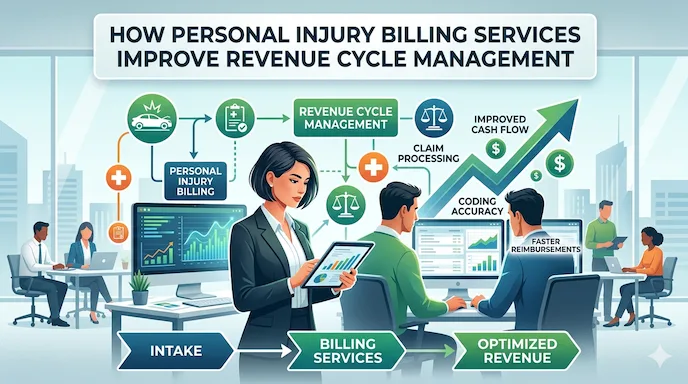
Specialized Personal Injury Billing Services are designed to bridge this gap, transforming a chaotic legal-medical intersection into a streamlined Revenue Cycle Management (RCM) engine. Here is how these services optimize the financial lifecycle of an injury-focused practice.
1. Navigating the Complexity of Multi-Payer Coordination
Traditional RCM usually involves a patient and a single insurance carrier. In personal injury, the landscape is crowded with auto insurance adjusters, health insurance providers, and legal counsel.
- The Problem: Standard billing teams often struggle to determine "who to bill first." Is it the patient’s Medical Payments (MedPay), Personal Injury Protection (PIP), or a Letter of Protection (LOP)?
The Solution: Specialized billing services act as a "traffic controller." They identify the correct primary payer and manage Lien Filing, ensuring the practice has a legal claim to a portion of the patient’s future settlement.
2. Letter of Protection (LOP) Management
For many personal injury patients, the only way to afford care is via an LOP—a contract between the attorney and the provider.
- Financial Risk: Without meticulous tracking, LOPs can become "zombie accounts" that never get collected once a case settles.
RCM Impact: Billing services maintain a rigorous LOP Tracking System, regularly checking in with law firms on case status. This ensures that when a settlement is reached, the provider is at the front of the line for payment rather than being forgotten in the administrative shuffle.
3. High-Precision Coding and Documentation
In personal injury, medical records are not just for clinical use; they are evidence.
- Legal Scrutiny: Insurance adjusters and defense attorneys scrutinize medical bills to find inconsistencies that might justify a lower payout.
The Solution: Specialized billers use Certified Coders who understand the nuances of accident-related injuries (like traumatic brain injuries or spinal trauma). They ensure that the documentation perfectly matches the billed CPT codes, reducing the risk of "downcoding" or claim reductions during negotiations.
4. Reducing Days in Accounts Receivable (A/R)
One of the most critical KPIs in RCM is Days in A/R. In personal injury, this number is naturally high due to the length of legal cases.
- Efficiency Gains: Personal injury billing services utilize automated follow-up protocols. Instead of waiting for an attorney to call, the billing service proactively sends monthly statements and status requests.
- Result: This consistent pressure shortens the time between a settlement reaching the attorney’s office and the provider receiving their funds.
Comparison: Standard vs. Personal Injury RCM
FeatureStandard RCMPersonal Injury RCMPayment SourceHealth Insurance / PatientLiens, LOPs, PIP, MedPayTimeline15–45 Days6 Months – 3 YearsPrimary RiskDenial of CoverageCase Dismissal / Settlement CapKey StakeholderInsurance CarrierPatient’s Attorney / Adjuster5. Maximizing Settlement Negotiations
When a PI case settles, the provider is often asked to take a "reduction" to help the attorney close the deal.
- Uninformed Reductions: In-house staff often accept any reduction just to get paid, leading to significant revenue leakage.
- Strategic Negotiation: Specialized billing services analyze the case value and the provider’s history with that specific law firm. They negotiate from a position of data, ensuring the practice accepts only fair reductions while protecting the bottom line.
6. Eliminating Administrative Burden
Personal injury billing is incredibly labor-intensive. It requires constant phone calls to law firms, faxing records to adjusters, and filing legal liens with the county.
- The "Opportunity Cost": When front-office staff are bogged down by legal paperwork, patient care and traditional billing suffer.
The Benefit: By outsourcing to a specialized service, the practice offloads the most tedious tasks, allowing the internal team to focus on daily operations and "clean" health insurance claims.
Summary: A Financial Safety Net
Effective Revenue Cycle Management is about predictability. Personal injury billing services take the most unpredictable sector of medical revenue and apply a structured, legalistic framework to it. By managing liens, perfecting documentation, and aggressively following up with legal counsel, these services ensure that providers are compensated fairly for the critical care they provide to accident victims.