
A small valve leak in an industrial plant can become a serious problem when the pipeline carries high-pressure steam, hot water or process fluids. Escaping fluid can expose workers to hazards, damage nearby equipment and interrupt production.
These risks make valve selection an important part of industrial process safety.
In power plants, refineries and chemical processing facilities, valves must operate reliably even when pressure and temperature change during normal operation.
Forged globe valves are commonly considered for these demanding conditions because they combine strong pressure-retaining construction with controlled flow regulation and shut-off capabilities.
Understanding how these valves work, and where their design features improve safety, helps plant operators make more informed decisions about critical piping systems.
Why Valve Performance Matters for Process Safety
Industrial piping networks transport fluids between pumps, boilers, heat exchangers, pressure vessels and processing equipment.
Each component operates within specific pressure and temperature limits.
A valve that fails to close properly can allow fluid to pass into a section of piping that should be isolated. A leaking stem seal can release hot or hazardous media into the surrounding work area.
Poor flow control can also affect downstream equipment.
For example, an unsuitable valve used to regulate steam may experience excessive vibration or wear, increasing the possibility of leakage over time.
Reliable industrial globe valves help manage these risks by providing a controlled way to restrict, regulate or stop fluid flow.
However, the valve must be selected for its actual operating conditions. No single design is suitable for every pressure, temperature or process medium.
How High Pressure Globe Valves Work
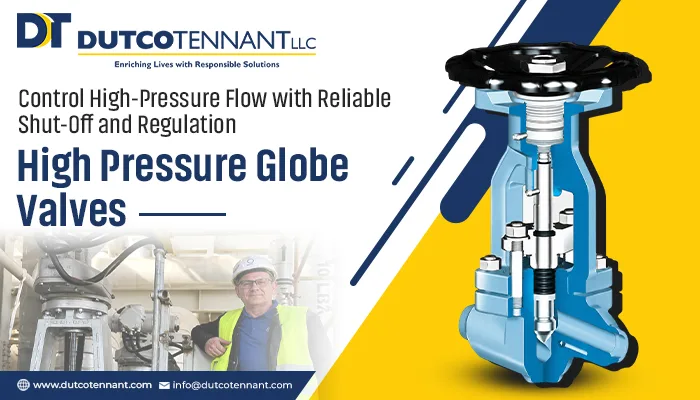
A globe valve controls flow through a movable disc and a fixed seat inside the valve body.
When the stem moves the disc toward the seat, the available flow passage becomes smaller. When the disc contacts the seat, the valve closes.
Moving the disc away from the seat increases the flow opening.
This arrangement allows globe valves to perform two important functions:
- Flow regulation: Adjusting the opening to control the amount of fluid passing through the valve.
- Shut-off: Closing the disc against the seat to stop flow within the valve's specified leakage performance.
Unlike valves primarily intended for fully open or fully closed operation, suitable globe valve designs can be used for throttling.
This makes them useful where operators need more control over fluid movement.
However, throttling performance depends on the disc design, pressure difference and service conditions. A shut-off disc should not automatically be assumed suitable for continuous throttling.
Forged Construction Supports Reliable Pressure Containment
The valve body is responsible for containing the pressure of the process fluid.
If the body develops a crack or other structural failure, the consequences can be serious.
For this reason, the material and manufacturing method are important when selecting high pressure globe valves.
Strength of Forged Valve Bodies
Forging involves shaping metal under controlled compressive forces.
When properly manufactured and inspected, forged components can provide a dense, consistent metal structure suitable for demanding pressure applications.
This helps reduce the risk of certain manufacturing defects associated with metal solidification, such as shrinkage cavities.
Forged construction does not eliminate every possibility of failure, but it can offer advantages where high mechanical strength and reliable pressure containment are required.
The valve's actual suitability still depends on its material grade, design, manufacturing quality and approved pressure-temperature rating.
Performance During Pressure Changes
Industrial systems do not always operate at a constant pressure.
Pumps start and stop, steam demand changes and process equipment moves between operating conditions.
These changes place varying mechanical loads on valves and piping components.
A correctly specified forged valve body helps withstand the expected pressure conditions without exceeding its design limits.
This is particularly important in systems where pressure changes occur repeatedly during normal operation.
Reliable Shut-Off Helps Prevent Unwanted Fluid Movement
Shut-off performance is essential when sections of a process system need to be isolated.
For example, maintenance personnel may need to stop steam flow before working on downstream equipment.
A valve that allows excessive leakage can make isolation more difficult and create additional hazards.
Disc and Seat Design
In a globe valve, the disc closes against a seating surface.
The condition of these surfaces affects how effectively the valve can stop fluid flow.
High-pressure designs may use hardfaced seating surfaces to improve resistance to wear.
This can be valuable where repeated operation, high temperatures or challenging process conditions may gradually damage the contact surfaces.
The PERSTA high-pressure globe valve range includes designs with forged bodies and specialised seating arrangements intended for demanding industrial service.
Some configurations also use replaceable or maintainable components that support inspection and repair.
Shut-Off Valves Are Not a Complete Isolation Procedure
Although shut off globe valves help stop process flow, they should not be treated as a complete safety system on their own.
Maintenance isolation may require additional arrangements, such as double isolation, depressurisation, draining or other procedures defined by the plant's safety requirements.
The valve's leakage classification and suitability for the intended isolation duty must also be verified.
This distinction is important because a valve that performs well during normal operation may not be approved as the sole protective barrier for every maintenance activity.
Better Flow Regulation Reduces Process Instability
Process safety is not limited to preventing leaks.
Maintaining suitable flow conditions is also important for protecting equipment and keeping operations stable.
Globe valves are useful in applications where fluid flow needs to be adjusted rather than simply switched on or off.
Controlling Flow Through Critical Equipment
Consider a pipeline supplying hot water or steam to a process unit.
If the flow is too low, the equipment may not receive the required supply. If the flow is excessive, operating conditions may move outside the intended range.
A suitably selected globe valve can help operators adjust the flow to meet process requirements.
This supports more consistent operation and reduces the need for repeated manual corrections.
However, globe valves introduce pressure loss, and throttling can create high fluid velocities. Severe service may require specialised trim to manage erosion, cavitation or noise.
Avoiding Damage from Incorrect Throttling
Not every globe valve is suitable for prolonged operation in a partially open position.
Under high differential pressure, fluid passing through a small opening can cause rapid wear.
For this reason, valves intended for continuous flow regulation should have an appropriate throttling disc or other suitable trim.
Selecting the correct internal arrangement helps protect the seating surfaces and maintain reliable performance.
High-Temperature Performance in Steam Systems
Steam systems are among the most demanding applications for industrial valves.
High temperatures can affect material strength, sealing performance and the dimensions of valve components.
As the equipment heats and cools, metal parts expand and contract.
These changes can influence stem movement, packing performance and seating contact.
Globe Valves for Steam Applications
Globe valves for steam applications are used in suitable boiler systems, steam distribution networks and power generation processes.
Depending on the valve design, they may provide isolation or flow regulation.
A properly selected high temperature valve must use materials that retain the required mechanical properties at the operating temperature.
Packing, gaskets, seat materials and other components must also be compatible with the service conditions.
PERSTA's broader valve portfolio includes high-pressure and high-temperature designs for applications involving steam, water, oil and other process media.
The manufacturer's published range includes products for temperatures up to 650°C, although this is a portfolio-level capability rather than the rating of every individual valve.
The exact valve configuration must always be checked against its technical datasheet.
Managing Thermal Expansion
Thermal expansion is an important consideration in steam service.
When a valve experiences temperature changes, the stem, body and bonnet may expand at different rates.
Suitable construction and operating arrangements help maintain the intended seating and sealing performance.
Correct installation and gradual operation during startup and shutdown can also reduce unnecessary thermal stress.
Reducing External Leakage Through Suitable Sealing Arrangements
A valve may close properly internally while still allowing fluid to escape around its stem or body connections.
External leakage is especially concerning when the fluid is hot, pressurised or hazardous.
Several design details influence the risk of leakage.
Stem Packing
Stem packing provides a seal around the moving valve stem.
The packing material must be suitable for the operating temperature, pressure and process medium.
Incorrect packing selection or adjustment can lead to leakage or excessive operating resistance.
Regular inspection helps identify deterioration before it becomes a more serious problem.
Body and Bonnet Connections
The connection between the valve body and bonnet is another important sealing area.
Different high-pressure valve designs use different bonnet arrangements.
Some use bolted connections, while certain high-pressure designs incorporate pressure-seal bonnets.
These arrangements must be assessed according to the intended service conditions.
A pressure-seal design, for example, uses internal pressure to assist the sealing action, but its suitability depends on the specific design and operating range.
Applications Where High Pressure Globe Valves Are Used
The importance of reliable flow control becomes clearer when considering actual industrial applications.
Industrial applicationRole of globe valvesSafety considerationPower generationSteam and water flow control or isolationManaging high temperature and pressure conditionsChemical processingRegulating compatible process fluidsMaintaining containment and controlled flowRefineriesIsolation and regulation in suitable process linesReducing leakage and uncontrolled fluid movementIndustrial steam networksControlling steam supply to equipmentSupporting reliable operation during changing demandHigh-pressure water systemsAdjusting or stopping flowProtecting piping and connected equipment within design limitsThe specific valve material, pressure class and internal components must be selected according to the application.
A valve suitable for high-pressure water is not automatically suitable for aggressive chemicals or superheated steam.
Selecting the Right Valve for a Critical Process Line
Even a well-manufactured valve can perform poorly if it is installed in the wrong application.
Plant engineers should therefore review the complete operating conditions before approving a valve.
Pressure and Temperature Ratings
The valve must be rated for the maximum design pressure at the relevant design temperature.
Pressure ratings should not be considered independently of temperature because the allowable pressure of some materials decreases as temperature increases.
Material Compatibility
The body, disc, seat, stem and sealing materials must be compatible with the process fluid.
For example, a material suitable for non-aggressive water may not be appropriate for a corrosive chemical service.
Flow Control Requirements
The intended function should be clear.
A valve selected primarily for isolation may require different internal components from one used for continuous throttling.
The expected pressure drop, flow rate and frequency of operation should guide this decision.
Inspection and Maintenance Access
Critical valves require periodic inspection and, in some cases, maintenance of the seating surfaces or stem packing.
Accessible installation locations and suitable maintenance arrangements make this work easier.
For industrial facilities operating continuously, maintainability can influence both safety and operational reliability.
Why Proper Valve Specification Matters More Than Price Alone
Valve procurement often involves comparing products with different materials, pressure classes and internal designs.
Two valves may appear similar externally while offering different performance capabilities.
Selecting a lower-cost valve without confirming its suitability can lead to premature wear, leakage or repeated maintenance.
A more effective comparison considers the valve's complete service requirements, including pressure-temperature ratings, materials, shut-off performance and relevant testing documentation.
For industrial plants across the UAE and GCC, Dutco Tennant LLC offers high pressure globe valves for applications such as power generation, chemical processing and other demanding industrial services.
The published product information describes forged body and bonnet construction, hardfaced or welded seating options, and configurations with pressure ratings up to 160 bar and temperature ratings up to 550°C. These are range-level specifications, so the limits for the selected model and material must be confirmed before procurement.
For critical process lines, reviewing the detailed technical submittal is more valuable than relying on a general product description.
Improving Industrial Process Safety Through Reliable Valve Selection
High-pressure industrial processes require dependable control over fluid movement.
Forged globe valves contribute to this requirement through strong pressure-retaining construction, suitable shut-off arrangements and controlled flow regulation.
Their value is particularly important in steam networks, power plants and chemical processing systems where leakage, wear or incorrect flow conditions can create operational hazards.
However, safe performance depends on more than the valve's construction. Correct sizing, material selection, installation, inspection and maintenance all play important roles.
When these factors are considered together, high-pressure globe valves can help industrial facilities improve process reliability, reduce avoidable leakage risks and maintain safer operating conditions.