
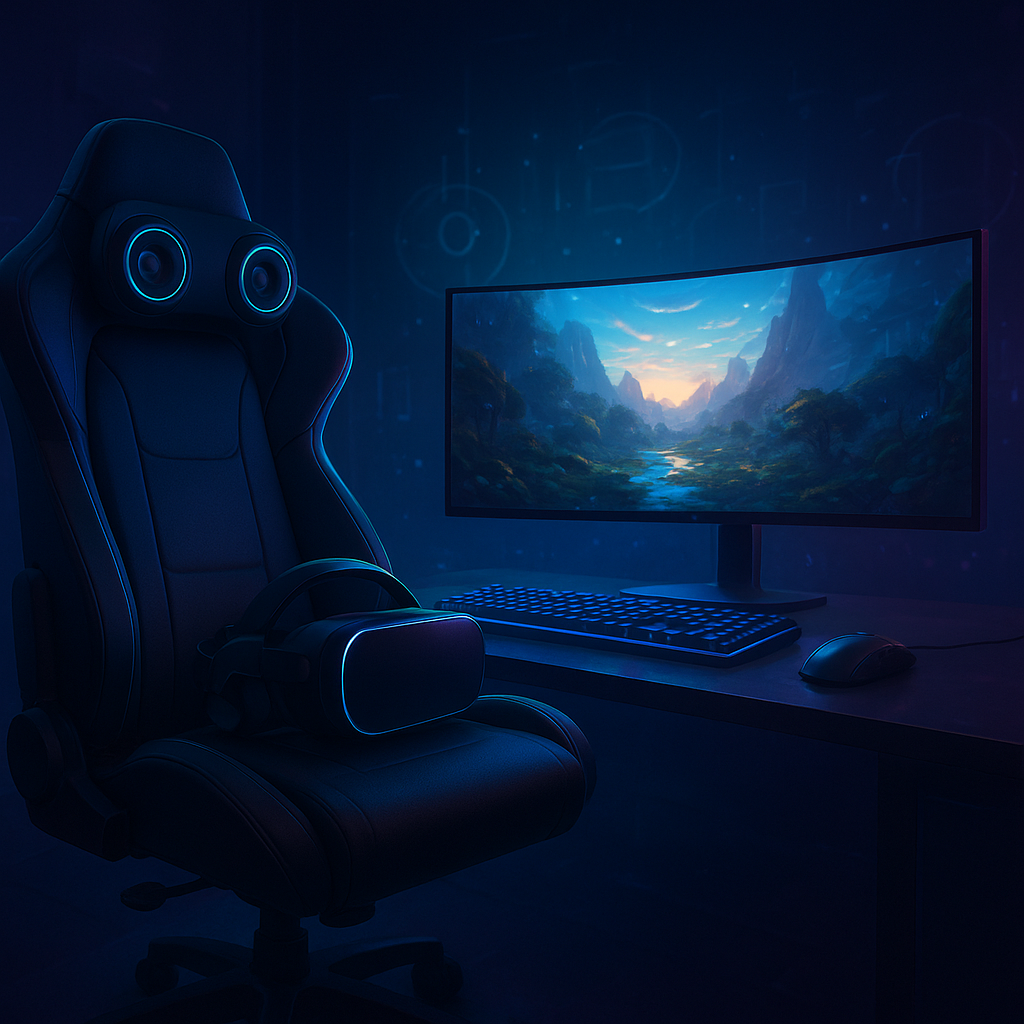
Gaming Hardware’s Evolution: From Niche Hobby to Global Powerhouse
Imagine a scene at an international esports arena in mid-2026: thousands of spectators watch as competitors wield ultra-responsive controllers paired with stunning 8K displays, powered by hardware that pushes the limits of physics and engineering. What once was a hobbyist's domain has become a multifaceted global industry where hardware innovation directly influences player performance and immersion. According to industry analysts, the global gaming hardware market surpassed $60 billion in 2025, fueled by rapid advancements in GPUs, CPUs, and peripherals. The stakes have never been higher. The evolution of gaming hardware is no longer just about raw power but about creating seamless, immersive experiences that redefine how players interact with virtual worlds.
Today’s gamers demand more than just speed; they seek precision, comfort, and an emotional connection to the gameplay. This demand spurs manufacturers to innovate relentlessly, integrating AI-driven optimizations, adaptive ergonomics, and next-generation connectivity technologies. As we explore this dynamic landscape, we uncover how gaming hardware has transformed into a cornerstone of modern digital culture and entertainment.
The Historical Context: How Gaming Hardware Reached Its Current Heights
Tracing the journey of gaming hardware reveals a fascinating timeline marked by milestones in computing and consumer electronics. The 1990s introduced dedicated graphics cards, enabling 3D rendering that laid the foundation for modern gaming visuals. The early 2000s saw the rise of multi-core CPUs and the first mainstream gaming consoles that integrated customized hardware for enhanced gameplay.
By the 2010s, the industry was revolutionized with the advent of VR headsets and the rise of competitive esports, which demanded ultra-low latency and high-refresh-rate monitors. The 2020s accelerated these trends, with AI-assisted rendering technologies and cloud gaming infrastructure reshaping hardware requirements. The push for sustainability also influenced hardware design, leading to energy-efficient components that do not compromise performance.
“The interplay between hardware innovation and game design has never been more critical,” notes Dr. Elena Vasquez, a leading expert in interactive media technologies. “Each leap in hardware capability unlocks new creative possibilities for developers and deeper immersion for players.”
Core Components Driving Gaming Excellence in 2026
The backbone of any gaming setup lies in its core hardware components: the CPU, GPU, RAM, storage, and peripherals. In 2026, these elements have reached unprecedented sophistication, thanks to breakthroughs in semiconductor manufacturing and system architecture.
Graphics Processing Units (GPUs) have advanced beyond traditional rasterization techniques, incorporating real-time ray tracing and AI-powered upscaling technologies like NVIDIA’s DLSS 5.0 and AMD’s FidelityFX Super Resolution 3. These technologies enable photorealistic lighting and textures at resolutions up to 8K with framerates exceeding 240 FPS on high-end rigs, a feat unimaginable just five years ago. The top GPUs now sport up to 48GB of ultra-fast VRAM and utilize chiplet designs that improve efficiency and thermal performance.
Central Processing Units (CPUs) have evolved to support heterogeneous computing, integrating specialized cores for machine learning tasks alongside traditional cores for game logic and physics simulations. Intel's 17th Gen and AMD's Zen 7 architectures dominate the market, offering upwards of 32 cores tailored for multitasking and streaming simultaneously without performance dips.
Memory and Storage have also transformed. DDR6 RAM modules running at speeds exceeding 10,000 MHz have become standard, drastically reducing bottlenecks. Meanwhile, NVMe Gen 6 SSDs with PCIe 5.0 interfaces offer blazing-fast load times, crucial for open-world and cloud-synced games. These components synergize to deliver near-instantaneous asset streaming and seamless gameplay.
Peripherals have not been left behind. Mechanical keyboards with adaptive haptic feedback and ultra-low latency wireless mice have become essential tools for competitive gamers. Headsets now feature spatial audio powered by AI to better localize in-game sounds, enhancing situational awareness.
- Key 2026 gaming hardware specs:
- GPUs with up to 48GB VRAM and AI ray tracing
- CPUs featuring 32+ heterogeneous cores
- DDR6 RAM exceeding 10,000 MHz
- PCIe 5.0 NVMe Gen 6 SSDs
- Adaptive haptic feedback peripherals
2026 Gaming Hardware Trends: What’s Shaping the Market Now
Several notable trends are dominating the gaming hardware sector this year, reflecting both technological progress and shifting consumer priorities.
1. AI Integration: Beyond performance boosts, AI is now embedded at multiple levels of hardware. AI-driven overclocking automatically adjusts clock speeds for optimal thermal and power efficiency. Smart cooling systems anticipate heat spikes, preventing throttling during intense sessions. Even peripherals use AI to customize input sensitivity based on player behavior.
2. Sustainability and Modular Design: The environmental impact of gaming hardware is under scrutiny. Manufacturers are adopting recyclable materials and modular designs, enabling users to upgrade components rather than replace entire systems. This approach not only reduces e-waste but also lowers the total cost of ownership.
3. Cloud-Edge Hybrid Architectures: Hardware is increasingly designed to complement cloud gaming. Hybrid consoles and PCs integrate edge computing chips that offload heavy processing to nearby servers, enhancing latency and reliability while reducing local hardware demands.
4. Immersive Displays and Haptics: Beyond resolution and refresh rates, displays now incorporate micro-LED technology with variable refresh rates up to 480 Hz, delivering crisp visuals without motion blur. Haptic suits and gloves, though still niche, are gaining traction, promising full-body immersion in the near future.
“We are entering an era where hardware not only serves as a tool but becomes a medium for deeper engagement and emotional connection,” says Marcus Lee, CTO of HyperCore Gaming Hardware.
- AI-driven hardware tuning for performance and energy efficiency
- Modular and recyclable components as environmental priorities
- Cloud-edge hybrid architectures enhancing gameplay fluidity
- Next-gen display and haptic technologies for sensory immersion
Expert Insights and Industry Impact: Voices from the Frontline
Leading voices in the gaming hardware ecosystem emphasize that today’s innovations are setting a foundation for the next decade’s breakthroughs. Industry giants like NVIDIA and AMD continue to invest billions into R&D, focusing on scalability and cross-device compatibility.
Competitive esports organizations report that the margin between victory and defeat increasingly hinges on hardware precision and reliability. According to a 2026 study by the Global Esports Federation, 78% of pro players upgraded their rigs in the past year to maintain peak performance, underscoring hardware’s strategic role.
Meanwhile, indie developers benefit from hardware advancements that democratize access to powerful tools. Enhanced AI-driven SDKs allow smaller teams to optimize games for diverse hardware profiles, improving accessibility without sacrificing quality.
“Hardware innovation fuels creativity across the entire gaming ecosystem — from developers to players to broadcasters,” affirms Sophia Nguyen, lead hardware engineer at Zenith Technologies.
These insights align with findings in TheOmniBuzz’s own coverage, such as the detailed strategies in Mastering Gaming Hardware: Pro Tips for Ultimate Performance and Longevity and the exploration of player immersion in Why Gaming Hardware Innovation Is Driving the Next Level of Player Immersion. Both articles underscore the critical role hardware plays in elevating the player experience.
Future Outlook: What Gamers and Developers Should Watch For
Looking ahead, several developments are poised to reshape gaming hardware throughout the late 2020s.
Quantum computing, while still nascent, is being explored for its potential to revolutionize rendering algorithms and AI-driven content generation. Although practical quantum gaming hardware is likely a decade away, early experimentation signals a transformative horizon.
Advances in neuromorphic chips — hardware designed to mimic the human brain’s architecture — promise gaming AI that can adapt dynamically to player behavior, creating truly personalized experiences. This could redefine difficulty scaling and narrative branching.
On the consumer side, the proliferation of 5G and 6G networks will enable more seamless integration between hardware and cloud services, reducing the need for costly upgrades and expanding access to high-fidelity gaming on mobile and lightweight devices.
- Quantum computing research impacting future rendering and AI
- Neuromorphic chips enabling adaptive in-game AI
- 6G connectivity enhancing cloud gaming integration
- Greater emphasis on sustainability in hardware lifecycle
For gamers assembling new rigs or upgrading, prioritizing modular and future-proof components now will pay dividends. Developers should continue leveraging hardware capabilities to push creative boundaries while ensuring cross-platform compatibility.
As the industry advances, staying informed and adaptable will be key to thriving amid rapid change.
For those beginning their journey, TheOmniBuzz offers comprehensive guides such as Unlocking the Power of Gaming Hardware: A Beginner’s Roadmap to Winning Setup and Navigating Your First Gaming Hardware Setup: From Basics to Performance Boosts, which provide actionable insights tailored to different skill levels.