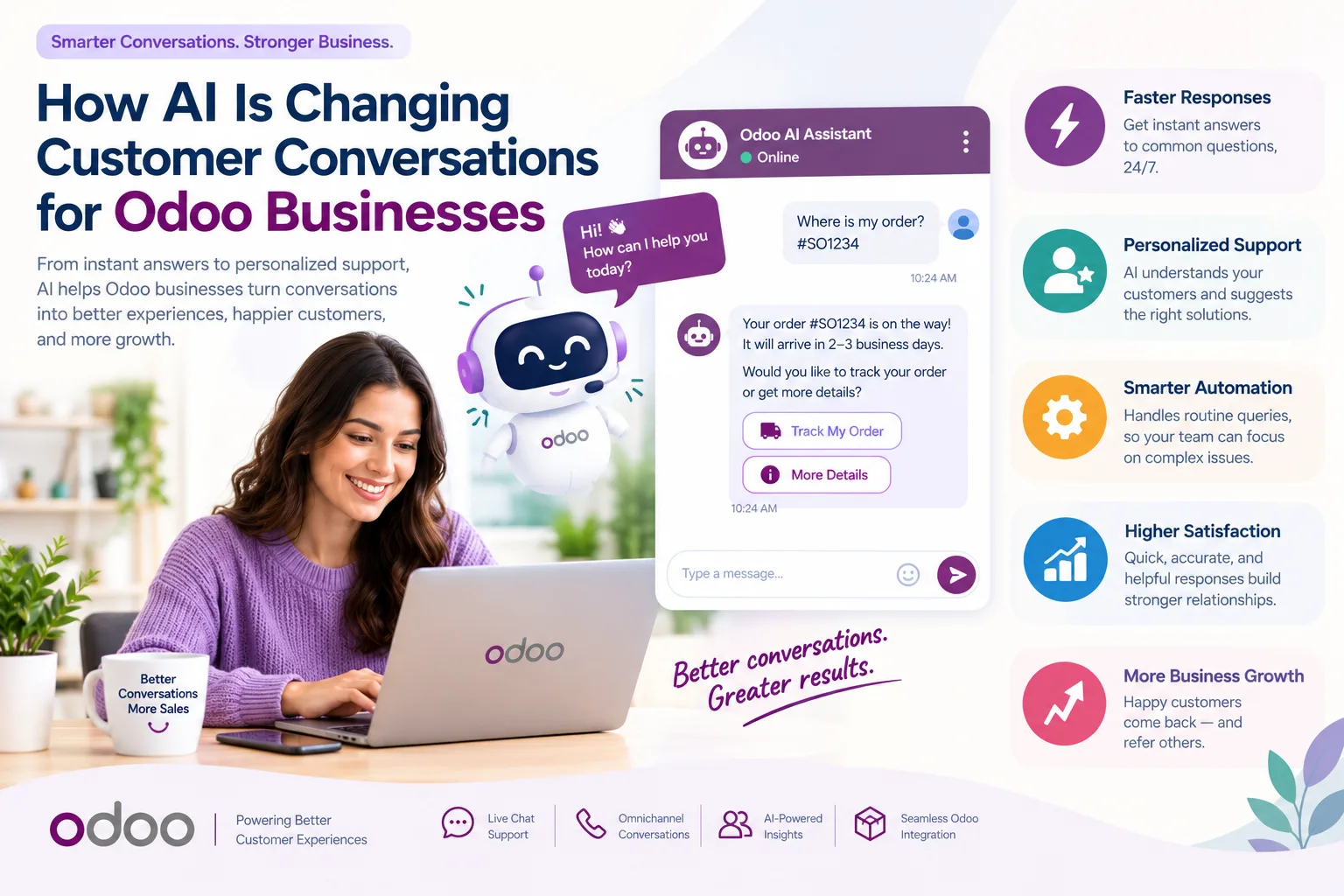
Odoo gives businesses a flexible platform for managing websites, ecommerce, sales, marketing, customer relationships, and other daily operations. As online interactions increase, however, businesses also need efficient ways to answer visitor questions and provide useful information without placing every conversation on a human support team.
This is where conversational AI can become useful.
An AI chatbot can have conversations with website visitors, respond to common questions, provide information from approved business content, and guide users toward relevant products or services. For organizations already working with Odoo, adding AI-powered customer assistance can create a more responsive website experience while helping teams manage repetitive inquiries.
Why Customer Communication Matters for Odoo Businesses
For many companies, the website is a key point of contact for prospective customers. People may visit to check prices, explore products or services, confirm availability, learn about delivery options and policies, or understand how a particular process works.
If finding an answer requires searching through several pages or waiting for a response, visitors may leave before completing their intended action.
This doesn't mean every customer interaction needs to be automated. Human support remains important for complicated questions, sensitive situations, and requests that require individual attention. However, many website questions are repetitive and straightforward.
An AI chatbot can help handle these routine conversations while allowing employees to focus on tasks that require human judgment.
What Is an Odoo AI Chatbot?
An Odoo AI chatbot is a conversational assistant designed to support businesses that use Odoo for their website or other business operations. Depending on its configuration, the chatbot can help visitors find information, answer frequently asked questions, assist with product discovery, and direct users toward relevant resources.
Instead of requiring visitors to navigate through every page manually, conversational AI gives them another way to interact with business information.
For example, a visitor might ask about a product's features, request information about a service, or ask where to find a particular policy. If the relevant information is available to the chatbot, it can provide an answer based on the business's available content.
Businesses can therefore use AI as an additional communication channel rather than treating it as a complete replacement for their support team.
Common Ways Businesses Can Use AI Chatbots
The usefulness of an AI chatbot depends on the business, its content, and the type of questions customers typically ask. Several use cases are particularly relevant to Odoo-based websites.
1. Answering Frequently Asked Questions
Businesses receive many recurring questions. Customers may repeatedly ask about payment methods, shipping, returns, services, opening hours, product specifications, or account-related information.
A chatbot can provide quick answers to these common questions when the relevant information is available in its knowledge sources.
2. Helping Visitors Find Information
Not every visitor knows exactly where information is located on a website. A conversational assistant can help direct users toward relevant pages, resources, products, or services.
This can make the website easier to navigate, particularly when a business has a large amount of information.
3. Supporting Product Discovery
For ecommerce businesses, visitors often need help deciding which product or service fits their needs.
A chatbot can assist by answering questions about available products, features, categories, and other information provided by the business. This can make the product research process more conversational.
4. Supporting Lead Generation
Some website visitors are potential customers who need additional information before contacting a sales team.
A chatbot can help initiate conversations, understand what a visitor is looking for, and direct interested users toward an appropriate contact or conversion path.
5. Reducing Repetitive Support Work
Support employees can spend considerable time answering the same basic questions.
Automating suitable repetitive inquiries can reduce the volume of routine conversations reaching human agents. Employees can then dedicate more attention to complicated issues and customer situations requiring personal assistance.
Why Knowledge Sources Matter
An AI chatbot is only useful when it has access to relevant and reliable information.
For a business website, this may include FAQs, product information, service descriptions, policies, documentation, and other approved content.
Providing appropriate knowledge sources helps the chatbot respond in a way that is more closely connected to the business rather than producing generic answers.
Businesses should also review their source material regularly. If pricing, policies, product details, or services change, outdated information can create an inconsistent customer experience.
This makes content maintenance an important part of deploying conversational AI.
AI Chatbots and Human Support Can Work Together
One common concern about automation is whether customers will lose access to human assistance. A well-planned chatbot strategy does not have to work that way.
AI can handle straightforward questions while human employees manage conversations that require deeper expertise or individual attention.
For example, a chatbot could answer a basic question about a service, while a sales representative handles a customized quotation. Similarly, the chatbot might explain a general return policy while a support employee handles an unusual customer situation.
This combination creates a division of work: AI handles suitable repetitive interactions, while people remain available for situations where human judgment matters.
What to Consider Before Choosing an Odoo AI Chatbot
Businesses should evaluate several factors before implementing an AI chatbot.
Integration and Compatibility
The chatbot should fit naturally into the organization's existing website and business workflow. Odoo users should consider how the solution will work with their current website setup and processes.
Knowledge Management
Look at how easily business information can be added, updated, and maintained. A chatbot that uses outdated information can create more problems than it solves.
Response Quality
The quality and relevance of responses matter more than simply having an AI assistant on the website. Businesses should test common customer questions and evaluate whether the answers are useful and appropriate.
Human Handoff
There should be a clear process for situations the chatbot cannot resolve. Customers should have an appropriate path to human assistance when necessary.
Scalability
A solution should be able to support the business as website traffic, content, products, and customer inquiries grow.
How Businesses Can Prepare for AI Chatbot Adoption
Before launching a chatbot, businesses can start by reviewing their most common customer questions.
Look at support emails, live chat conversations, FAQ pages, sales inquiries, and website search data. This can reveal which questions occur repeatedly and which areas create the most friction for visitors.
Next, organize the information into clear, reliable resources. Well-structured FAQs and product information can make it easier to provide useful chatbot responses.
It is also worth establishing boundaries. Decide what the chatbot should answer, what information it should provide, and which situations should be transferred to a human team.
Testing is another important step. Employees can ask realistic questions and identify areas where responses need improvement before the chatbot is exposed to a wider audience.
Measuring the Results
Businesses should not evaluate an AI chatbot solely by how many conversations it handles.
Useful metrics may include:
- Number of chatbot conversations
- Frequently asked questions
- Response usefulness
- Human handoff rate
- Lead interactions
- Customer engagement
- Support workload
- Conversion-related actions
- Unanswered questions
These measurements can help businesses understand where the chatbot is providing value and where its knowledge or configuration needs improvement.
For example, if many users ask questions that the chatbot cannot answer, that may indicate that additional business content should be added to its knowledge sources.
The Role of AI in the Odoo Ecosystem
Odoo businesses have many different operational requirements. Some organizations may focus heavily on ecommerce, while others use Odoo for services, events, manufacturing, sales, or customer management.
This means an AI chatbot should be configured around the actual needs of the business rather than treated as a generic website feature.
A useful chatbot experience starts with understanding what customers want to know and how those questions connect to the company's existing website and workflows.
For businesses exploring this approach, WhisperChat's Odoo AI chatbot solution provides a dedicated resource for understanding how conversational AI can be used with Odoo websites and customer interactions.
The page can be explored here:https://www.whisperchat.ai/odoo-ai-chatbot
Final Thoughts
AI chatbots can give Odoo businesses another way to communicate with website visitors and manage routine customer questions. They can help people find information, explore products and services, receive answers to common questions, and connect with the appropriate support channel.
The most effective approach is not simply to automate as many conversations as possible. Instead, businesses should identify suitable use cases, provide reliable knowledge sources, test the chatbot carefully, and maintain a clear path to human assistance.
For Odoo businesses considering conversational AI, the goal should be a balanced customer experience where automation handles appropriate routine interactions while employees remain available for situations that require expertise, context, and personal attention.