
For years, the construction industry has lived with an uncomfortable rule: speed and quality rarely improve together. Push a project forward faster, and precision usually takes the hit. Slow down for precision, and the budget and timeline both stretch. Few countries feel that trade-off as acutely as the Philippines, where a housing shortage of nearly six million units collides with a government infrastructure program worth close to USD 177 billion spread across more than 200 major projects.
A precast building method originally developed in Japan is now being deployed in the country to challenge that trade-off directly, and its arrival offers a useful window into where large-scale construction is heading across Southeast Asia.
Where the Delays Actually Come From
Ask most engineers where reinforced concrete projects lose time, and the answer usually isn't the concrete pour itself. It's the connections — the columns, beams, and beam-column joints that hold a structure together. In standard construction, these are formed and cured on-site, which ties the entire project's pace to weather conditions, crew availability, and the day-to-day consistency of open-air work. A single floor of a building can take several days to complete, and the quality of that floor often comes down to who happened to be on-site pouring it.
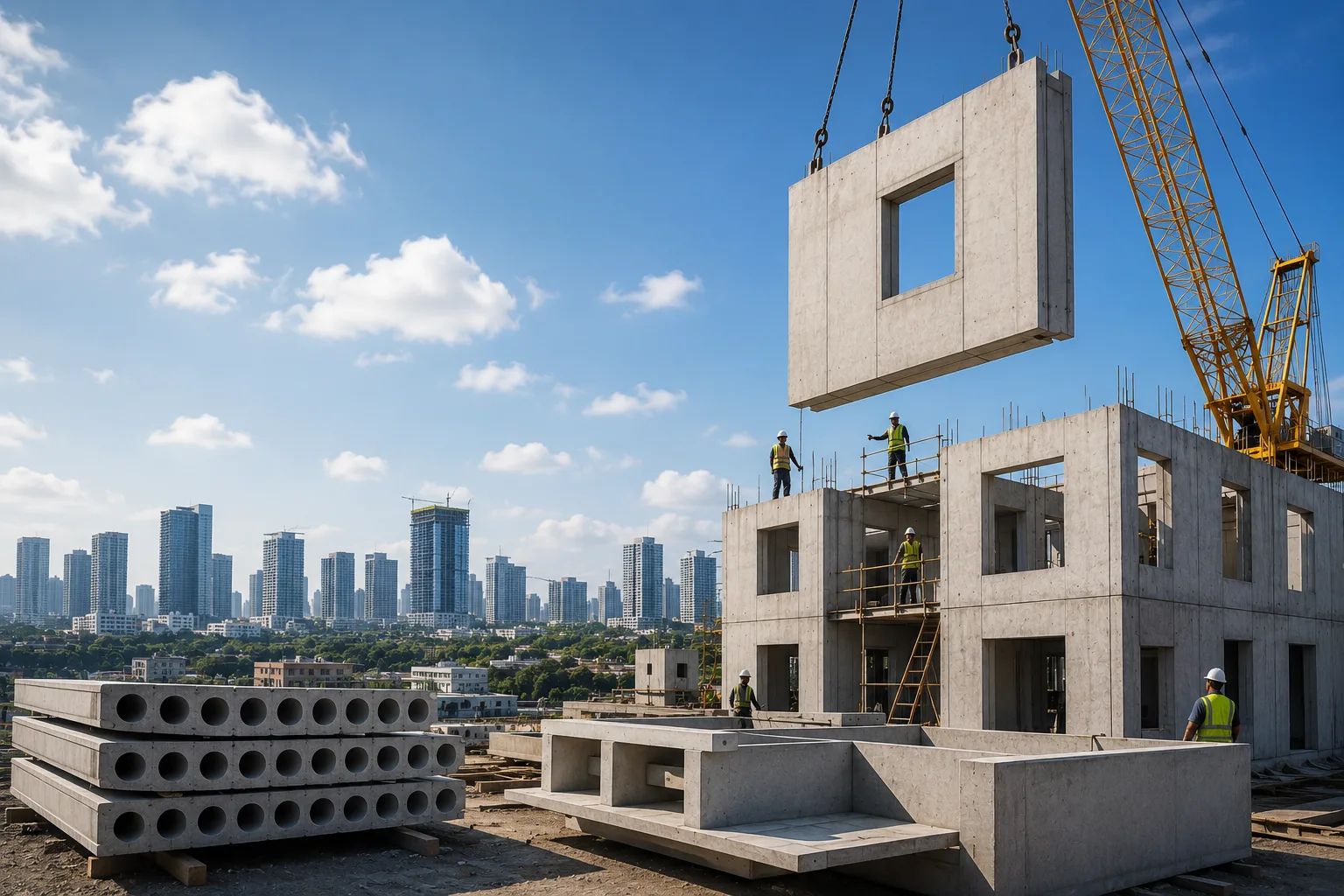
The precast method, engineered by Sumitomo Mitsui Construction Co., Ltd., removes that variable almost entirely. Instead of forming structural joints on-site, columns are manufactured as standalone precast units, while beams and their joint cores are produced as a single fused element — a manufacturing detail that distinguishes this system from more conventional precast approaches, which still depend on concrete poured at the connection points. These factory-made components are shipped to the construction site and locked together using grouted mechanical sleeves, creating a connection with the same structural rigidity as a traditional cast-in-place frame.
The engineering tolerance involved is not trivial. A single beam-column joint typically requires around twenty steel rods, each 40 millimeters thick, to be aligned with near-zero margin for error. That kind of precision is genuinely hard to guarantee on an active job site. In a factory, where every unit can be measured and verified before it ever leaves the production line, it becomes routine.
The Numbers Behind the Method
What makes this approach worth paying attention to isn't the engineering alone — it's the measurable outcomes. Combined with a floor-zoning production process, projects using this system have reached three-day construction cycles per floor, a benchmark that used to belong almost exclusively to steel-frame buildings. In an earlier deployment in Malaysia, the method delivered a threefold jump in construction productivity while cutting labor costs by two-thirds compared to conventional precast techniques that still relied on cast-in-place joints.
There are knock-on benefits, too. Because the structural connections arrive pre-made, the amount of formwork and temporary shoring required on-site drops considerably — which means simpler logistics, less material waste, and fewer moving parts to manage. Quality assurance also becomes less about inspecting after the fact and more about verifying components before they're even installed, since every precast unit is dimensionally checked at the factory.
Given that the Philippines sits along the Pacific Ring of Fire, seismic resilience isn't a footnote — it's a requirement. In 2025, the method received international technical certification from both ICC-ES and IAPMO-UES in the United States, confirming its compliance with the seismic design standards set out in ACI 318, based on structural testing conducted under ACI 374.
Why This Matters Specifically for the Philippines
Technologies like this rarely take hold everywhere at once — they tend to land first in markets where the pressure to solve the speed-versus-quality problem is highest. The Philippines checks nearly every box: fast urban growth, a housing gap that conventional building methods haven't been able to close, and an infrastructure pipeline moving faster than the traditional labor force can support.
That combination is exactly where full precast construction earns its value — in high-volume residential developments, transport infrastructure, and institutional buildings where faster project handover and dependable structural quality directly affect cost and risk. A construction company in the Philippines currently holds the exclusive Southeast Asian license for this method and has begun applying it across major residential and infrastructure projects nationwide — an early signal of how large-scale building in the country may increasingly be approached going forward.
What It Signals for the Industry at Large
The bigger story here isn't a single construction technique — it's the direction the industry is moving. As labor becomes more expensive and project timelines get tighter, the ability to shift structural fabrication off the job site and into a controlled factory setting is likely to become a genuine competitive advantage, not just an operational upgrade.
For developers and project owners choosing partners for major builds, the presence of advanced precast capability, backed by recognized international certification, is increasingly a factor worth weighing seriously — not a minor technical detail buried in a proposal. The Philippines doesn't need to wait years for construction innovation to catch up with its ambitions. In this case, it's already arrived.