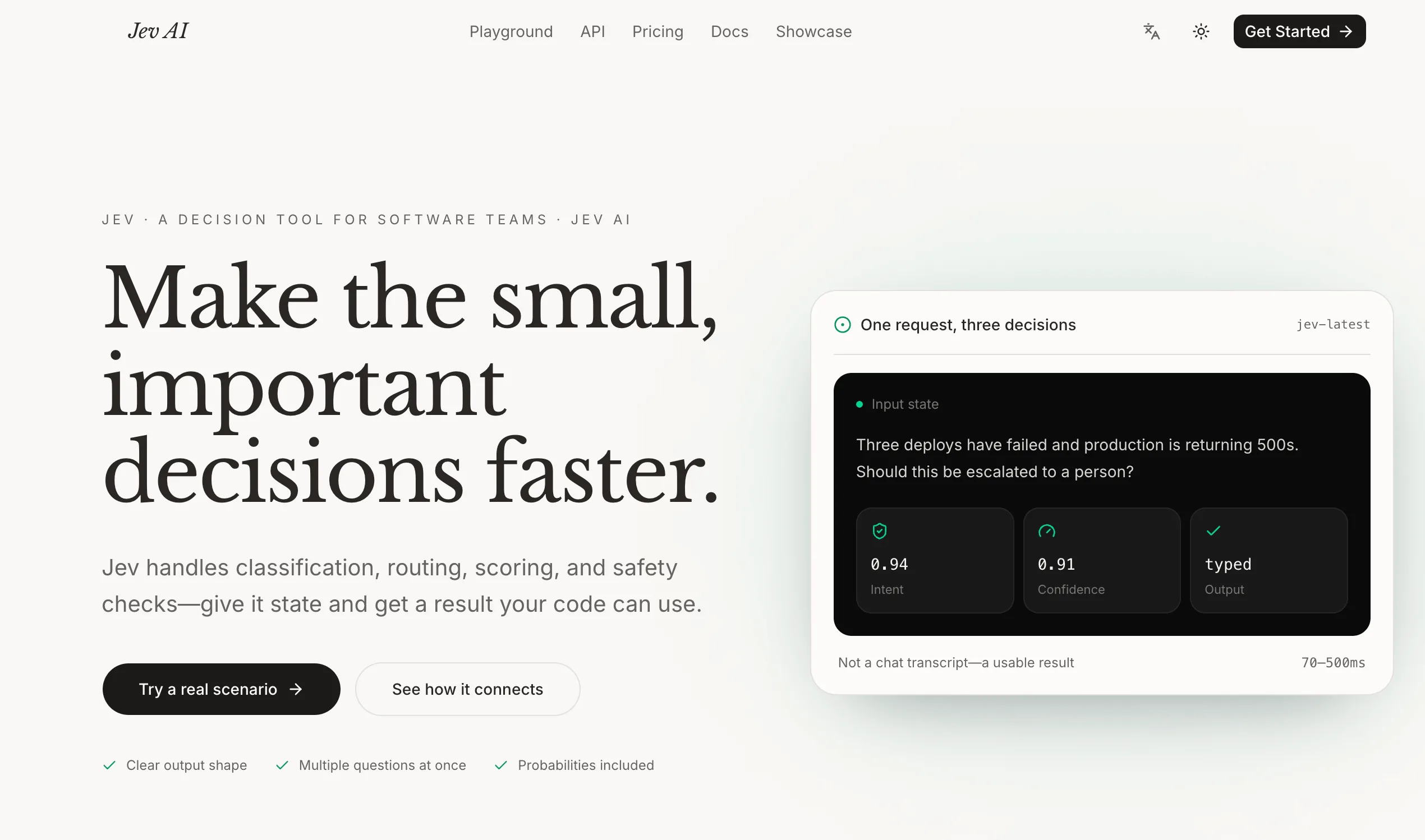
Many software products begin with a simple question: how can a team turn messy, shared context into a decision that is clear enough to use? Jev AI is built for that moment. It is a TypeSafe AI System One model and developer platform for turning shared state into typed decisions with probabilities.
Instead of treating every workflow like an open-ended chat, Jev AI focuses on structured outcomes. Teams can use it for classification, routing, scoring, safety checks, and agent workflows. The result is a decision that can be represented in a system, passed to the next step, and reviewed with the context that produced it.
The platform supports three question types: Choice, Score, and Noul. That gives developers a practical vocabulary for common product and operations problems. A Choice question can route a request to the right path, a Score can express a graded evaluation, and Noul can support a richer decision format when a binary answer is not enough. Together, these building blocks help teams define decisions before connecting them to an application.
Jev AI is available through an online playground, an SDK, and a REST API. The Jev AI Playground is a convenient place to explore the model online and understand how a decision behaves before integrating it. Developers who need a repeatable service can then work with the API or SDK as part of an existing workflow. This progression—from trying an idea in a browser to connecting it to production software—can make evaluation more approachable.
There is also a useful distinction between a model that generates text and a system that returns a decision. In many business processes, the next action depends on a typed result: send the request to a queue, apply a safety check, assign a score, or ask for another piece of information. A probability-backed result can make that transition more explicit and easier to monitor.
For teams exploring practical AI infrastructure, Jev AI offers a focused way to think about decision automation. It combines a free online starting point with developer-oriented access, while keeping the core idea simple: represent the important decision, define the available outputs, and let structured state guide the next step. Whether the use case is routing, scoring, classification, safety, or an agent workflow, the same approach can help turn an ambiguous process into something a system can understand.
This approach is especially useful when teams want decisions that remain understandable, testable, and ready to connect to the software they already use.