Why Florals Refuse to Go Out of Style
Florals get dismissed as the "safe" print — something you reach for when you don't want to think too hard about an outfit. That's a misreading. Look closely at how florals have actually moved through fashion history and you'll find something closer to a recurring argument about beauty and impermanence than a default pattern choice.
It Didn't Start on a Runway
Most fashion writing treats the floral revival as a Western phenomenon — shift dresses, the 60s, that whole era of bold prints as rebellion. But florals were doing serious work in Indian textile traditions long before that: hand-embroidered into sherwanis, block-printed onto dupattas, woven through silk saris passed down across generations. The West caught up to something the subcontinent's weavers and karigars had already mastered.
Treating Fabric Like a Canvas
What's different about how designers use florals now is the shift from ornament to idea. A flower on a garment used to just be decoration. Increasingly, it's doing something closer to what a painting does — carrying mood, memory, even argument.
You can see designers pulling from botanical illustration, from Impressionist brushwork, from the miniature painting traditions of South Asia, and landing on something that doesn't feel printed so much as composed. The silhouette stays clean; the surface does the talking. It's the kind of garment you look at twice — once for the shape, once for what's actually happening on the fabric.
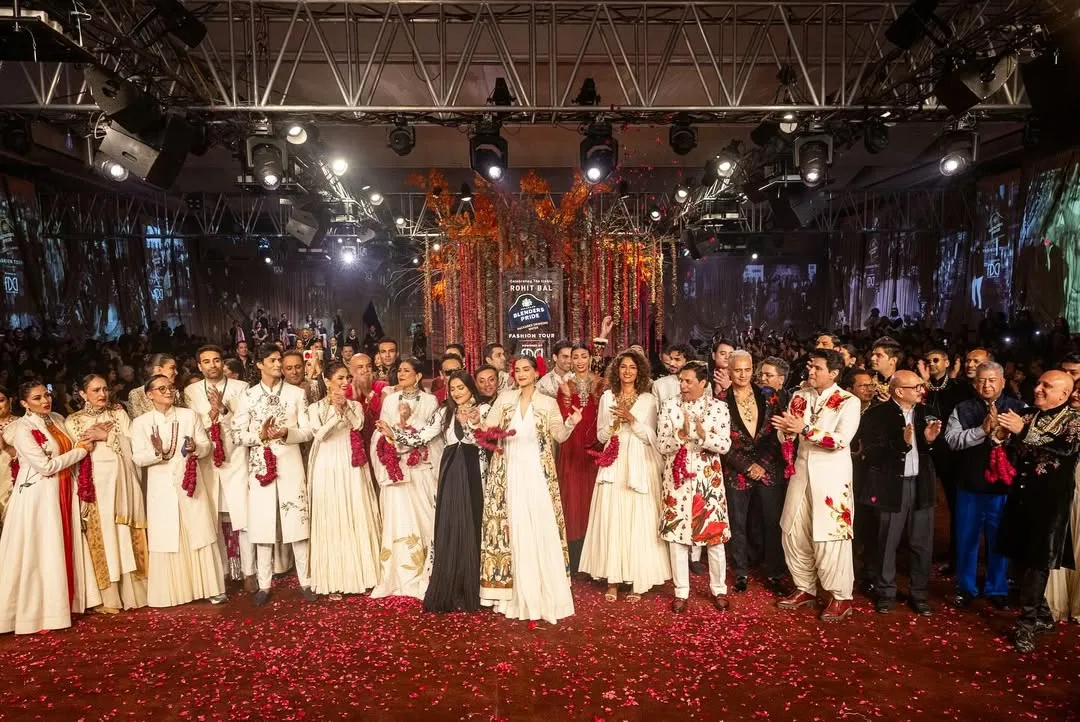
This is exactly the territory the Blenders Pride Fashion Tour has carved out for itself over the years — a stage built around the idea that clothing says something about the person wearing it, not just what's in fashion that season. Designers who treat floral print as a genuine artistic language have found a real home there.
The Pull of the Past
There's a particular kind of floral that hits differently — the ones that feel inherited rather than designed. A print pulled from a grandmother's old saree, reworked by a contemporary designer, carries a kind of weight that nothing freshly trend-driven can fake. It's not nostalgia exactly. It's closer to continuity.
Indian consumers especially seem drawn to this right now — clothing that connects back to craft and lineage rather than just following a seasonal trend cycle. A kurta with motifs lifted from old Awadhi garden paintings, or a lehenga referencing Mughal jaali work, isn't really a "look." It's closer to an heirloom you happen to be able to buy.
One Print, Endless Versions
What makes florals genuinely interesting is how differently they can behave depending on context. The same motif can read as quiet and demure or loud and theatrical, depending entirely on cut and styling. A floral silk blouse paired with tailored trousers says something completely different from that same print used across a full kurta — and both versions are still recognizably, confidently floral.
That flexibility is probably the real reason the print never actually goes away. It doesn't ask you to look a certain way. It adapts to however you already want to look.
A Print That Keeps Getting Reinvented
Designers don't keep returning to florals out of laziness or habit — if anything, it's one of the harder prints to do well, because everyone's seen a version of it before. The ones doing it right are arriving from completely different angles: botanical reference, abstract painting, dying craft revival. The common thread is that none of them treat it as filler.
Platforms like the Blenders Pride Fashion Tour have given that range of interpretation an actual stage — where a floral silk piece isn't just shown off, it's positioned as part of a larger cultural conversation about what Indian fashion is doing right now.