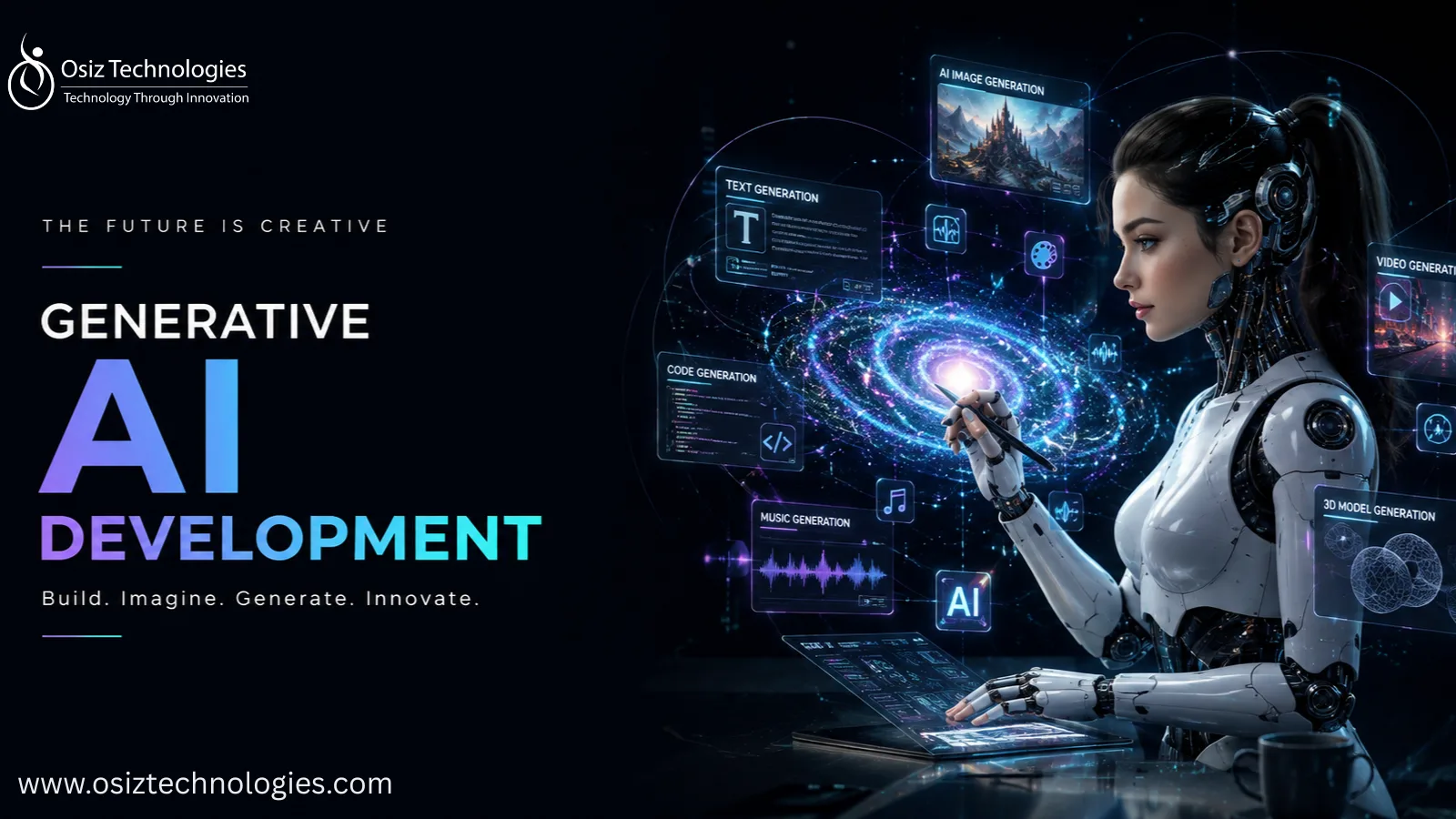
Generative AI has changed how people interact with artificial intelligence. Instead of simply searching for information or selecting predefined options, users can provide an instruction and receive newly generated content in response. Generative AI Development enables businesses to build applications that can create text, images, code, summaries, recommendations, and other digital outputs based on user inputs.
But what actually happens between entering an instruction and receiving an intelligent response? The process involves understanding the prompt, interpreting context, identifying relevant patterns, and generating an output that aligns with the user's request. Understanding this journey helps businesses recognize where generative AI can provide practical value.
What Happens When You Give Generative AI an Instruction?
The process begins with an instruction, commonly called a prompt. This could be a question, a content request, a description for an image, or an instruction to perform a particular task.
The AI system processes the input and determines what the user is asking for. Unlike a traditional software system that may depend on a fixed command, generative AI can interpret different ways of expressing a similar request.
For example, a user could ask an AI system to summarize a report, rewrite an email, or generate product descriptions. The system uses the instruction as the starting point for producing an appropriate output.
How Generative AI Understands Prompts and Context
Understanding the instruction alone is not always enough. Context can significantly influence the quality and relevance of the generated response.
Generative AI models analyze the words, relationships, and information contained within an input to determine what type of response is appropriate. When additional context is provided, the system can use it to make the output more specific.
For example, asking an AI to “write a description” provides limited direction. Adding the product type, target audience, tone, and desired length gives the model more context and helps it produce a more suitable result.
From Understanding to Creation: How AI Generates Outputs
After processing the instruction and context, the generative AI model produces an output based on patterns learned during training. Depending on the model, the result could be written content, an image, software code, audio, or another type of digital material.
For text generation, the model determines what words and structures are most appropriate based on the input and surrounding context. The result is generated dynamically rather than retrieved as a single predefined response.
This ability to create new outputs is one of the main characteristics that separates generative AI from systems designed primarily for classification, prediction, or data analysis.
What Makes Generative AI Outputs More Relevant?
The quality of a generated output depends on several factors, including the quality of the underlying model, the information available to it, the clarity of the instruction, and how the system has been designed.
Businesses can improve relevance by providing reliable data, well-designed prompts, appropriate context, and connections to specialized knowledge sources. An AI development company can help organizations integrate these elements into generative AI applications while aligning the technology with specific business requirements.
Testing and continuous refinement are also important. AI-generated results should be evaluated to identify inaccuracies, inconsistencies, or outputs that do not meet the intended objective.
How Businesses Are Using Generative AI
Businesses are applying generative AI across a growing range of use cases. Marketing teams can use it for content ideation and campaign support, while customer service teams can use it to generate response suggestions and summarize conversations.
Developers can use generative AI for code assistance, documentation, and testing. Organizations can also use it to summarize large documents, create personalized content, support internal knowledge systems, and assist employees with routine knowledge-based tasks.
The most effective implementations focus on specific business needs rather than using generative AI simply because it is a new technology.
Key Benefits of Generative AI for Modern Businesses
Generative AI can provide several practical benefits:
- Faster content creation: Generate drafts and variations in less time.
- Improved productivity: Reduce repetitive knowledge-based work.
- Personalization: Adapt content and responses to different users.
- Creative assistance: Generate ideas, concepts, and alternative approaches.
- Scalability: Handle large volumes of content and information efficiently.
- Better accessibility: Summarize, translate, and transform information into different formats.
These capabilities allow employees to focus more on strategic and creative activities while AI assists with repetitive or time-consuming tasks.
The Future of Generative AI
Generative AI is moving toward systems that can understand more complex instructions, work with multiple forms of information, and support complete business workflows.
Future applications are likely to combine generative capabilities with other AI technologies, business data, and digital tools. This could allow AI systems to move beyond generating individual outputs and become more deeply involved in planning, decision support, and task execution.
As these capabilities develop, businesses will need to focus not only on what AI can generate but also on how reliably and responsibly those outputs can be used.
Conclusion
Generative AI transforms a simple instruction into an opportunity for intelligent creation. By understanding prompts, processing context, and generating new outputs, these systems are changing how businesses approach content, automation, productivity, and digital experiences.
As Generative AI Development continues to evolve, businesses have greater opportunities to build intelligent solutions that create value across marketing, customer engagement, software development, and knowledge-driven workflows. Osiz Technologies helps organizations develop customized generative AI solutions that turn innovative ideas into scalable, intelligent digital experiences.