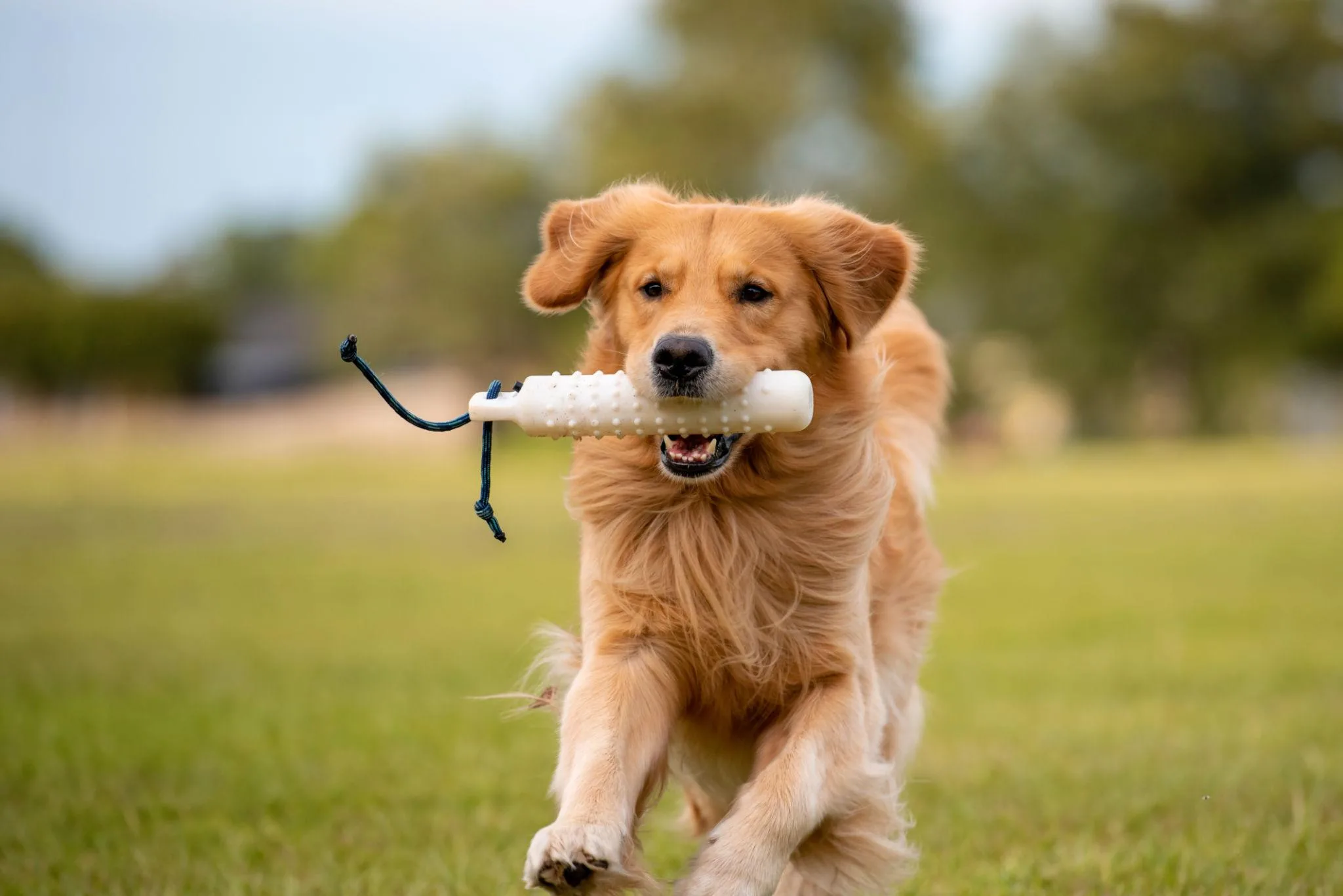
You call your Golden Retriever. She hears you. She looks at you. Then she keeps trotting toward the pond, the squirrel, or the neighbor's picnic.
If that sounds familiar, you are not alone, and you did not buy a "stubborn" dog. Goldens are bright, social and bred to work with people, but they are also bred to go. When a bird, a scent or a swim is in front of them, your voice has to compete with some of the strongest instincts a dog can have.
That is where e collar training for a Golden Retriever comes in. Used well, an electronic collar is a communication tool that lets you reach your dog at distance, in distraction, and in the moments that matter most. Used badly, it can create confusion and stress. The difference is almost never the collar. It is the training plan behind it.
After almost 50 years of working with animals, from field-trial retrievers to detection dogs for military, police and anti-poaching work, I have seen both outcomes. Here is how to get the good one.
Why Golden Retrievers and E-Collar Training Can Be a Good Match
Golden Retrievers were developed in 19th-century Scotland as gundogs, built to mark falling birds, remember where they landed and retrieve gently to hand. That heritage explains a lot about your dog today:
- High desire to retrieve. This is the engine of good training, and we can use it.
- Strong people focus. Goldens want to cooperate, which makes clear communication very rewarding.
- Big environmental pull. Water, birds and wildlife can overpower a verbal cue, especially off leash.
Goldens also consistently rank among the most popular breeds in the American Kennel Club's yearly registration rankings. That popularity means a lot of families are asking the same question: how do I get reliable obedience from a dog this energetic and enthusiastic?
An e-collar does not replace relationship, play or good management. It gives you a clear, consistent way to say "I mean it" once your dog already understands what you are asking.
What an E-Collar Actually Is (and Isn't)
A modern training collar is a receiver worn on the neck and a handheld remote. Quality units offer many adjustable levels of stimulation, plus tone and vibration options, so you can find the lowest level your individual dog notices.
It is not a punishment device
In a well-run program, the e-collar is a tap on the shoulder, not a shout. The dog learns that the sensation is simply information, and that responding to it, by turning toward you or coming back, is the path to something they want.
It is not a shortcut
If your Golden does not yet know "here," "sit" or "heel," a collar will not teach those skills. The dog must understand the command first. The collar then helps with reliability under distraction.
Is the E-Collar Debate Settled? An Honest Look at the Research
Trustworthy training advice should acknowledge the controversy. Studies on electronic collars have reached different conclusions, and welfare organizations in several countries take strong positions on them. A few points are consistent across the discussion:
- Outcomes depend heavily on the handler. Timing, stimulation level and training method vary enormously between studies and between owners.
- Poorly applied use is where most welfare concerns arise, such as high levels, bad timing or using the collar to punish a dog who has not been taught the behavior.
- Reward-based foundations matter. Dogs trained with clear communication, motivation and fair expectations tend to stay happier and more confident.
My position after decades of hands-on work is simple: if you choose an e-collar, learn the principles first, and keep your dog's motivation at the center. As I often say, if you do not understand the principles, you will be a slave to techniques.
When to Start E-Collar Training Your Golden Retriever
Before a collar goes on, your Golden needs a foundation.
Step 1: Build the foundation first
Most Goldens are ready to begin e-collar conditioning only after they reliably understand basic obedience, usually after the puppy stage and often around six months or older, depending on the individual dog's maturity. Before that, focus on:
- Name response and recall on a long line
- Sit, stay and heel on leash
- Positive associations with retrieving, play and training time
If you are raising a young dog, the Retriever from the Pup Up course walks you through shaping character traits and a love of training from the very beginning.
Step 2: Check your dog's readiness
Your Golden is likely ready when she:
- Understands the commands you plan to reinforce
- Is physically comfortable wearing a collar
- Has a strong, positive relationship with you and with training
A Three-Step Approach to E-Collar Conditioning
The goal of conditioning is simple: your dog understands what the sensation means and knows exactly how to turn it off. This mirrors the three-step process taught in my E-Collar Conditioning for the Field course.
Step 1: Find the lowest effective level
Fit the collar snugly, high on the neck, with good contact. With your dog relaxed and a little distracted, start at the lowest level and increase slowly until you see a subtle awareness response, such as an ear flick or a slight head turn. That is her working level. Higher is not better.
Step 2: Teach her the response
Pair the sensation with a command she already knows. For example, apply a low-level stimulation and give your recall cue, then reward enthusiastically when she comes. She learns two things quickly: the sensation is manageable, and obedience is the path to the good stuff.
One of my students, Jane, put it perfectly. The lesson that changed things for her was showing her dog that obedience was the path to the bird, not the obstacle. That shift ends the battles.
Step 3: Proof in new places and around distractions
Once she responds reliably at home, practice in the yard, the park and eventually the field. Increase distractions gradually, and keep sessions short and successful.
Common E-Collar Training Mistakes to Avoid
- Starting too early. Skipping the foundation confuses the dog.
- Using too high a level. Stress shuts down learning.
- Poor timing. The cue and the sensation must be clearly connected to the behavior you want.
- Using the collar as the only tool. Reward, play and marking skills still matter.
- Inconsistent sessions. Long, irregular training days create fatigue. Short and frequent works better.
How Much Time Does It Take?
The good news is you do not need hours. Consistent practice of about 20 to 30 minutes a day makes a real difference in your dog's progress. That is a manageable commitment for most families, and a Golden's enthusiasm usually makes those minutes feel more like play than work.
You can even sharpen skills in a small space. Quick drills, like a simple memory and marking exercise, fit in a suburban yard or park and need very little equipment or help.
Why a Motivational Approach Beats "Do What I Say"
Early in my career, I trained the mechanical way: command, compliance, correction. Then I realized that the best retriever work is built on motivation. When obedience becomes your dog's route to what she desires most, whether that is a retrieve, a swim or a bird, training speeds up and the relationship improves.
That philosophy is at the heart of every course I teach, including The Complete Retrieve and Basics in Drive, my most comprehensive platform combining e-collar conditioning, land and water T drills and retrieve training.
Safety and Welfare Checklist
Whatever method you choose, follow these guidelines:
- Choose a reputable collar with adjustable levels and a proper fit
- Check the neck regularly for skin irritation and rotate collar position
- Never use the collar out of frustration or anger
- Stop and reassess if your dog shows fear, shutdown or avoidance
- Consult your veterinarian if there are health or behavior concerns
- Consider working with an experienced trainer if you feel unsure
Final Thoughts: Same Team, Less Stress
E-collar training a Golden Retriever is not about control for its own sake. Done properly, it is about clarity: giving a happy, driven dog a consistent way to understand you, even when the world is calling her name.
Start with a strong foundation, find the lowest effective level, build the response with rewards, and proof gradually. Do that, and you will spend less time fighting and more time working as a team.
Ready to take the next step? Explore Pat Nolan's retriever training courses and learn the principles that help you and your Golden enjoy the process, starting with just 20 minutes a day.
Frequently Asked Questions
At what age can I start e-collar training my Golden Retriever?
Most trainers begin conditioning after the puppy stage, once the dog understands basic obedience. Maturity varies, so judge readiness by your individual dog.
Will an e-collar hurt my Golden Retriever?
When introduced correctly at the lowest effective level, it should feel like a tap or tingle that gets attention rather than pain. Poor technique is where problems begin.
Can I e-collar train my Golden myself?
Yes. With solid instruction and an understanding of the principles, many owners train their own dogs without sending them away.
How long until I see results?
Many owners notice better responsiveness within a few weeks of consistent daily practice, though reliability under heavy distraction takes longer.
About the author: Pat Nolan has worked with animals for almost 50 years, training retrievers for field trials, detection canines for military, police and anti-poaching work, falconry birds, and animals for commercials. He teaches owners how to tap into their dog's desire to retrieve at patnolan.com.