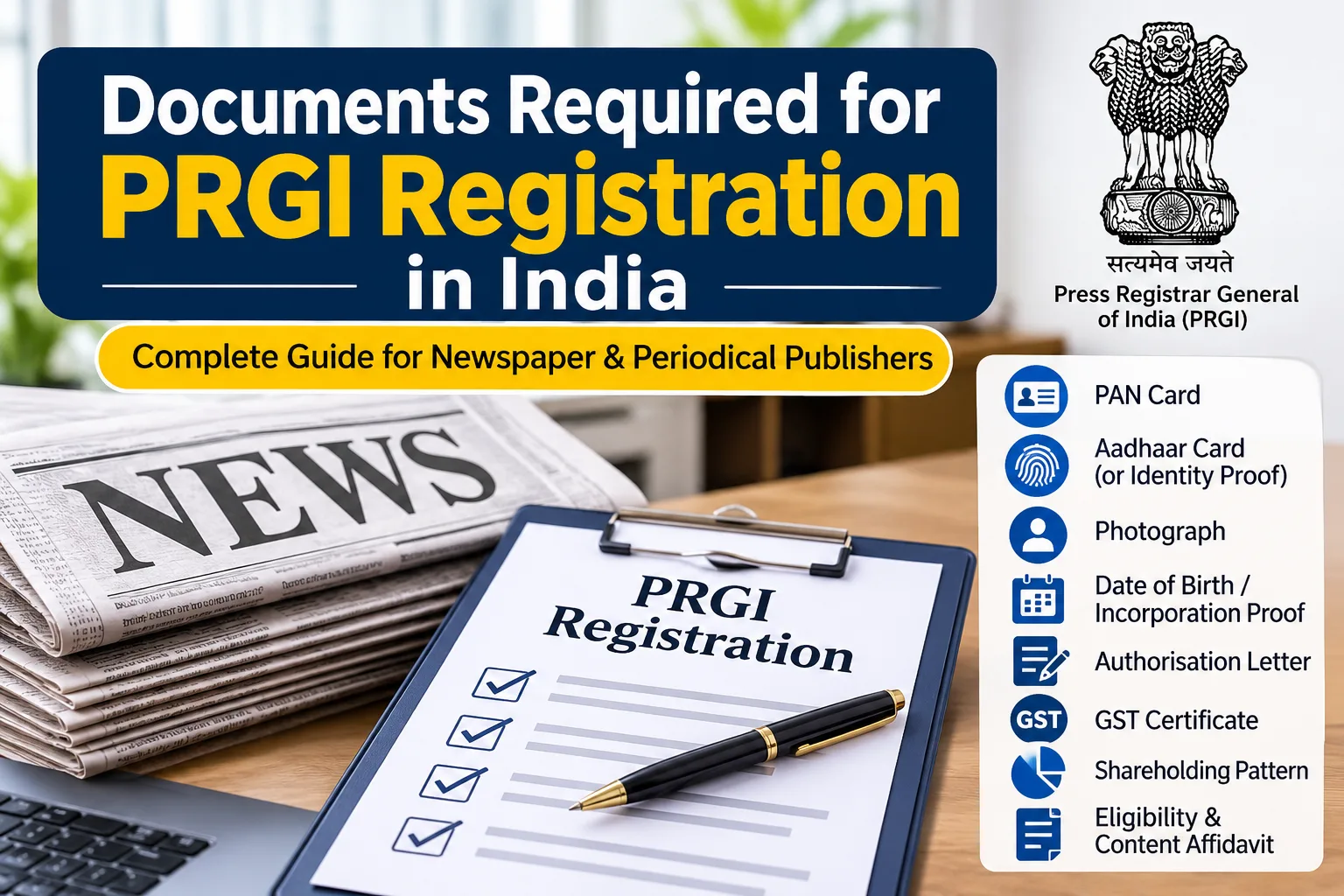
Documents Required for PRGI Registration in India: Complete Guide
Starting a newspaper, magazine or other periodical in India requires proper registration with the Press Registrar General of India (PRGI). Before starting a publication, owners and publishers should understand the registration requirements and arrange the necessary documents.
PRGI registration is now managed through the online Press Sewa Portal under the Press and Registration of Periodicals (PRP) Act, 2023. The process requires applicants to provide correct information about the publication, ownership, publisher and printing press.
The documents required for PRGI registration may vary depending on the type of ownership and the details of the proposed publication. In this article, we will explain the important documents, additional information and basic application steps that applicants should understand before starting the process.
What Is PRGI Registration?
PRGI registration is the official registration process for newspapers and other eligible periodicals in India. PRGI stands for Press Registrar General of India, which is responsible for maintaining records and overseeing the registration of periodicals under the applicable law.
Earlier, newspaper registration was commonly associated with the Registrar of Newspapers for India (RNI). With the implementation of the Press and Registration of Periodicals Act, 2023, the registration process moved to the Press Sewa Portal.
This online system allows applicants to submit publication-related information and complete the required formalities digitally. It is important for publishers to understand the process before launching a new newspaper or periodical.
Documents Required for PRGI Registration in India
Preparing the required documents in advance can make the application process more organised. The documents may differ depending on whether the owner is an individual, company or another legal entity.
Here are some important documents that applicants may need to arrange.
1. PAN Card
A PAN card is an important identity and financial document used for verification purposes.
For individual ownership, the PAN card of the owner may be required. If a company or organisation owns the proposed publication, the relevant organisational PAN details may also be required.
Applicants should ensure that the name mentioned on the PAN card matches the details entered in the application.
2. Aadhaar Card or Identity Proof
Identity proof helps establish the personal details of the owner or authorised applicant. Aadhaar may be used where accepted by the portal.
Applicants should check that their name, date of birth and other personal information are consistent across the documents submitted. Any mismatch can create difficulties during verification.
3. Recent Photograph of the Applicant
A recent passport-size photograph of the owner or applicant may be required while creating a profile on the Press Sewa Portal.
The photograph should be clear and follow the portal's prescribed size and format. It is better to keep a digital copy ready before starting the online application.
4. Date of Birth or Date of Incorporation Proof
The applicant may need to provide proof of identity or legal establishment depending on the ownership structure.
For individual applicants, proof of Date of Birth (DOB) may be required. For companies and other registered organisations, proof of Date of Incorporation (DOI) may be applicable.
These documents help establish the legal identity of the person or organisation applying for registration.
5. Authorisation Letter
An authorisation letter may be required when a company or organisation owns the proposed periodical and an authorised representative is handling the application.
The letter should generally be issued on the organisation's official letterhead. It should clearly mention the authorised person's details and the purpose of the authorisation.
Before submitting it, applicants should check whether the document follows the applicable portal requirements.
6. GST Certificate
For certain non-individual applicants, GST registration details may be required where applicable.
A GST certificate contains important information about the registered business, including its legal name and GST identification number.
Applicants should keep the latest available certificate ready if it applies to their ownership category. The exact requirement should be checked against the current PRGI document checklist.
7. Shareholding Pattern
If a company owns the proposed publication, details of its shareholding structure may be required.
A shareholding pattern helps explain who owns the company and how its ownership is distributed. It may also help establish the details of the persons associated with the organisation.
Companies should prepare accurate and updated ownership information before submitting their application.
8. Eligibility and Content Affidavit
An Eligibility and Content Affidavit is an important supporting document for the registration process where prescribed.
It may include information and declarations relating to the owner, publisher, proposed publication title and eligibility requirements under the applicable law.
The affidavit should be prepared in the prescribed format and completed with the required declarations. Applicants should carefully check the current portal instructions regarding notarisation, signatures and supporting information.
Additional Information Required for PRGI Registration
Apart from identity and ownership documents, applicants should also prepare basic information about the proposed publication.
Some important details include:
- Proposed name or title of the newspaper or periodical.
- Language in which the publication will be printed.
- Periodicity, such as daily, weekly, fortnightly or monthly.
- Place where the publication will be published.
- Name and details of the owner.
- Publisher and editor information.
- Printing press details.
- Address and contact information.
- Relevant ownership and publication declarations.
All information should be checked carefully before submission. Incorrect publication details can lead to clarification requests or delays.
How to Apply for PRGI Registration in India?
The PRGI registration process is completed online through the Press Sewa Portal. Applicants should follow the portal instructions and complete the required sections.
Step 1: Create an Account
The owner or applicant needs to access the Press Sewa Portal and create an account. Basic details should be entered correctly to establish the applicant's profile.
Step 2: Enter Owner Details
Provide the required personal or organisational information. Make sure the details match the supporting identity and registration documents.
Step 3: Provide Publication Details
Enter information about the proposed periodical, including its title, language, periodicity and place of publication.
Step 4: Complete Publisher Information
The relevant publisher details must be provided as required by the application process. The information should be accurate and consistent with the proposed publication.
Step 5: Complete Printing Press Details
The printing press information must be provided through the applicable portal process. The printer or authorised person may need to complete the required verification or confirmation.
Step 6: Upload Documents and Submit
Review the application, upload the required supporting documents and complete the applicable digital signing and payment formalities. After submission, applicants should keep track of the application status and respond to any official clarification requests.
Common Mistakes to Avoid During PRGI Registration
Many application-related problems can be avoided by checking the information and documents before submission.
Some common mistakes include:
- Uploading unclear or incomplete documents.
- Entering different names in the application and supporting documents.
- Providing incorrect owner or publisher details.
- Missing an applicable affidavit or declaration.
- Entering incorrect printing press information.
- Selecting a publication title without checking the relevant guidelines.
- Ignoring clarification requests from the concerned authority.
Applicants should always refer to the latest instructions available on the Press Sewa Portal because document formats and requirements may change.
Why Is Proper Documentation Important?
Proper documentation helps establish the identity of the applicant and provides information about the proposed publication. It also allows the concerned authority to review ownership, publisher and printing press details.
When documents are arranged properly, applicants can reduce avoidable mistakes and make the application process more organised.
It is also useful to maintain digital copies of submitted documents and application-related communication for future reference.
Get Professional Assistance with PRGI Registration
Planning to start a newspaper, magazine or other periodical in India? Understanding the document requirements is an important part of preparing your registration application.
PSR Compliance provides professional assistance with PRGI registration, documentation and application-related requirements. Our team helps applicants understand the process, organise supporting documents and prepare for the necessary formalities.
If you need guidance with newspaper or periodical registration, connect with PSR Compliance.
Contact PSR Compliance
Website: https://www.psrcompliance.com/
Phone: +91 8796104190
Email: [email protected]
PSR Compliance – Regulations Simplified.